- A supermajority of Americans support mandatory vaccines for public school attendance.
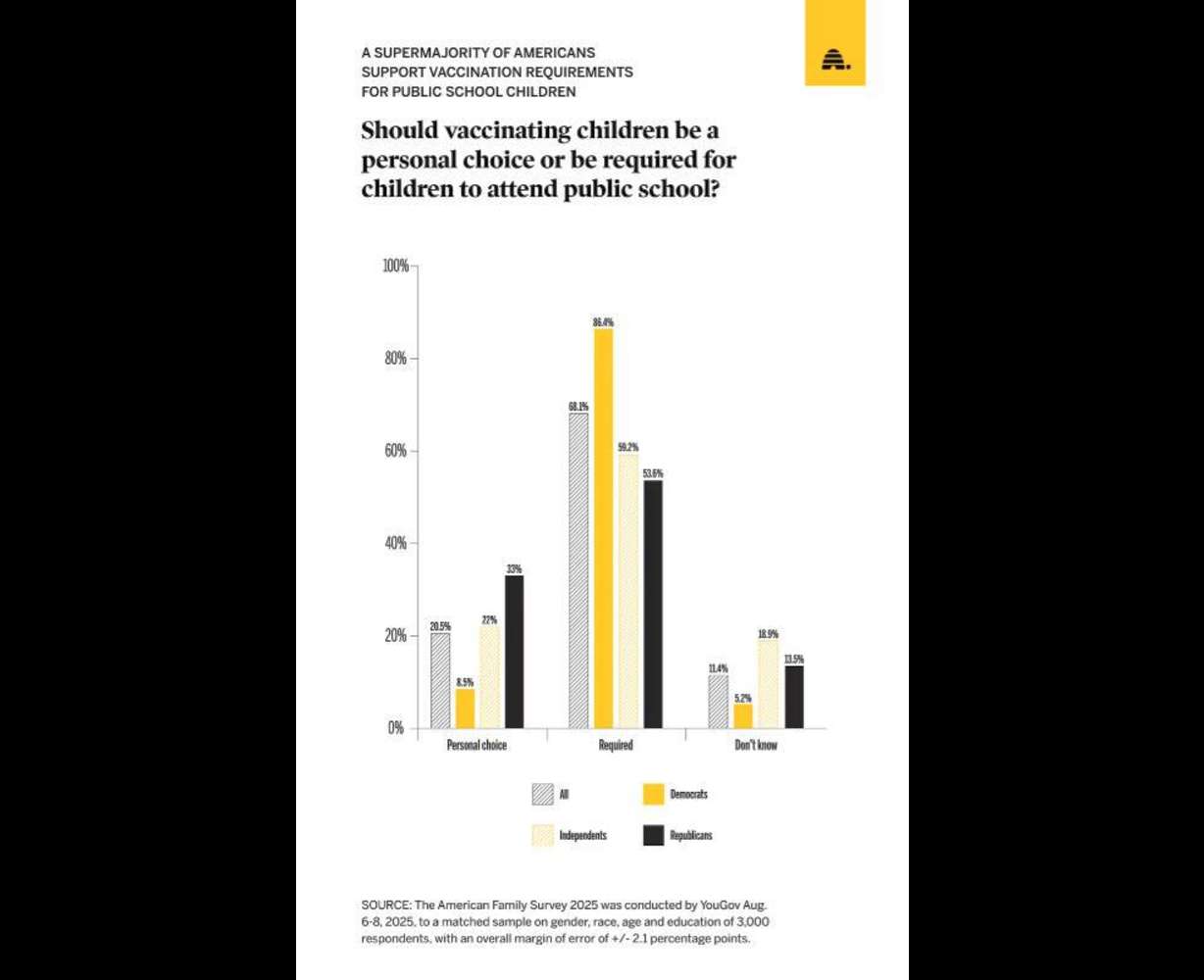
- The American Family Survey shows 68.1% view vaccines as a public health issue.
- Democrats (86.4%) and Republicans (53.6%) differ on mandatory vaccination support.
SALT LAKE CITY — A supermajority of Americans — including both Republicans and Democrats — believe vaccinating children is a public health issue, "so vaccines should be required for children to attend public schools."
That's the finding of the new American Family Survey, a collaboration between Brigham Young University's Wheatley Institute, Deseret News and BYU's Center for the Study of Elections and Democracy. Because vaccines are a big topic right now, the finding is being released ahead of the full release of the survey in November.
Overall, more than two-thirds of U.S. adults (68.1%) believe vaccines should be required, while 20.5% say it's a personal choice and 11.4% answered "don't know." Broken down by political party, 86.4% of Democrats, 53.6% of Republicans and 59.2% of independents say vaccines are a public health issue and support vaccination requirements for public schoolchildren.
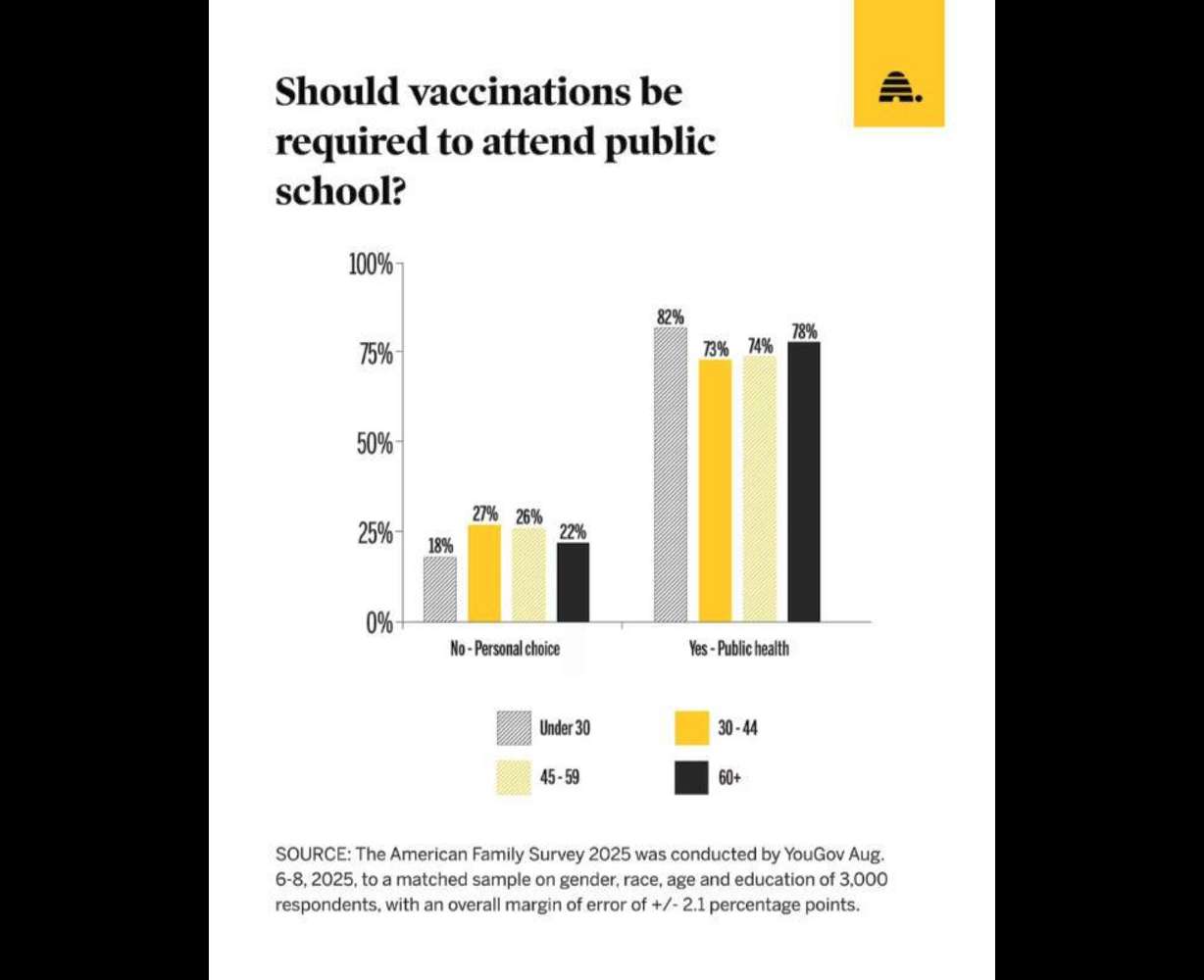
Per the survey report, written by Christopher F. Karpowitz and Jeremy C. Pope, "Though it is now the subject of intense debates in Florida and in the nation as a whole, support for dropping vaccine requirements rarely attracts more than one-third support among any group and it is never more popular than keeping the requirements."
Pope and Karpowitz are the annual survey's principal investigators and are political science professors at BYU. The nationally representative survey — the 11th edition — was conducted of 3,000 U.S. adults Aug. 6-18 by YouGov. The margin of error is plus or minus 2.1%. The full survey tackles a range of issues, from what concerns parents to views on marriage and the economy.
"In the midst of ongoing disputes about vaccine schedules, requirements and availability," Karpowitz and Pope write that "among self-reported 2024 Trump voters, a majority (51.9%) support required vaccinations, compared to 34.2% who do not."
Heated ongoing political debate
The clearest difference of opinion is partisanship. Though most Republicans and Democrats support vaccination for school as a public health issue, the numbers show that some see it as a political issue, according to Karpowitz and Pope. They wrote: "It betrays a lack of trust in the public health bureaucracy (perhaps earned in some ways). It shows ways in which a subset of Republicans feel alienated from their government." The two suggest that "should provoke us to figure out ways to build trust in these institutions and practices."
All kinds of vaccines, from those for COVID-19 to the vaccines traditionally required for school, have been the subject of heated ongoing debate. U.S. Secretary of Health and Human Services, Robert F. Kennedy Jr., has long expressed vaccine skepticism and has recast the committee in the Centers for Disease Control and Prevention that makes vaccine recommendations. The newly minted Advisory Committee on Immunization Practices includes some who are at the very least vaccine wary. The committee is expected to make some of its recommendations this week.
But vaccination requirements for daycare and school entry are set by state and local jurisdictions, as KFF reported, although the federal government approves the child vaccination schedule, which is set by the CDC based on the advisory committee's recommendations.
And the Trump administration "recently released a report that calls for a new vaccine framework that includes reevaluating the childhood vaccine schedule and addressing vaccine injuries," per KFF.
All states allow medical exemptions to school vaccine requirements. Washington, D.C., and 46 states (including Utah) allow exemptions for religious and/or personal belief. Just California, Connecticut, Maine and New York allow only the medical exemptions. Parents can ask that children be exempt from some vaccines, but not others, if they want.
KFF said nine states have recently made changes that could result in more students requesting a nonmedical exemption.
Pediatricians on childhood immunization
Pediatricians have been outspoken in support of vaccinations for children. As Utah pediatrician Dr. Paul Wirkus told Deseret News last week, "Immunization works both by protecting the individual and protecting the group because there will be some people who either can't be immunized or those for whom the vaccine may not work fully. Group immunization is the ultimate act of caring for your neighbor while also caring for yourself. When people opt out of immunization, they're generally benefiting from the fact that their neighbors have protected them by forming a wall of immunity around them. That wall becomes a lot more porous if there are more people who don't immunize."
As Deseret News reported, Utah's Community Vaccine Forum recently "sounded alarms about Utah's declining vaccine uptake — especially expressing concern about measles, which has been more common in the U.S. recently than in many years. Forum members are worried that preventable diseases like measles could regain a foothold.
When people opt out of immunization, they're generally benefiting from the fact that their neighbors have protected them by forming a wall of immunity around them. That wall becomes a lot more porous if there are more people who don't immunize.
–Dr. Paul Wirkus
The group released a study, "The Impact of Declining Vaccination Rates for Children Entering School in Utah," hoping to spark what forum chairman Michael Stapley called "responsible and informed discussion."
The American Academy of Pediatrics has broken with the CDC in a clash over COVID-19 vaccine guidance. And it continues to publish its own vaccine schedule.
The Annenberg Public Policy Center in its nationally representative Science and Public Health Survey in April had findings similar to those of the more recent American Family Survey, only it focused specifically on the measles, mumps and rubella (MMR) vaccine, which has been among the most contentious.