
- Sen. Mike Lee criticized postal worker unions' endorsements, suggesting potential election influence.
- Lee argued such endorsements create conflicts of interest in mail-in voting systems.
- Proponents of mail-in voting cited the Hatch Act and Postal Service protocols as safeguards against election fraud.
WASHINGTON — Sen. Mike Lee, R-Utah, issued his latest criticism of mail-in voting this week, this time suggesting that the political endorsements of postal workers' unions create a "cozy arrangement" that could result in mass election fraud.
In a thread posted to X on Monday, Lee argued it is highly questionable that the United States Postal Service could be trusted to administer mail-in ballots when related unions such as the National Association of Letter Carriers or the American Postal Workers Union throw their support behind a presidential candidate. Such endorsements, Lee argues, create conflicts of interest that put the entire mail-in voting system at risk.
"This creates at least a potential conflict of interest, given that USPS handles tens of millions of mail-in ballots with each election — 99.22 million in 2024 alone," Lee wrote in a post. "If a union backs one candidate, could that influence ballot handling?"
Lee pointed to the two unions' history of backing Democratic candidates such as Kamala Harris in 2024 and Joe Biden in 2020, claiming it creates risk of election fraud that cannot be fully mitigated.
Republicans have previously raised questions about whether postal worker unions can be trusted to help run elections. Rep. James Comer, R-Ky., the highest ranking Republican on the House Oversight Committee, flagged concerns about mail-in ballots during the 2020 election when states adopted the strategy on a national scale due to the COVID-19 pandemic.
Comer, similar to Lee, cited concerns that the unions that help collect ballots routinely endorse Democratic candidates who express support for public postal services — arguing it could lead to skewed results.
Proponents of mail-in ballots say that union workers are limited by the Hatch Act, a federal law that restricts federal workers, including mail carriers, from engaging in political activities. Other proponents have pointed to strict protocols that the the U.S. Postal Service must follow when conducting elections that provide for heavy government oversight.
"The Hatch Act very strictly prohibits any sort of partisan political activity by postal employees, whether that's from the union or any other source on postal property while they're wearing their uniform or, obviously, while they're working," Brian Renfroe, president of the National Association of Letter Carriers, told the Deseret News in an interview. "But it also protects the workers who, on their own time as employees of an independent agency, have the right to participate. Just like every other American should have the right to participate in our political process."
Renfroe defended the union's endorsement history, arguing they've supported candidates in both parties.
However, Lee argued those stipulations require voters to place "a lot of faith" in the Postal Service.
"There's simply no way to fully mitigate against the immense risks presented by universal mail-in voting — especially considering how many U.S. Postal Service workers belong to unions that overwhelmingly endorse Democrats, many times more than Republicans," Lee said. "Although unions are legally permitted to endorse, the setup invites opportunities for election fraud. This cozy arrangement puts USPS worker unions — which strongly prefer to endorse Democrats — in a position to manipulate the outcome of elections."
Renfroe pushed back on that characterization, calling it "complete insanity" not to trust letter carriers to deliver ballots without substantial evidence.
"Letter carriers, on a daily basis, literally see and handle thousands and thousands and thousands of pieces of mail," he said. "They, frankly, don't have time to worry about what's in a ballot or what's not in a ballot. Their job is to collect that mail and get it back to be processed or to deliver that mail and get it to the right place."
Lee has long called for the elimination of mail-in voting, demanding instead that voting be done in person and on Election Day — despite local laws in his home state of Utah allowing voters to cast their ballots by mail in the two weeks leading up to the election. The Utah senator has carved out some exceptions, but said in-person voting should be required for most voters.
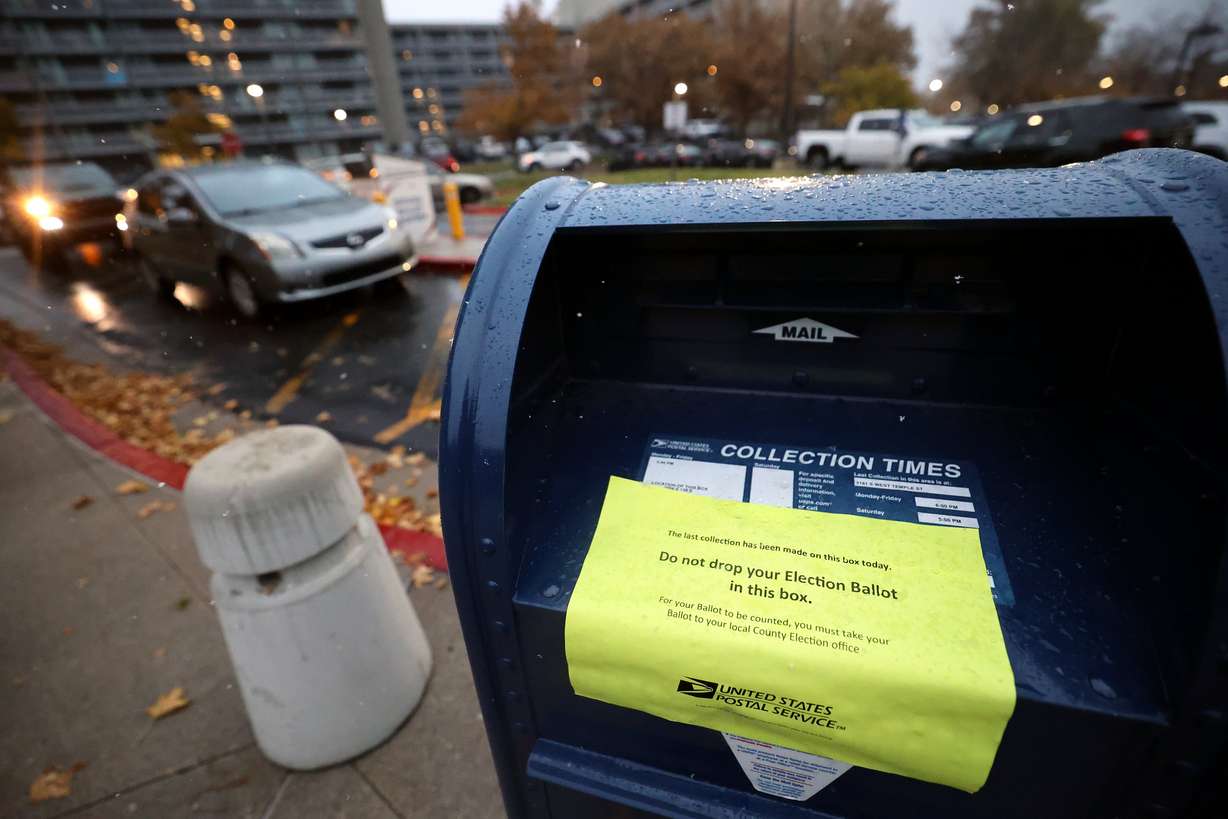
"We can restore public confidence in election integrity by only allowing mail-in ballots in special cases — such as overseas service members and their families — and requiring most people to show up in person on Election Day with proof of identity and citizenship," Lee told the Deseret News in August.
One-half of Utah voters still prefer the state's previously universal mail-in voting system, according to a recent poll by the Deseret News in June. The other half are divided over the state's revised mail-in voting system, with those sentiments largely split along party lines.






