'%3e%3cpath%20d='M34.1406%205.85938C30.3906%202.10547%2025.3047%200%2020%200C14.6953%200%209.60938%202.10547%205.85938%205.85938C2.10938%209.61328%200%2014.6953%200%2020C0%2025.3047%202.10547%2030.3906%205.85938%2034.1406C9.61328%2037.8906%2014.6953%2040%2020%2040C25.3047%2040%2030.3906%2037.8945%2034.1406%2034.1406C37.8906%2030.3906%2040%2025.3047%2040%2020C40%2014.6953%2037.8945%209.60938%2034.1406%205.85938ZM37.0117%2023.543H31.1602V13.5391H27.6328V19.9414C28.1211%2020.6914%2028.3711%2021.582%2028.3711%2022.5625V22.625C28.3711%2023.668%2028.1172%2024.6055%2027.6328%2025.4297V26.6094H36.082C33.4883%2032.9375%2027.2891%2037.3789%2020.0039%2037.3789C10.3711%2037.3789%202.62109%2029.6289%202.62109%2020C2.62109%2010.3711%2010.3711%202.62109%2020%202.62109C29.6289%202.62109%2037.3789%2010.3711%2037.3789%2020C37.3789%2021.1484%2037.2617%2022.2656%2037.0508%2023.3477C37.0391%2023.4141%2037.0234%2023.4766%2037.0117%2023.543Z'%20fill='white'/%3e%3cpath%20d='M22.3086%2018.5352C20.4336%2018.125%2019.9531%2017.8398%2019.9766%2017.1836V17.1406C19.9766%2016.6992%2020.3477%2016.2148%2021.4023%2016.2148C22.582%2016.2148%2023.8867%2016.6797%2025.0781%2017.4766L26.8516%2015.0195C25.4453%2013.8906%2023.707%2013.3398%2021.5547%2013.3398C18.5195%2013.3398%2016.4375%2015%2016.4063%2017.4766V17.5352C16.3633%2020.2617%2018.5859%2020.9805%2021.293%2021.6016C23.0391%2021.9766%2023.5703%2022.3164%2023.5703%2022.9609L23.5469%2022.9766C23.5469%2023.3906%2023.2578%2023.7031%2022.7852%2023.8359C22.5742%2023.9062%2022.1289%2023.9727%2021.5156%2023.9727C20.7617%2023.9727%2019.7539%2023.8633%2018.6328%2023.4844C18.0898%2023.2891%2017.4727%2023.0039%2016.8047%2022.6133L20.1406%2026.625C20.2813%2026.6602%2021.0977%2026.8516%2021.7734%2026.8516C25.0039%2026.8516%2027.0859%2025.2461%2027.1094%2022.6328V22.5703C27.1602%2020.1133%2025.2148%2019.1719%2022.3086%2018.5352Z'%20fill='white'/%3e%3cpath%20d='M5.24219%2013.5664V26.6133H8.75391V23.7578L10.2969%2021.9531L14.2031%2026.6133H18.3867L12.3555%2019.5195L17.4023%2013.5664H13.4531L8.75391%2019.0586V13.5664H5.24219Z'%20fill='white'/%3e%3c/g%3e%3cdefs%3e%3cclipPath%20id='clip0_97_2430'%3e%3crect%20width='40'%20height='40'%20fill='white'/%3e%3c/clipPath%3e%3c/defs%3e%3c/svg%3e)


This archived news story is available only for your personal, non-commercial use. Information in the story may be outdated or superseded by additional information. Reading or replaying the story in its archived form does not constitute a republication of the story.
- Judge denies Ralph Menzies another competency hearing citing no substantial change.
- Menzies, convicted of murder in 1986, is set for execution on Sept. 5.
- His last chance to avoid execution may lie with the state pardons board, currently holding a commutation hearing.
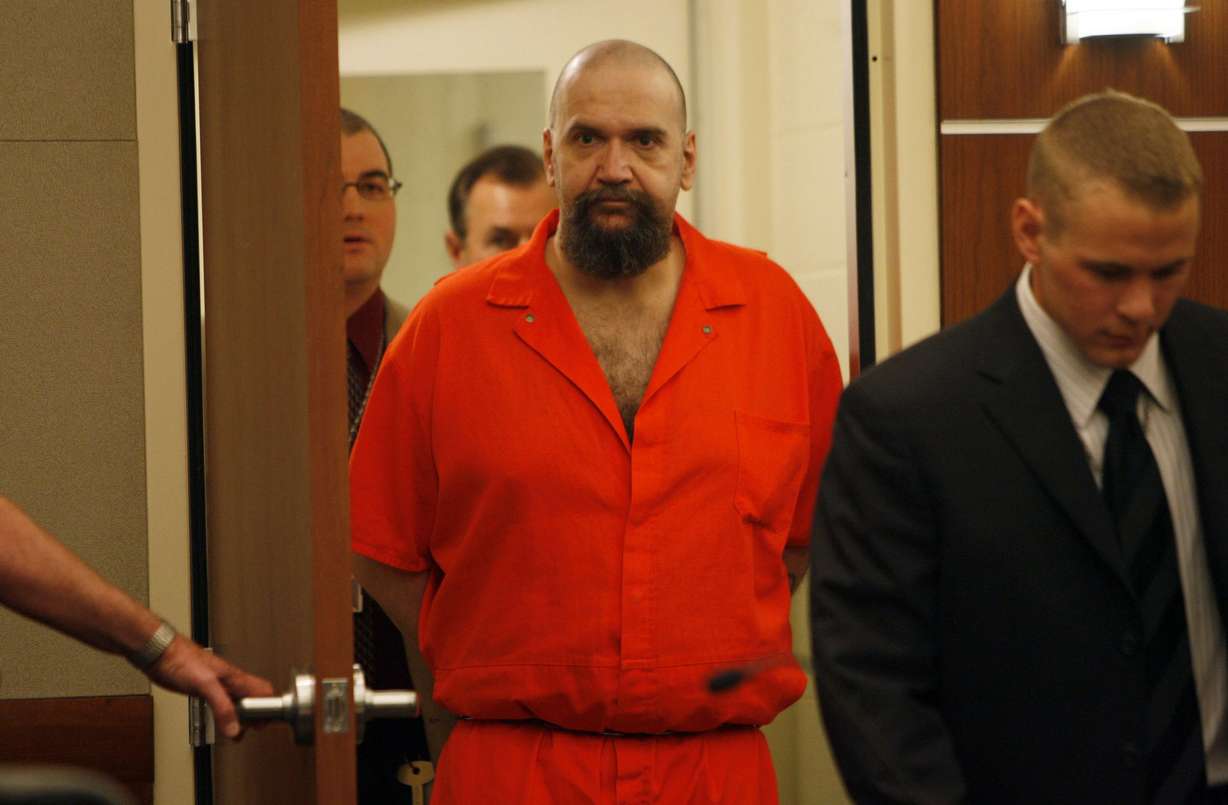
SALT LAKE CITY — Death row inmate Ralph Leroy Menzies will not be granted another competency hearing.
On Thursday, 3rd District Judge Matthew Bates denied the latest petition by Menzies' attorneys to take another look at their client's mental competency. While Bates agrees with "Menzies' claim that his physical and mental difficulties have worsened over time … the court concludes Menzies has not shown a substantial change of circumstances to warrant a new hearing."
With Bates denying the request, Menzies' last chance to avoid execution may rest with the Utah Board of Pardons and Parole.
On Friday, the board will resume a commutation hearing for Menzies, who is seeking to have his sentence changed to life in prison without the possibility of parole. Many of the same arguments used by both sides in the petition for another competency hearing are also being used in Menzies' request for mercy by the board.
Menzies, 67, is scheduled to be executed by firing squad early on the morning of Sept. 5. He was convicted of killing Maurine Hunsaker, a 26-year-old mother of three, in 1986. Menzies robbed, kidnapped and tied Hunsaker to a tree near Storm Mountain in Big Cottonwood Canyon before slitting her throat. Her body was found two days later.
On June 6, Menzies was determined to be mentally competent to be executed. Last month, however, his attorneys asked the court to reevaluate their client's condition, claiming that it had deteriorated so much over the past month that he is no longer competent enough for execution.
In Thursday's ruling, Bates noted that for a second competency hearing to be held, "Menzies must first show that there has been a substantial change of circumstances subsequent to the previous determination of competency."
In his decision, however, Bates found "the changes since Menzies was last evaluated in the fall of 2024 are not substantial."
What matters is whether (Ralph) Menzies' new allegations raise a significant question about his ability to reach a rational understanding of his death sentence. Attending to the particular circumstances of this case, the court concludes they do not.
–Ruling by 3rd District Judge Matthew Bates
Menzies' defense team also argued that their client no longer has a rational understanding that he will be put to death or the reasons for his sentence.
Bates agrees that Menzies' answers to questions presented to him by evaluators "were not as robust in 2025 as in prior evaluations." But whether that is due to "cognitive decline or depression and a lack of interest in engaging with the experts" was not a factor in the court's decision.
"What matters is whether Menzies' new allegations raise a significant question about his ability to reach a rational understanding of his death sentence. Attending to the particular circumstances of this case, the court concludes they do not," the ruling states. "Menzies' current responses do not raise significant questions about his competency but reinforce Menzies' decades-long mindset that he did not commit murder and thus the government has no reason to execute him."
Bates further states in his decision that "the test of competency is not whether an inmate remembers and can articulate his own crime and punishment. The test is whether he can reach a rational understanding of his punishment."
The judge says his decision was partly based on 32 phone calls Menzies made to family members from prison between May and July. Although he entered a wrong PIN or dialed a wrong number in a dozen of those calls, Bates says it's reasonable to assume this was due to Menzies' physical struggles. In the other calls, the judge notes that Menzies "is able to speak with normal speed" and could "ask questions, track conversations and laugh at appropriate times," the ruling states. He also remembers the names of family members and gives brief updates on his court case.
"Nothing in the current phone conversations demonstrate a substantial change in his cognitive functioning from the court's previous assessment," according to Bates' decision.
While Menzies' attorneys argue that their client has "moments of lucidity" despite his vascular dementia diagnosis, Bates wrote in his decision that no evidence has been presented of Menzies displaying "irrational or confused thinking."
"At most, he has shown that Menzies is struggling physically and his memory is not as good as it used to be. Forgetfulness, an inability to concentrate, and a paucity of language do not amount to a lack of an ability to reach a rational understanding of the link between crime and punishment," the judge ruled.
The issue of the prison phone calls made by Menzies became a point of contention during Wednesday's commutation hearing with the Utah Board of Pardons and Parole. Menzies' attorneys argued that the content of those calls was protected information for the purpose of the commutation hearing, but the state allegedly violated that protective order during questioning.
The hearing will resume on Friday with both sides delivering closing arguments and victim representatives from Hunaker's family addressing board members.
Related:
Ralph Menzies' cognitive decline debated during first day of commutation hearing
Doctors testified Wednesday about death row inmate Ralph Menzies' cognitive skills during a commutation hearing to determine whether his sentence should be changed to life without parole.