'%3e%3cpath%20d='M34.1406%205.85938C30.3906%202.10547%2025.3047%200%2020%200C14.6953%200%209.60938%202.10547%205.85938%205.85938C2.10938%209.61328%200%2014.6953%200%2020C0%2025.3047%202.10547%2030.3906%205.85938%2034.1406C9.61328%2037.8906%2014.6953%2040%2020%2040C25.3047%2040%2030.3906%2037.8945%2034.1406%2034.1406C37.8906%2030.3906%2040%2025.3047%2040%2020C40%2014.6953%2037.8945%209.60938%2034.1406%205.85938ZM37.0117%2023.543H31.1602V13.5391H27.6328V19.9414C28.1211%2020.6914%2028.3711%2021.582%2028.3711%2022.5625V22.625C28.3711%2023.668%2028.1172%2024.6055%2027.6328%2025.4297V26.6094H36.082C33.4883%2032.9375%2027.2891%2037.3789%2020.0039%2037.3789C10.3711%2037.3789%202.62109%2029.6289%202.62109%2020C2.62109%2010.3711%2010.3711%202.62109%2020%202.62109C29.6289%202.62109%2037.3789%2010.3711%2037.3789%2020C37.3789%2021.1484%2037.2617%2022.2656%2037.0508%2023.3477C37.0391%2023.4141%2037.0234%2023.4766%2037.0117%2023.543Z'%20fill='white'/%3e%3cpath%20d='M22.3086%2018.5352C20.4336%2018.125%2019.9531%2017.8398%2019.9766%2017.1836V17.1406C19.9766%2016.6992%2020.3477%2016.2148%2021.4023%2016.2148C22.582%2016.2148%2023.8867%2016.6797%2025.0781%2017.4766L26.8516%2015.0195C25.4453%2013.8906%2023.707%2013.3398%2021.5547%2013.3398C18.5195%2013.3398%2016.4375%2015%2016.4063%2017.4766V17.5352C16.3633%2020.2617%2018.5859%2020.9805%2021.293%2021.6016C23.0391%2021.9766%2023.5703%2022.3164%2023.5703%2022.9609L23.5469%2022.9766C23.5469%2023.3906%2023.2578%2023.7031%2022.7852%2023.8359C22.5742%2023.9062%2022.1289%2023.9727%2021.5156%2023.9727C20.7617%2023.9727%2019.7539%2023.8633%2018.6328%2023.4844C18.0898%2023.2891%2017.4727%2023.0039%2016.8047%2022.6133L20.1406%2026.625C20.2813%2026.6602%2021.0977%2026.8516%2021.7734%2026.8516C25.0039%2026.8516%2027.0859%2025.2461%2027.1094%2022.6328V22.5703C27.1602%2020.1133%2025.2148%2019.1719%2022.3086%2018.5352Z'%20fill='white'/%3e%3cpath%20d='M5.24219%2013.5664V26.6133H8.75391V23.7578L10.2969%2021.9531L14.2031%2026.6133H18.3867L12.3555%2019.5195L17.4023%2013.5664H13.4531L8.75391%2019.0586V13.5664H5.24219Z'%20fill='white'/%3e%3c/g%3e%3cdefs%3e%3cclipPath%20id='clip0_97_2430'%3e%3crect%20width='40'%20height='40'%20fill='white'/%3e%3c/clipPath%3e%3c/defs%3e%3c/svg%3e)


Estimated read time: 7-8 minutes
This archived news story is available only for your personal, non-commercial use. Information in the story may be outdated or superseded by additional information. Reading or replaying the story in its archived form does not constitute a republication of the story.
- Ralph Menzies' attorneys argue for life in prison without parole over execution in a commutation hearing Wednesday.
- Defense highlights Menzies' cognitive decline and past judicial errors in sentencing.
- State argues Menzies' cognitive decline is exaggerated.
SALT LAKE CITY — Although the Utah Board of Pardons and Parole said it would not conduct a competency inquiry during the commutation hearing for death row inmate Ralph Leroy Menzies, much of the testimony and questions during the hearing's first day Wednesday focused on Menzies' current diagnosis, his cognitive skills and how much he is aware of what's going on around him.
Menzies, 67, is scheduled to be executed by firing squad early on the morning of Sept. 5. At stake is whether the board will change Menzies' death sentence to life in prison without the possibility of parole.
Attorneys for both sides called witnesses to testify Wednesday. Menzies' defense called medical doctors with expertise in neurology, while the state countered with psychologists who specialize in clinical and neuropsychology. Both sides also called current or former Department of Corrections officers who have interacted with Menzies in prison.
An argument for life in prison
Menzies will die in prison one way or another, his attorney Eric Zuckerman argued. But he says the board should allow Menzies "to die from his terminal illness and not by firing squad."
Menzies was convicted of capital murder in the 1986 killing of Maurine Hunsaker, a 26-year-old mother of three, who Menzies robbed, kidnapped, tethered to a tree near Storm Mountain in Big Cottonwood Canyon, and slit her throat.
Menzies' attorneys addressed the board first on Wednesday. Zuckerman argued that his client is not the same person he was when he was convicted 37 years ago. He has grown old and has a terminal illness.
"That's not a matter of argument or to be debated," Zuckerman said. "His brain is literally shrinking."
While Zuckerman says the defense recognizes that Menzies has had more of a life than his victim, his life has been limited by being incarcerated for the past 37 years.
"It has not been a good life," he said while adding that the execution of Menzies will not bring Hunsaker back. "(It's) not the only way to bring closure to this situation."
Doctors testify to differing diagnoses
The two doctors who were called as witnesses for the defense on Wednesday went into great detail about Menzies' vascular dementia diagnosis and what is happening to his brain.
"Basically, it means his brain is wasting away," one doctor told the board while showing several MRI scans of Menzies.
Dr. David Thompson, who determined Menzies was competent for execution in 3rd District Court, testified as a state witness on Wednesday, saying that when he evaluated Menzies in 2024, Menzies was aware of his pending execution and had a rational understanding of why he was being executed.
"I found little evidence of cognitive decline (since April 2024)," he said, adding that what decline Menzies has shown could possibly be attributed to other factors like depression, which Thompson argued would be understandable considering a death warrant was signed.
Likewise, Dr. Ryan Green, who also found Menzies to be competent for execution, testified Wednesday that Menzies' current condition should not be solely attributed to vascular dementia.
"Reducing Mr. Menzies to that is unfair, in my point of view, because he's a very complex person," he said.

Green called Menzies a "very intelligent person" and believes that other factors, such as possible attention-deficit/hyperactivity disorder or antisocial personality disorder, should have also been looked at.
"He's probably had some cognitive decline … but not to the degree written about in the reports," he told the board.
Both Green and Thompson said they based much of their conclusions on recorded phone calls Menzies has made to family members over the past few months, saying that his ability to carry on a meaningful conversation and pay attention to what is being is being said — or his "processing speed" — is good, as is both his short- and long-term memory. Both men also noted that they were not allowed by Menzies' defense attorneys to reinterview the inmate nor look at his latest medical reports.
At one point during Green's testimony, in an unusual move for a commutation hearing, Menzies' attorneys objected to Green giving details about one of the prison phone calls, saying it violated a previously agreed-upon protection order. Attorneys for the state moved on from the phone call questioning after several minutes of back-and-forth discussion between the board and both sides, but Zuckerman hinted he would revisit the issue during his closing arguments.
Menzies' conduct in prison
Both sides also called past and present corrections officers to the witness stand on Wednesday.
Lyle Richard Smith, a retired captain, was asked whether Menzies ever presented a threat to other inmates or corrections officers while incarcerated. The threat of violence against others was allegedly one of the aggravating factors in issuing the death penalty.
"I never seen him act out ever. I've never seen him raise his temper all the time I was there," Smith said. "I don't think he would ever strike out at anyone at this point."
"Not to corrections officers?" the defense asked.
"Absolutely not," Smith replied.
Officers called to the stand by the state agreed that Menzies has not been a behavioral problem. On the contrary, one sergeant called him "very organized" while another officer noted he never needed help using the phone or his computer tablet, and was very aware about when he was supposed to have visitors.
Affidavits support change in sentencing
Menzies' attorneys on Wednesday also presented affidavits to the board that were signed by the judge who sentenced Menzies to death and from an inmate whose testimony in court influenced the sentencing decision.
In 2010, 3rd District Judge Raymond Uno, who is now deceased, signed a sworn affidavit stating, "It appears that I misapplied the heinousness factor in Mr. Menzies' case. According to my reading of the case law, my error should simply result in a reduction in the sentence from capital murder to the next lowest sentence available, which is life imprisonment."
The option of sentencing a person to life in prison without the possibility of parole was not available when Menzies was convicted.
"Utah has never executed a person where the sentencing judge believes he made a mistake," Zuckerman emphasized to the board.
Zuckerman said the judge's decision was based heavily on another inmate's testimony, who claimed Menzies had told him that killing Hunsaker was one of the "biggest thrills" he ever had. That inmate later signed a sworn declaration that he actually committed perjury because he was facing his own 100-year prison sentence for bank robbery and weapons offenses.
"I made these statements because I was trying to strike a deal with federal authorities and thought that making such statements would be helpful to me," he wrote in his affidavit.
A second inmate also signed an affidavit saying that after the first inmate learned of Menzies' possible death sentence, he came up with a plan "to use this case to get out of jail."
Zuckerman further presented to the board on Wednesday a 2024 report from the Salt Lake County district attorney's Conviction Integrity Panel, which was led by former Utah Supreme Court Chief Justice Christine Durham. The panel concluded "by a preponderance of the evidence that we reviewed and the standards that apply to our review, that on balance Mr. Menzies' death sentence lacks integrity. The panel recommends that the sentence of death in Mr. Menzies' case be vacated and that the district attorney recommend that Mr. Menzies be resentenced to life without the possibility of parole."
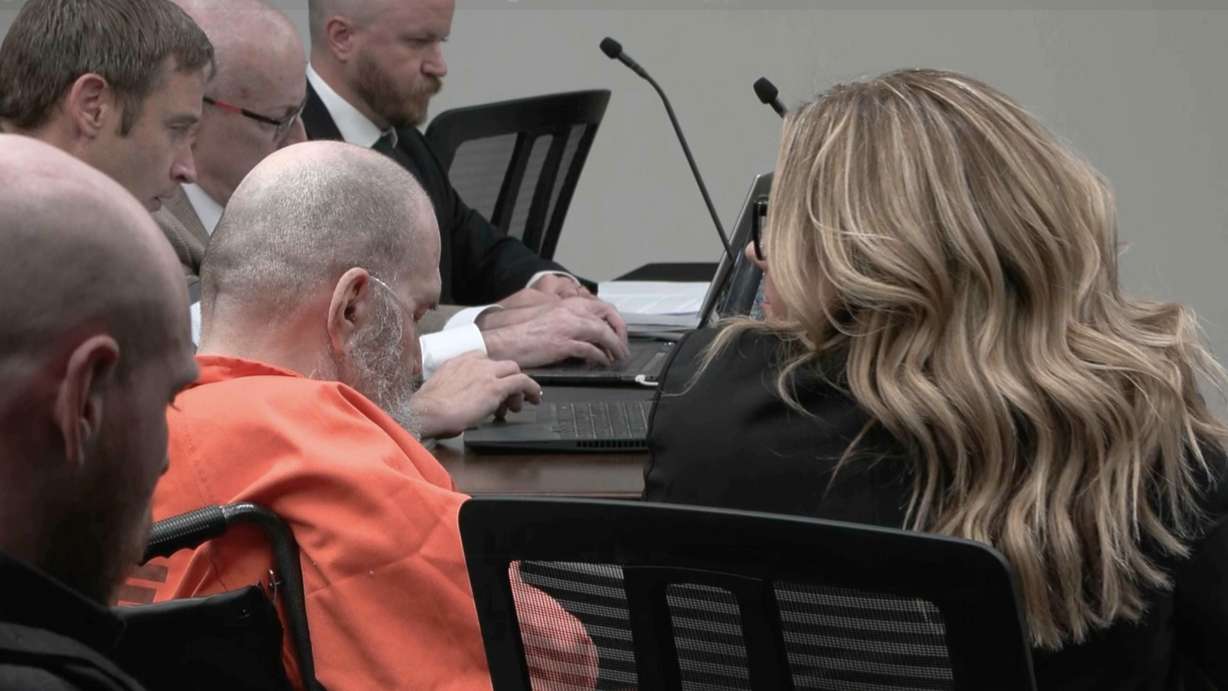
Menzies, wearing an orange prison jumpsuit with his supplemental oxygen tank connected, sat in a wheelchair Wednesday and did not speak during the hearing. As his attorneys noted in their petition for a commutation hearing, they "advised Mr. Menzies not to speak, as he cannot meaningfully prepare, recall his remarks, or remain focused on the subject at hand."
What happens next
Because both sides got through their expert witnesses on Wednesday, the second day of the commutation hearing originally scheduled for Thursday was cancelled. The hearing will resume and wrap up on Friday with what are expected to be lengthy closing arguments and testimony from victim representatives.
Once the hearing is completed, the full five-member board will take all the information made available to them under advisement and, at some point before Sept. 5, vote whether to change Menzies' death sentence to life in prison without the possibility of parole. A final decision will be based on a majority vote.