'%3e%3cpath%20d='M34.1406%205.85938C30.3906%202.10547%2025.3047%200%2020%200C14.6953%200%209.60938%202.10547%205.85938%205.85938C2.10938%209.61328%200%2014.6953%200%2020C0%2025.3047%202.10547%2030.3906%205.85938%2034.1406C9.61328%2037.8906%2014.6953%2040%2020%2040C25.3047%2040%2030.3906%2037.8945%2034.1406%2034.1406C37.8906%2030.3906%2040%2025.3047%2040%2020C40%2014.6953%2037.8945%209.60938%2034.1406%205.85938ZM37.0117%2023.543H31.1602V13.5391H27.6328V19.9414C28.1211%2020.6914%2028.3711%2021.582%2028.3711%2022.5625V22.625C28.3711%2023.668%2028.1172%2024.6055%2027.6328%2025.4297V26.6094H36.082C33.4883%2032.9375%2027.2891%2037.3789%2020.0039%2037.3789C10.3711%2037.3789%202.62109%2029.6289%202.62109%2020C2.62109%2010.3711%2010.3711%202.62109%2020%202.62109C29.6289%202.62109%2037.3789%2010.3711%2037.3789%2020C37.3789%2021.1484%2037.2617%2022.2656%2037.0508%2023.3477C37.0391%2023.4141%2037.0234%2023.4766%2037.0117%2023.543Z'%20fill='white'/%3e%3cpath%20d='M22.3086%2018.5352C20.4336%2018.125%2019.9531%2017.8398%2019.9766%2017.1836V17.1406C19.9766%2016.6992%2020.3477%2016.2148%2021.4023%2016.2148C22.582%2016.2148%2023.8867%2016.6797%2025.0781%2017.4766L26.8516%2015.0195C25.4453%2013.8906%2023.707%2013.3398%2021.5547%2013.3398C18.5195%2013.3398%2016.4375%2015%2016.4063%2017.4766V17.5352C16.3633%2020.2617%2018.5859%2020.9805%2021.293%2021.6016C23.0391%2021.9766%2023.5703%2022.3164%2023.5703%2022.9609L23.5469%2022.9766C23.5469%2023.3906%2023.2578%2023.7031%2022.7852%2023.8359C22.5742%2023.9062%2022.1289%2023.9727%2021.5156%2023.9727C20.7617%2023.9727%2019.7539%2023.8633%2018.6328%2023.4844C18.0898%2023.2891%2017.4727%2023.0039%2016.8047%2022.6133L20.1406%2026.625C20.2813%2026.6602%2021.0977%2026.8516%2021.7734%2026.8516C25.0039%2026.8516%2027.0859%2025.2461%2027.1094%2022.6328V22.5703C27.1602%2020.1133%2025.2148%2019.1719%2022.3086%2018.5352Z'%20fill='white'/%3e%3cpath%20d='M5.24219%2013.5664V26.6133H8.75391V23.7578L10.2969%2021.9531L14.2031%2026.6133H18.3867L12.3555%2019.5195L17.4023%2013.5664H13.4531L8.75391%2019.0586V13.5664H5.24219Z'%20fill='white'/%3e%3c/g%3e%3cdefs%3e%3cclipPath%20id='clip0_97_2430'%3e%3crect%20width='40'%20height='40'%20fill='white'/%3e%3c/clipPath%3e%3c/defs%3e%3c/svg%3e)




Estimated read time: 3-4 minutes
This archived news story is available only for your personal, non-commercial use. Information in the story may be outdated or superseded by additional information. Reading or replaying the story in its archived form does not constitute a republication of the story.
- The Protect Medicaid Utah coalition launched Tuesday to urge continued Medicaid coverage amid potential cuts.
- Federal discussions on cuts include work requirements, risking $500 million in federal funding for Utah.
- Speakers stressed Medicaid's role for low-income families, elderly and disabled in Utah.
SALT LAKE CITY — The Protect Medicaid Utah coalition launched its new organization focused on maintaining Medicaid coverage on Tuesday. The group has members all over Utah who seek to share stories about why Medicaid is important.
In 2018, Utah voters expanded Medicaid coverage to thousands of low-income and other individuals and families in the state. The changes made under the Affordable Care Act significantly reduced the number of uninsured people, resulting in economic benefits and better health care for low-income families.
More recently, the federal government has been discussing potential cuts to the Medicaid program, the most significant of which is a work requirement. This would require all recipients to prove completion of 48 job applications to access treatments that would otherwise be provided without further documentation. Additionally, many individuals would need to provide documentation of any disability to access health care coverage.
"Someone can be incredibly ill with no paperwork to prove it. Tumors can cause symptoms and threaten lives before there is any evidence of the disease. A person can spend years in pain, confined to a bed or a wheelchair, without a diagnosis on paper from a physician. That is why it is so important to eliminate as many barriers as possible between people and access to health care," explained Stacy Stanford, a representative with the American Cancer Society Cancer Action Network.
Members of the coalition expressed concern that disability is a spectrum and cannot always be "proved" via paperwork or other means. Unease has also been raised for those with invisible disabilities, such as mental health issues that can be difficult to document.
"For many individuals battling significant behavioral health challenges, stable health care isn't a reward for work; it's the foundation that makes work possible," said Evan Doan, associate director for Utah Support Advocates for Recovery Awareness.
The group claims that if changes are implemented, the state would lose $500 million in federal funding annually, and 7,000 jobs — including many essential workers in the health care system — would also be put at risk. With over 352,000 Utahns currently using Medicaid, the coalition is fighting to ensure that cuts to Medicaid are not made.
Multiple speakers from various organizations addressed the crowd gathered Tuesday at Pioneer Park to discuss their experiences and perspectives on the proposed cuts; some held signs explaining what Medicaid does for them, for their families and for those around them.
For many individuals battling significant behavioral health challenges, stable health care isn't a reward for work; it's the foundation that makes work possible.
–Evan Doan, Utah Support Advocates for Recovery Awareness
"I'm a retired health care worker," said Kris Calfrick. "Medicaid was enormously important to cancer patients and to the elderly who needed supplements. … I think it would be devastating to health care if this were removed."
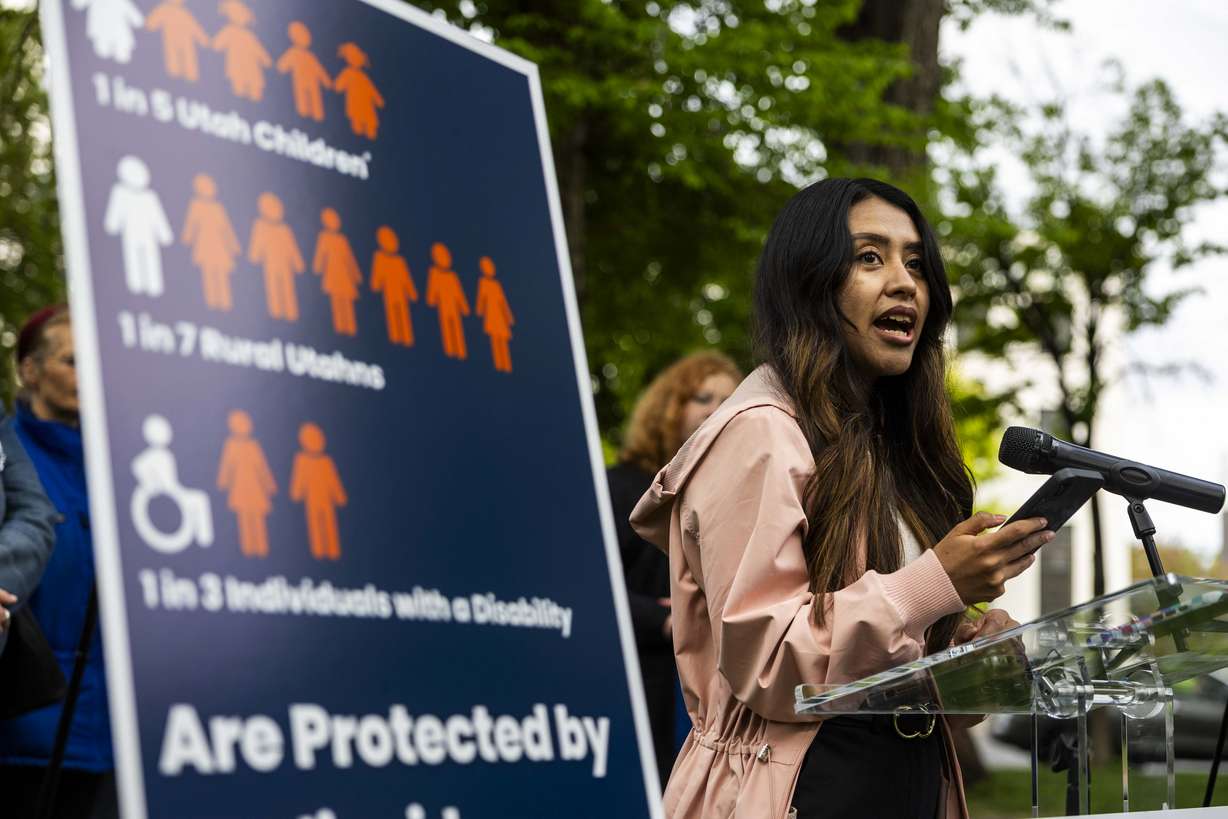
The speakers and attendees repeatedly emphasized that Medicaid budget cuts would most directly impact low-income families, the elderly and people with disabilities. One in five Utah children and 1 in 3 individuals with a disability are currently protected by Medicaid, according to state data.
"I want to be clear: All the cuts discussed will directly affect people with disabilities," said Disability Law Center representative Nate Crippes. "If enacted, many of them will have their health care terminated."
According to the coalition, with the budget cuts, the state would be forced to move the financial burden elsewhere. Many health care institutions currently operating under Medicaid would no longer be able to provide the level of care that many patients need.
For more information about the coalition, visit protectmedicaidutah.org. Protect Medicaid Utah urges anyone interested in advocating for the cause to reach out to local legislators to share their own experiences with Medicaid.