Estimated read time: 4-5 minutes
This archived news story is available only for your personal, non-commercial use. Information in the story may be outdated or superseded by additional information. Reading or replaying the story in its archived form does not constitute a republication of the story.
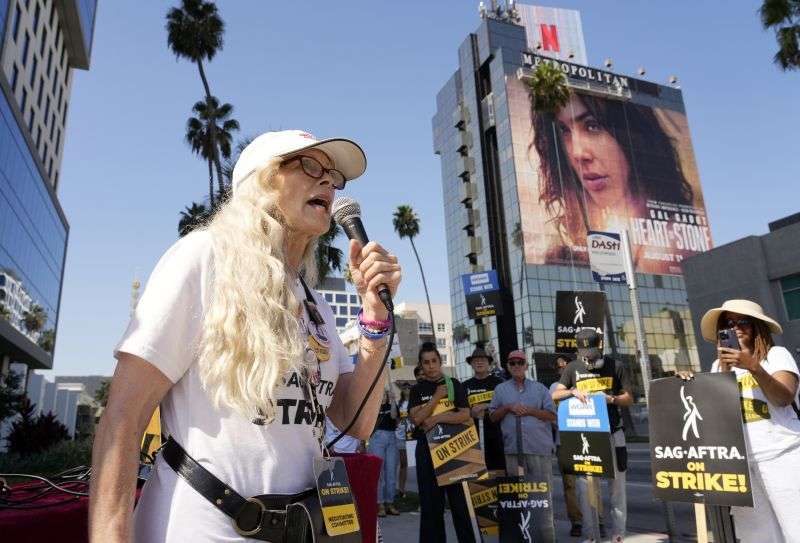
LOS ANGELES — While screenwriters are busy back at work, film and TV actors remain on picket lines, with the longest strike in their history set to hit 100 days on Saturday after talks broke off with studios.
A group of chief executives from the biggest studios had made a major deal just over a week earlier with striking writers, whose leaders celebrated their gains on many issues actors are also fighting for: long-term pay, consistency of employment and control over the use of artificial intelligence.
Hopes were high and leaders of the Screen Actors Guild-American Federation of Television and Radio Artists were cautiously optimistic when they resumed negotiations on Oct. 2 for the first time since the strike began 2½ months earlier.
But the actors' talks were tepid, with days off between sessions and no reports of progress. Then studios abruptly ended them on Oct. 11, saying the actors' demands were exorbitantly expensive and the two sides were too far apart to continue.
"We only met with them a couple of times, Monday, half a day Wednesday, half a day Friday. That was what they were available for," SAG-AFTRA President Fran Drescher told the Associated Press soon after the talks broke off. "Then this past week, it was Monday and a half a day on Wednesday. And then "Bye bye. I've never really met people that actually don't understand what negotiations mean. Why are you walking away from the table?"
The reasons, according to the Alliance of Motion Picture and Television Producers, included a union demand for a fee for each subscriber to streaming services.
"SAG-AFTRA gave the member companies an ultimatum: either agree to a proposal for a tax on subscribers as well as all other open items, or else the strike would continue," the alliance said in a statement to the Associated Press. "The member companies responded to SAG-AFTRA's ultimatum that unfortunately, the tax on subscribers poses an untenable economic burden."
Netflix co-CEO Ted Sarandos, one of the executives in on the bargaining sessions, told investors on an earnings call Wednesday that "This really broke our momentum unfortunately."
SAG-AFTRA leaders said it was ridiculous to frame this demand as though it were a tax on customers, and said it was the executives themselves who wanted to shift from a model based on a show's popularity to one based on the number of subscribers.
"We made big moves in their direction that have just been ignored and not responded to," Duncan Crabtree-Ireland, SAG-AFTRA's national executive director and chief negotiator, told the Associated Press. "We made changes to our AI proposal. We made dramatic changes to what used to be our streaming revenue share proposal," Crabtree-Ireland said.
The studios said just after the talks broke off that the per-subscriber charge would cost them $800 million annually, a figure SAG-AFTRA said was a vast overestimate.
The Alliance of Motion Picture and Television Producers later responded that the number was based on a union request for $1 per customer per year, which was lowered to 57 cents after SAG-AFTRA changed its evaluation to cut out non-relevant programming like news and sports.
The actors are in unscripted territory, with no end in sight. Their union has never been on a strike this long, nor been on strike at all since before many of its members were born. Not even its veteran leaders, like Crabtree-Ireland, with the union for 20 years, have found themselves in quite these circumstances.
"I think that they think that we're going to cower," Drescher said. "But that's never going to happen because this is a crossroads and we must stay on course."
Hollywood actors' strikes have been less frequent and shorter than those by writers. The Screen Actors Guild (it added the "AFTRA" in a 2011 merger) has gone on strike against film and TV studios only three times in its history.
In each case, emerging technology fueled the dispute. In 1960 — the only previous time actors and writers struck simultaneously — the central issue was actors seeking pay for when their work in film was aired on television, compensation the industry calls residuals. The union, headed by future U.S. President Ronald Reagan, was a smaller and much less formal entity back then. The vote to strike took place in the home of actors Tony Curtis and Janet Leigh, the parents of current SAG-AFTRA member and vocal striker Jamie Lee Curtis.
The return of writers has gotten the Hollywood production machine churning again, with rooms full of scribes penning new seasons of shows that had been suspended and film writers finishing scripts. But the finished product will await the end of actors strike, and production will remain suspended on many TV shows and dozens of films, including "Wicked," "Deadpool 3" and "Mission Impossible — Dead Reckoning Part 2."
The Emmys, whose nominations were announced the same day the actors' strike was called, opted to wait for the stars this time and move their ceremony from September to January, though that date could be threatened too.
The Oscars are a long way off in March, but the campaigns to win them are usually well underway by now. With some exceptions — non-studio productions approved by the union — performers are prohibited from promoting their films at press junkets or on red carpets.