'%3e%3cpath%20d='M34.1406%205.85938C30.3906%202.10547%2025.3047%200%2020%200C14.6953%200%209.60938%202.10547%205.85938%205.85938C2.10938%209.61328%200%2014.6953%200%2020C0%2025.3047%202.10547%2030.3906%205.85938%2034.1406C9.61328%2037.8906%2014.6953%2040%2020%2040C25.3047%2040%2030.3906%2037.8945%2034.1406%2034.1406C37.8906%2030.3906%2040%2025.3047%2040%2020C40%2014.6953%2037.8945%209.60938%2034.1406%205.85938ZM37.0117%2023.543H31.1602V13.5391H27.6328V19.9414C28.1211%2020.6914%2028.3711%2021.582%2028.3711%2022.5625V22.625C28.3711%2023.668%2028.1172%2024.6055%2027.6328%2025.4297V26.6094H36.082C33.4883%2032.9375%2027.2891%2037.3789%2020.0039%2037.3789C10.3711%2037.3789%202.62109%2029.6289%202.62109%2020C2.62109%2010.3711%2010.3711%202.62109%2020%202.62109C29.6289%202.62109%2037.3789%2010.3711%2037.3789%2020C37.3789%2021.1484%2037.2617%2022.2656%2037.0508%2023.3477C37.0391%2023.4141%2037.0234%2023.4766%2037.0117%2023.543Z'%20fill='white'/%3e%3cpath%20d='M22.3086%2018.5352C20.4336%2018.125%2019.9531%2017.8398%2019.9766%2017.1836V17.1406C19.9766%2016.6992%2020.3477%2016.2148%2021.4023%2016.2148C22.582%2016.2148%2023.8867%2016.6797%2025.0781%2017.4766L26.8516%2015.0195C25.4453%2013.8906%2023.707%2013.3398%2021.5547%2013.3398C18.5195%2013.3398%2016.4375%2015%2016.4063%2017.4766V17.5352C16.3633%2020.2617%2018.5859%2020.9805%2021.293%2021.6016C23.0391%2021.9766%2023.5703%2022.3164%2023.5703%2022.9609L23.5469%2022.9766C23.5469%2023.3906%2023.2578%2023.7031%2022.7852%2023.8359C22.5742%2023.9062%2022.1289%2023.9727%2021.5156%2023.9727C20.7617%2023.9727%2019.7539%2023.8633%2018.6328%2023.4844C18.0898%2023.2891%2017.4727%2023.0039%2016.8047%2022.6133L20.1406%2026.625C20.2813%2026.6602%2021.0977%2026.8516%2021.7734%2026.8516C25.0039%2026.8516%2027.0859%2025.2461%2027.1094%2022.6328V22.5703C27.1602%2020.1133%2025.2148%2019.1719%2022.3086%2018.5352Z'%20fill='white'/%3e%3cpath%20d='M5.24219%2013.5664V26.6133H8.75391V23.7578L10.2969%2021.9531L14.2031%2026.6133H18.3867L12.3555%2019.5195L17.4023%2013.5664H13.4531L8.75391%2019.0586V13.5664H5.24219Z'%20fill='white'/%3e%3c/g%3e%3cdefs%3e%3cclipPath%20id='clip0_97_2430'%3e%3crect%20width='40'%20height='40'%20fill='white'/%3e%3c/clipPath%3e%3c/defs%3e%3c/svg%3e)


Estimated read time: 4-5 minutes
This archived news story is available only for your personal, non-commercial use. Information in the story may be outdated or superseded by additional information. Reading or replaying the story in its archived form does not constitute a republication of the story.
HOUSTON — NASA scientists revealed the initial findings of the first United States asteroid sample mission, including carbon and water-based clay materials, from the Johnson Space Center in Houston Wednesday morning.
This event came two weeks after NASA scientists successfully landed its first mission to collect a sample from an asteroid in the Utah desert at the Department of Defense's Utah Test and Training Range on Sept. 24.
NASA Administrator Bill Nelson said the first analysis of the sample has revealed "abundant water in the form of hydrated clay minerals," which also contained carbon.
"The carbon and water molecules are exactly the kinds of material that we wanted to find," Nelson said. "They are crucial elements in the formation of our own planet, and they're going to help us determine the origin of elements that could have led to life."
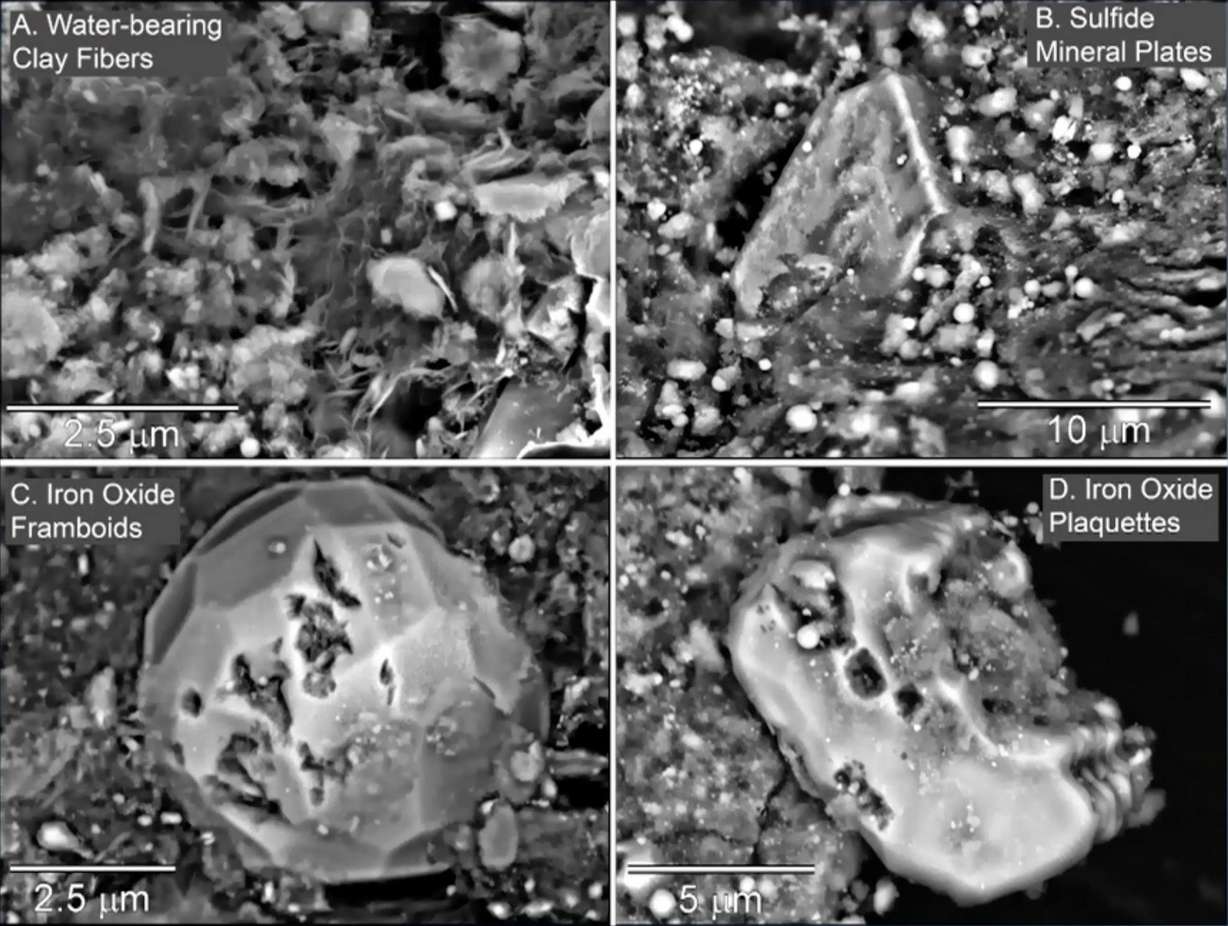
Dante Lauretta, an OSIRIS-REx principal investigator from the University of Arizona, showed four pieces of the sample that contain clues to how life on Earth may have developed. Those samples included water-bearing clay fibers, sulfide mineral plates, iron oxide framboids and iron oxide plaquettes.
"The reason that Earth is a habitable world, that we have oceans and lakes and rivers and rain, is because these clay minerals, minerals like the ones we're seeing from Bennu, landed on Earth 4 billion years ago to 4½ billion years ago, making our world habitable," Lauretta said.
Scientists are still working to reveal the exact quantity and more details about the contents of the capsule, but for a good reason — the sample retrieved from the asteroid Bennu is even larger than expected.
"With this abundance, we're taking our time methodically processing to properly care for every valuable piece of Bennu," said Eileen Stansbery, chief NASA scientist.
The reason that Earth is a habitable world, that we have oceans and lakes and rivers and rain, is because these clay minerals, minerals like the ones we're seeing from Bennu, landed on Earth 4 billion years ago to 4½ billion years ago, making our world habitable.
–Dante Lauretta, OSIRIS-REx principal investigator
Nicole Lunning, OSIRIS-REx lead curator, joined the broadcast from the mission's curation cleanroom in Houston. She said the recovery team was surprised when they opened the lid of the canister and found a "bonus sample" of extra material outside of the main canister.
She said NASA has also been collaborating with the Japan Aerospace Exploration Agency and Canadian Space Agency on this mission — there are more than 230 scientists from all over the world working on the sample analysis team.
More members of the public will have the opportunity to see portions of the sample in the next few months, as three samples from the asteroid will soon be displayed at the Smithsonian in Washington, D.C., the University of Museum in Tucson and the Johnson Space Center.
Lunning said her team will release a "sample catalog" in about six months to give scientists around the world the chance to propose studies and apply for portions of the sample.
Lori Glaze, director of NASA's Planetary Science Division, said the recovery team has been hard at work but still has a long way to go in analyzing the sample.
"This is really just the beginning," Glaze said. "There is so much incredible work to happen."
Background on OSIRIS-REx
The sample capsule's landing on Sept. 24 ended a seven-year journey to the asteroid Bennu and back, completing a major step in a mission roughly 20 years in the making.
On the day of the landing, a recovery team brought the capsule to a cleanroom at the Dugway Proving Ground, about 85 miles west of Salt Lake City. It was prepared and packaged with a nitrogen purge before being flown via C-17 cargo plane Sept. 25 to NASA's Johnson Space Center in Houston.
The mission, a joint effort between NASA and the University of Arizona, marks the largest asteroid sample ever returned to Earth. It's also the first asteroid sample mission for the U.S., and the third in the world, following two similar missions by the Japan Aerospace Exploration Agency over the past 13 years.
Utah desert was landing site for historic NASA asteroid sample mission landing
NASA successfully completed the first U.S. mission to collect a sample from an asteroid as they recovered the OSIRIS-REx sample capsule that landed Sunday at the Utah Test and Training Range.Analyzing the sample will help scientists not only understand the origin of life in the universe but, hopefully, also how common it is for life to form throughout the galaxy.
It will also help them prepare for the future, including "understanding our cosmic neighborhood and understanding any potential threats from outer space that we might need to deal with in the future," Lauretta said during a July 20 media briefing at Dugway.
Around 75% of the sample will be preserved in a vault in White Sands, New Mexico, to be studied by future generations with better technology for analyzing space samples. This is the same protocol followed with samples from NASA's moon landing missions.
The aircraft used for OSIRIS-REx isn't done yet. After dropping off its capsule Sept. 24, without landing, it embarked on mission OSIRIS-APEX to explore the asteroid Apophis.
The OSIRIS-REx mission also marks a unique turning point for NASA, as it entails many firsts for the agency, Lauretta said Sept. 24. Along with collecting the United States' first asteroid sample, this mission has included a new level of contamination control and better documentation of samples that he said will "become the agency standard moving forward."