'%3e%3cpath%20d='M34.1406%205.85938C30.3906%202.10547%2025.3047%200%2020%200C14.6953%200%209.60938%202.10547%205.85938%205.85938C2.10938%209.61328%200%2014.6953%200%2020C0%2025.3047%202.10547%2030.3906%205.85938%2034.1406C9.61328%2037.8906%2014.6953%2040%2020%2040C25.3047%2040%2030.3906%2037.8945%2034.1406%2034.1406C37.8906%2030.3906%2040%2025.3047%2040%2020C40%2014.6953%2037.8945%209.60938%2034.1406%205.85938ZM37.0117%2023.543H31.1602V13.5391H27.6328V19.9414C28.1211%2020.6914%2028.3711%2021.582%2028.3711%2022.5625V22.625C28.3711%2023.668%2028.1172%2024.6055%2027.6328%2025.4297V26.6094H36.082C33.4883%2032.9375%2027.2891%2037.3789%2020.0039%2037.3789C10.3711%2037.3789%202.62109%2029.6289%202.62109%2020C2.62109%2010.3711%2010.3711%202.62109%2020%202.62109C29.6289%202.62109%2037.3789%2010.3711%2037.3789%2020C37.3789%2021.1484%2037.2617%2022.2656%2037.0508%2023.3477C37.0391%2023.4141%2037.0234%2023.4766%2037.0117%2023.543Z'%20fill='white'/%3e%3cpath%20d='M22.3086%2018.5352C20.4336%2018.125%2019.9531%2017.8398%2019.9766%2017.1836V17.1406C19.9766%2016.6992%2020.3477%2016.2148%2021.4023%2016.2148C22.582%2016.2148%2023.8867%2016.6797%2025.0781%2017.4766L26.8516%2015.0195C25.4453%2013.8906%2023.707%2013.3398%2021.5547%2013.3398C18.5195%2013.3398%2016.4375%2015%2016.4063%2017.4766V17.5352C16.3633%2020.2617%2018.5859%2020.9805%2021.293%2021.6016C23.0391%2021.9766%2023.5703%2022.3164%2023.5703%2022.9609L23.5469%2022.9766C23.5469%2023.3906%2023.2578%2023.7031%2022.7852%2023.8359C22.5742%2023.9062%2022.1289%2023.9727%2021.5156%2023.9727C20.7617%2023.9727%2019.7539%2023.8633%2018.6328%2023.4844C18.0898%2023.2891%2017.4727%2023.0039%2016.8047%2022.6133L20.1406%2026.625C20.2813%2026.6602%2021.0977%2026.8516%2021.7734%2026.8516C25.0039%2026.8516%2027.0859%2025.2461%2027.1094%2022.6328V22.5703C27.1602%2020.1133%2025.2148%2019.1719%2022.3086%2018.5352Z'%20fill='white'/%3e%3cpath%20d='M5.24219%2013.5664V26.6133H8.75391V23.7578L10.2969%2021.9531L14.2031%2026.6133H18.3867L12.3555%2019.5195L17.4023%2013.5664H13.4531L8.75391%2019.0586V13.5664H5.24219Z'%20fill='white'/%3e%3c/g%3e%3cdefs%3e%3cclipPath%20id='clip0_97_2430'%3e%3crect%20width='40'%20height='40'%20fill='white'/%3e%3c/clipPath%3e%3c/defs%3e%3c/svg%3e)




Estimated read time: 5-6 minutes
This archived news story is available only for your personal, non-commercial use. Information in the story may be outdated or superseded by additional information. Reading or replaying the story in its archived form does not constitute a republication of the story.
SALT LAKE CITY — Utah lawmakers may have introduced only a minuscule portion of the nearly 400 bills across the nation that one free expression organization has labeled "educational intimidation" bills, but they were far more successful in passing those bills than many of their colleagues in other states.
That's according to a recent report by Pen America, a New York-based nonprofit focused on defending free expression, that examined state-level bills targeting the discussion of topics like race, gender and sexuality in schools.
Although the organization has previously tracked explicit prohibitions on materials and content that can be taught, it says there has been a rise of bills that indirectly threaten what can be taught by causing teachers and librarians to self-censor. Pen America says 392 such "educational intimidation" bills, have been introduced since 2021.
"Fear is the new watchword in public education. Across the country, teachers, librarians, and school administrators are attesting to a chilled climate, in which they are more concerned with running afoul of new censorious laws than with educating their students," report authors wrote. "These bills enable blanket restrictions on books or curricula for all students — and ultimately empower an ideological assault on public education while effectively disempowering other parents and overriding their preferences."
Utah ranked third in the number of such bills that were actually passed. The Beehive State passed four such bills, topped only by Florida and Tennessee, which passed nine and six bills, respectively. Across the nation, 39 such bills have been passed, about a tenth of those introduced.
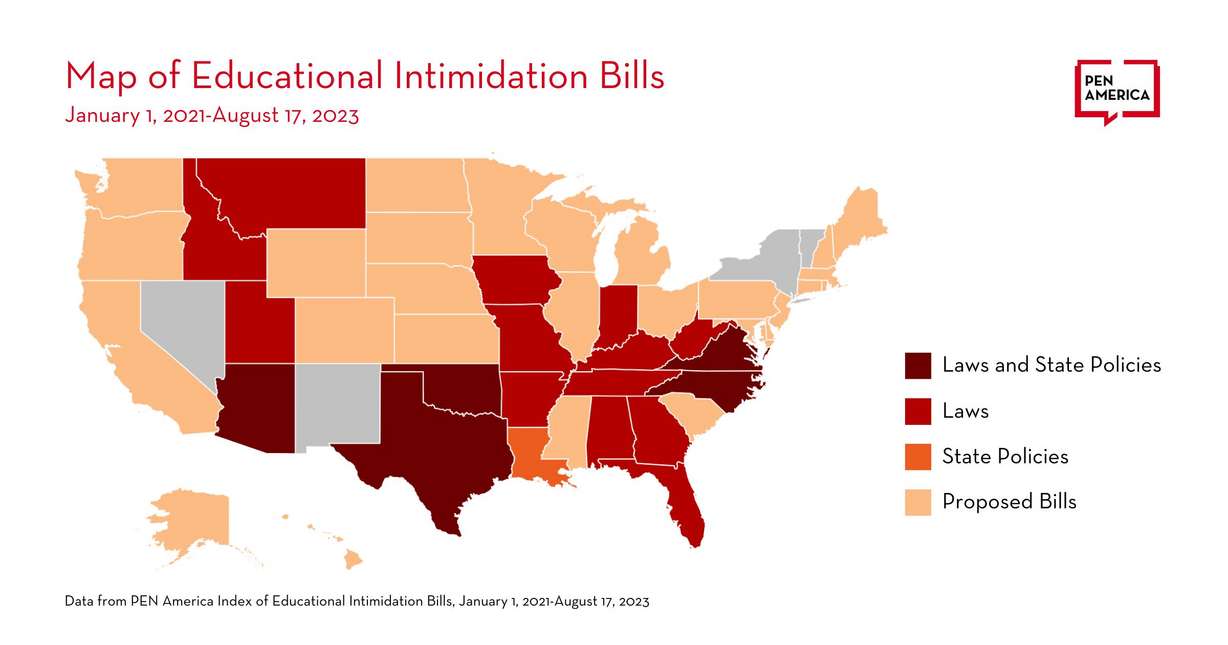
The nonprofit argues that these bills co-opt the heightened focus on the parental rights movement to spur self-censorship by making certain forms of instruction more burdensome or risky; for example, by creating opt-in or opt-out options for specific content or by creating new processes that make objections from parents and others easier to lodge.
"Many of these bills enable one parent to make decisions about what can be taught or read not just for their own child but for all children in a school or district," the report states. "As such, despite the common usage of 'parental rights' rhetoric, these bills actually disempower the majority of parents and empower an activist minority to make curricular decisions for all students in a school or district.
Utah ranked far lower when it came to the number of overall bills that were introduced (Missouri and Texas topped that list with 31 and 21, respectively).
The eight total bills in Utah were introduced exclusively by Republicans, with Sen. Todd. Weiler, R-Woods Cross, and Rep. Ken Ivory, R-West Jordan, sponsoring three and two, respectively.
The laws that did pass have already sparked controversy in Utah. For example, a 2022 bill that bans certain "sensitive materials" in school drew criticism from several districts who told lawmakers it has alienated teachers and exhausted resources. The bill later made national news after it was used to challenge whether the Bible should be allowed in schools.
Likewise, a handful of 2023 bills that targeted diversity, equity and inclusion received pushback from Democrats, higher education institutions, the NAACP Salt Lake Branch and businesses who said the bills' vagueness could encourage self-censorship and deepen existing inequities.
"Many of us from diverse backgrounds are exhausted right now of all these bills attacking diversity, equity and inclusion," House Minority Leader Angela Romero, D-Salt Lake City, said during a committee meeting on one of the bills. "And we're just done."
Meanwhile, Republican lawmakers who sponsored the bills and other supporters have argued critics were misinterpreting the bills.
"This is not about banning books," Weiler said told other lawmakers in defense of HB374. "It's about a good process for reviewing what books are appropriate in schools under the same standard already applied to students and other materials in our existing code."
The four Utah laws that Pen America identified are:
- HB374 (passed in 2022): Bans "sensitive materials" in schools and requires districts to evaluate objectionable content and report it to the Utah State Board of Education. School boards are supposed to consult parents "who are reflective of a school's community" when determining what materials are sensitive.
- SB100 (passed in 2023): Requires schools to receive parental consent before allowing a child to choose to go by a different name or pronoun on official records and states schools can't withhold a child's school records from parents.
- HB38 (passed in 2021): Stipulates that digital resource providers must block obscene materials or materials harmful to minors and requires schools to submit annual reports about any vendors' failures to block the materials.
- HB465 (passed in 2023): Requires school libraries to create an online platform where parents can view a complete history of what their child checks out.
Similar bills that did not pass included measures to give parents the right to inspect all curriculum and professional development materials, to require schools to post all proposed instructional material online before it's adopted, to require schools to remove materials that received complaints immediately pending a review and to require schools to post all syllabuses online prior to instruction.