'%3e%3cpath%20d='M34.1406%205.85938C30.3906%202.10547%2025.3047%200%2020%200C14.6953%200%209.60938%202.10547%205.85938%205.85938C2.10938%209.61328%200%2014.6953%200%2020C0%2025.3047%202.10547%2030.3906%205.85938%2034.1406C9.61328%2037.8906%2014.6953%2040%2020%2040C25.3047%2040%2030.3906%2037.8945%2034.1406%2034.1406C37.8906%2030.3906%2040%2025.3047%2040%2020C40%2014.6953%2037.8945%209.60938%2034.1406%205.85938ZM37.0117%2023.543H31.1602V13.5391H27.6328V19.9414C28.1211%2020.6914%2028.3711%2021.582%2028.3711%2022.5625V22.625C28.3711%2023.668%2028.1172%2024.6055%2027.6328%2025.4297V26.6094H36.082C33.4883%2032.9375%2027.2891%2037.3789%2020.0039%2037.3789C10.3711%2037.3789%202.62109%2029.6289%202.62109%2020C2.62109%2010.3711%2010.3711%202.62109%2020%202.62109C29.6289%202.62109%2037.3789%2010.3711%2037.3789%2020C37.3789%2021.1484%2037.2617%2022.2656%2037.0508%2023.3477C37.0391%2023.4141%2037.0234%2023.4766%2037.0117%2023.543Z'%20fill='white'/%3e%3cpath%20d='M22.3086%2018.5352C20.4336%2018.125%2019.9531%2017.8398%2019.9766%2017.1836V17.1406C19.9766%2016.6992%2020.3477%2016.2148%2021.4023%2016.2148C22.582%2016.2148%2023.8867%2016.6797%2025.0781%2017.4766L26.8516%2015.0195C25.4453%2013.8906%2023.707%2013.3398%2021.5547%2013.3398C18.5195%2013.3398%2016.4375%2015%2016.4063%2017.4766V17.5352C16.3633%2020.2617%2018.5859%2020.9805%2021.293%2021.6016C23.0391%2021.9766%2023.5703%2022.3164%2023.5703%2022.9609L23.5469%2022.9766C23.5469%2023.3906%2023.2578%2023.7031%2022.7852%2023.8359C22.5742%2023.9062%2022.1289%2023.9727%2021.5156%2023.9727C20.7617%2023.9727%2019.7539%2023.8633%2018.6328%2023.4844C18.0898%2023.2891%2017.4727%2023.0039%2016.8047%2022.6133L20.1406%2026.625C20.2813%2026.6602%2021.0977%2026.8516%2021.7734%2026.8516C25.0039%2026.8516%2027.0859%2025.2461%2027.1094%2022.6328V22.5703C27.1602%2020.1133%2025.2148%2019.1719%2022.3086%2018.5352Z'%20fill='white'/%3e%3cpath%20d='M5.24219%2013.5664V26.6133H8.75391V23.7578L10.2969%2021.9531L14.2031%2026.6133H18.3867L12.3555%2019.5195L17.4023%2013.5664H13.4531L8.75391%2019.0586V13.5664H5.24219Z'%20fill='white'/%3e%3c/g%3e%3cdefs%3e%3cclipPath%20id='clip0_97_2430'%3e%3crect%20width='40'%20height='40'%20fill='white'/%3e%3c/clipPath%3e%3c/defs%3e%3c/svg%3e)


Estimated read time: 4-5 minutes
This archived news story is available only for your personal, non-commercial use. Information in the story may be outdated or superseded by additional information. Reading or replaying the story in its archived form does not constitute a republication of the story.
SALT LAKE CITY — Jacob Sheffield and Ian Esplin, co-creators of the Sego Charger: the Origami Travel Solar Panel, posted their product on Kickstarter last week with the goal of receiving $10,000 in funding.
In just a week's time, the product has exceeded its goal fifteenfold — receiving over $150,000 in funding from private donations.
Esplin noted that "every penny of this Kickstarter campaign that we raised" would go toward manufacturing the product.
"We're both very pleasantly surprised by the success the campaign has had. It's done extremely well, better than I think, again, that we could have really hoped for," Esplin said. "I think it's a very compelling design; I think we really bring something new and that sets portable solar panels apart."
The Sego Charger is a small, compact device that folds into a square and can be stored in a backpack. When needed, it unfurls to a panel eight times its size, absorbing solar energy and providing power to campers, hikers and anyone exploring outdoors where they couldn't otherwise obtain needed power, Sheffield said.
And for the outdoorsy co-founders and adventurous Utahns, the product is perfect.
"Living in Salt Lake and growing up in Salt Lake, we have always enjoyed camping and backpacking and skiing," Esplin said. "I think it was just a natural sort of fit for us because of our love for the outdoors."
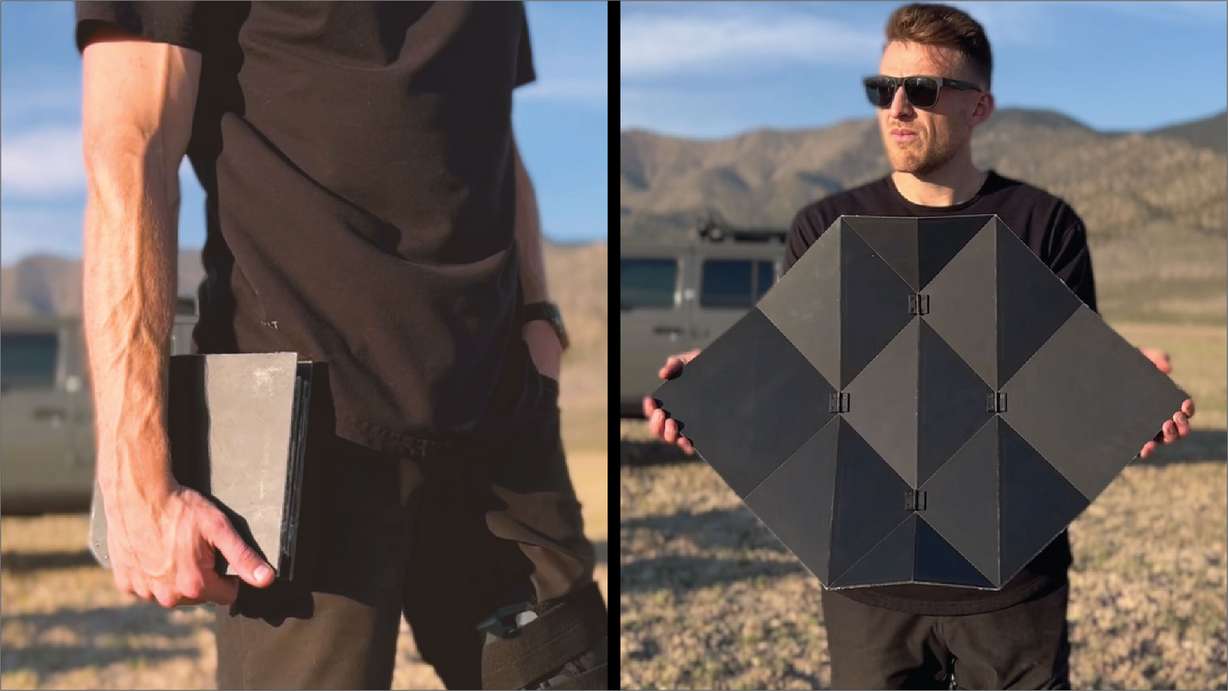
The idea was born when Sheffield and product engineer Diana Bolaños worked at Brigham Young University's Compliant Mechanisms Research Lab — where they performed mechanical engineering graduate projects and partnered with NASA. Bolaños worked with NASA directly and specialized in the space-based origami arrays, Esplin noted.
There, Bolaños and Sheffield worked to incorporate origami technology into satellites. The satellite would originally be a small, folded shape — but once the compact craft was sent into space, it would unfurl into the complete satellite, saving time, money and energy.
"We just saw how beneficial it was to have compactly stowed mechanisms for launch that could then be launched into space and unfurled out to have this great functionality," Sheffield said. "And the thought is, 'Wow, I mean, it's so compact, so space-efficient for this crazy application for space. Why can't there be other Earth-based options?'"
It was just last year when Sheffield and Esplin began working together to figure out how to best apply the technology, using LEGOs and fidget toys to experiment with how the product would look and how they would create it.
Most importantly, the creators wanted to put originality into the product.
"People rebrand solar panels and there are little innovations — but if you look at it from, you know, an uninformed perspective, they all kind of look the same," Sheffield said. "Really, when it comes down to it, they've been using the same design concept for the last two decades."
But when they finally formed the origami panel, Sheffield added how its originality brought "new and improved benefits to the table."
After they completed their prototype, the founders were not disappointed — after over 1,000 consumers and experts reviewed the concept and prototype for Sego Charger, they noted their satisfaction with its high quality and space efficiency, Sheffield said.
Sego Charger's portable nature is especially helpful during times when hikers and Utah adventurers would want to power their phones or any sources of light, protecting them in case of emergency.
"You harness the sun's energy coming in; it collects that energy, and then it has an output with a voltage and currents — which then gives you the power, which then you're able to either store in a battery system and then power your devices, or you could just power your devices directly," Sheffield said.
The original product will cost $289, and the premium carbon fiber version will cost $475, according to Esplin.
After the product finishes its funding period in 23 days, backers who supported the Kickstarter project will receive a Sego Charger and its carbon fiber counterpart — which will likely be shipped to them in May of 2024, Esplin said.
And the co-founders aren't planning on stopping with Sego. In fact, Esplin and Sheffield added that they'll be planning on continuing with other solar panel products or improving the current origami models.
"Jacob and I both have our sights set on additional products and making this a solid business and moving the product line forward — whether that's with more solar panel products, maybe larger wattage," Esplin said. "We want to make this an ongoing business."