'%3e%3cpath%20d='M34.1406%205.85938C30.3906%202.10547%2025.3047%200%2020%200C14.6953%200%209.60938%202.10547%205.85938%205.85938C2.10938%209.61328%200%2014.6953%200%2020C0%2025.3047%202.10547%2030.3906%205.85938%2034.1406C9.61328%2037.8906%2014.6953%2040%2020%2040C25.3047%2040%2030.3906%2037.8945%2034.1406%2034.1406C37.8906%2030.3906%2040%2025.3047%2040%2020C40%2014.6953%2037.8945%209.60938%2034.1406%205.85938ZM37.0117%2023.543H31.1602V13.5391H27.6328V19.9414C28.1211%2020.6914%2028.3711%2021.582%2028.3711%2022.5625V22.625C28.3711%2023.668%2028.1172%2024.6055%2027.6328%2025.4297V26.6094H36.082C33.4883%2032.9375%2027.2891%2037.3789%2020.0039%2037.3789C10.3711%2037.3789%202.62109%2029.6289%202.62109%2020C2.62109%2010.3711%2010.3711%202.62109%2020%202.62109C29.6289%202.62109%2037.3789%2010.3711%2037.3789%2020C37.3789%2021.1484%2037.2617%2022.2656%2037.0508%2023.3477C37.0391%2023.4141%2037.0234%2023.4766%2037.0117%2023.543Z'%20fill='white'/%3e%3cpath%20d='M22.3086%2018.5352C20.4336%2018.125%2019.9531%2017.8398%2019.9766%2017.1836V17.1406C19.9766%2016.6992%2020.3477%2016.2148%2021.4023%2016.2148C22.582%2016.2148%2023.8867%2016.6797%2025.0781%2017.4766L26.8516%2015.0195C25.4453%2013.8906%2023.707%2013.3398%2021.5547%2013.3398C18.5195%2013.3398%2016.4375%2015%2016.4063%2017.4766V17.5352C16.3633%2020.2617%2018.5859%2020.9805%2021.293%2021.6016C23.0391%2021.9766%2023.5703%2022.3164%2023.5703%2022.9609L23.5469%2022.9766C23.5469%2023.3906%2023.2578%2023.7031%2022.7852%2023.8359C22.5742%2023.9062%2022.1289%2023.9727%2021.5156%2023.9727C20.7617%2023.9727%2019.7539%2023.8633%2018.6328%2023.4844C18.0898%2023.2891%2017.4727%2023.0039%2016.8047%2022.6133L20.1406%2026.625C20.2813%2026.6602%2021.0977%2026.8516%2021.7734%2026.8516C25.0039%2026.8516%2027.0859%2025.2461%2027.1094%2022.6328V22.5703C27.1602%2020.1133%2025.2148%2019.1719%2022.3086%2018.5352Z'%20fill='white'/%3e%3cpath%20d='M5.24219%2013.5664V26.6133H8.75391V23.7578L10.2969%2021.9531L14.2031%2026.6133H18.3867L12.3555%2019.5195L17.4023%2013.5664H13.4531L8.75391%2019.0586V13.5664H5.24219Z'%20fill='white'/%3e%3c/g%3e%3cdefs%3e%3cclipPath%20id='clip0_97_2430'%3e%3crect%20width='40'%20height='40'%20fill='white'/%3e%3c/clipPath%3e%3c/defs%3e%3c/svg%3e)


Estimated read time: 5-6 minutes
This archived news story is available only for your personal, non-commercial use. Information in the story may be outdated or superseded by additional information. Reading or replaying the story in its archived form does not constitute a republication of the story.
SOUTH JORDAN — Small fishnets draped over seats, bubbles hung from the ceiling, and a sparkly blue flooring decorated the South Jordan Megaplex theater as dozens of families, many with children of color, packed the seats — creating a world that, despite the oxygen, most definitely was "under the sea."
Outside the theatre, Kortney King-Lives sat dressed up as Ariel, her smile bright as little girls, teenagers, and parents stood in line to take pictures with her.
"I'm really excited to see it; I like that they made (Ariel) Black — it's pretty cool. I never thought they'd do that," said Nora Whitaker, an 11-year-old girl. "I loved watching 'The Little Mermaid' as a kid, and when I was little, I was like, 'Huh, why don't they have a lot of Black Disney princesses?'"
The Raising Me Foundation, a nonprofit organization that empowers children and parents united through transracial adoption or interracial families, hosted the private screening of Disney's "The Little Mermaid" this Thursday and Friday.
Other sponsors that contributed to the screening include the Larry H. & Gail Miller Family Foundation, the Larry H. Miller Megaplex Theatres, Raise the Future, Curly Me, L3Harris, Focal Point, Rise Virtual Academy and Enso Rings.
"We are pleased to sponsor 'The Little Mermaid' screening event at Larry H. Miller Megaplex Theatres and recognize the importance of fostering community and belonging for (Black, Indigenous and people of color) children and their families," said the Larry H. Miller Family Foundation in a statement.
Raising Me Foundation began after Bri Ray Aupiu, the now president and founder of the organization, noted how it was difficult growing up in a biracial family in Utah, where even though she had a loving family, it was difficult to find a successful female Black role model.
Aupiu set up the nonprofit to better help other children of color, as well as parents, have access to the education and resources they need to build bridges between communities. She also said the movie showed unique symbolism where, just like how the mermaid and human world came together, different cultures and communities can come together as well.
"I got kind of emotional when she was singing her 'Part of Your World' song, because growing up Black in Utah, I remember wanting to speak differently, wanting to act differently, wanting to feel differently about myself, and to just become what I was surrounded by," Aupiu said. "And thinking that's what I wanted so badly, and that was my identity to be part of someone else's world, and not really feeling like I had a space, especially as a mixed woman."
And with 61,000 Utahns classifying as biracial or multiracial — and 50% of those Utahns being under the age of 18 — guidance, love, and representation are needed more than ever, according to Raising Me.
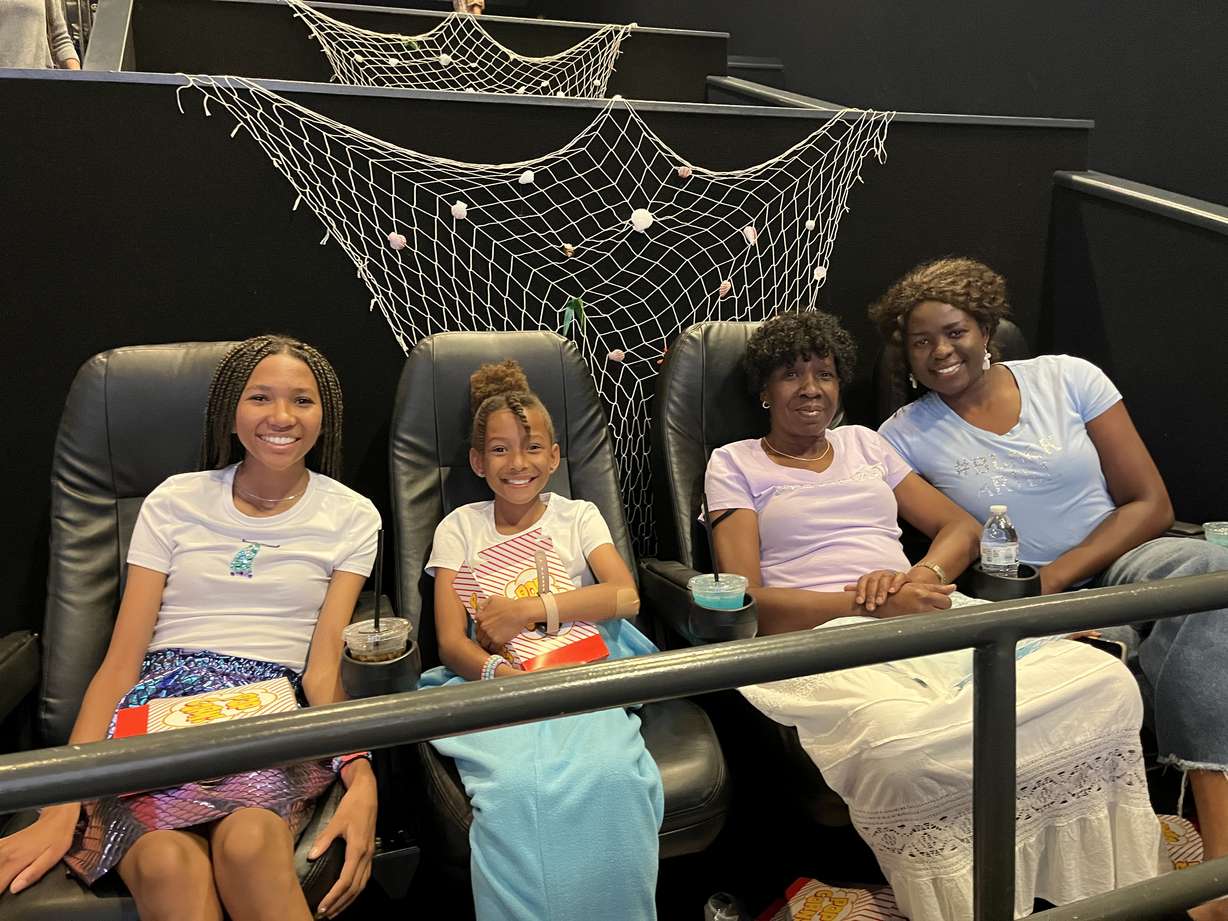
"This representation is so important — and all these little girls being able to see this beautiful princess with a beautiful voice and dreadlocks in her hair like — I wish I would have had that as a kid," said Hannah Rowntree, Raising Me Foundation's communications specialist. "I remember wanting to play princesses with my friends, and I couldn't choose any of the princesses to be."
Malaika Bennett, president of Providence High School's Black Student Union, noted that she especially appreciated Ariel's hair.
"Especially the type of hair she portrays. Many people outside see it as weird, 'ghetto,' different words for it, but at the same time, it's representing who we are, what we are, and Black excellence and beauty," Bennett said.
Rowntree explained that as a kid, she felt she had to conform to white beauty standards and white culture — and how it has harmed her sense of confidence even today. A movie with a Black Disney princess, however, can show another sense of beauty, Rowntree said.
"It just shows them that like they can be beautiful too and that their natural hair or their braids and their faux locs are beautiful, and their skin is beautiful — and that they matter," Rowntree said. "We haven't had anything like this."
Bryjé Adu-Akumatey, president of Corner Canyon's Black Student Union, said in Utah, it can be difficult to be oneself, especially in a state with a larger population percentage of white people, but it's important for kids to remember how to be themselves and avoid masking.
"Try to be yourself and express that in a way that you're not masking it because it's a white state, but we need to remember that we are Black people, so we can't just try and blend in. And lots of times, there will be times when it's like you feel like you want to blend in, or you can't blend in, but you just need to know where you stand and remember who you are," Adu-Akumatey said.
As Ariel lost her voice in the movie, it can be synonymous with Black people losing their voice and parts of who they are to fit in with another community, Aupiu said.
"She did lose pieces of who she was to fit where she wanted to belong — when in reality, she already belonged in that space, just as much as she belonged under the sea," Aupiu said. "She was what belongs; it had nothing to do with the environment. And it's such a powerful message of self-identity."
Aupiu also said that while there has been some backlash against the movie with the lead actress Halle Bailey being Black, it is important to build bridges between communities and empower people as who they are.
"We don't have to transform; we don't have to change our communities to become one community. We can keep all of the unique things that make us who we are and that make our cultures special, that makes our histories unique and special — that makes us who we are," Aupiu said. "That's the power that we're bringing into our community. And it doesn't make sense that we have to strip pieces away from anybody to be able to come together as one."
Correction: An earlier version incorrectly referred to one of the sponsors as LJHarris instead of L3Harris.