'%3e%3cpath%20d='M34.1406%205.85938C30.3906%202.10547%2025.3047%200%2020%200C14.6953%200%209.60938%202.10547%205.85938%205.85938C2.10938%209.61328%200%2014.6953%200%2020C0%2025.3047%202.10547%2030.3906%205.85938%2034.1406C9.61328%2037.8906%2014.6953%2040%2020%2040C25.3047%2040%2030.3906%2037.8945%2034.1406%2034.1406C37.8906%2030.3906%2040%2025.3047%2040%2020C40%2014.6953%2037.8945%209.60938%2034.1406%205.85938ZM37.0117%2023.543H31.1602V13.5391H27.6328V19.9414C28.1211%2020.6914%2028.3711%2021.582%2028.3711%2022.5625V22.625C28.3711%2023.668%2028.1172%2024.6055%2027.6328%2025.4297V26.6094H36.082C33.4883%2032.9375%2027.2891%2037.3789%2020.0039%2037.3789C10.3711%2037.3789%202.62109%2029.6289%202.62109%2020C2.62109%2010.3711%2010.3711%202.62109%2020%202.62109C29.6289%202.62109%2037.3789%2010.3711%2037.3789%2020C37.3789%2021.1484%2037.2617%2022.2656%2037.0508%2023.3477C37.0391%2023.4141%2037.0234%2023.4766%2037.0117%2023.543Z'%20fill='white'/%3e%3cpath%20d='M22.3086%2018.5352C20.4336%2018.125%2019.9531%2017.8398%2019.9766%2017.1836V17.1406C19.9766%2016.6992%2020.3477%2016.2148%2021.4023%2016.2148C22.582%2016.2148%2023.8867%2016.6797%2025.0781%2017.4766L26.8516%2015.0195C25.4453%2013.8906%2023.707%2013.3398%2021.5547%2013.3398C18.5195%2013.3398%2016.4375%2015%2016.4063%2017.4766V17.5352C16.3633%2020.2617%2018.5859%2020.9805%2021.293%2021.6016C23.0391%2021.9766%2023.5703%2022.3164%2023.5703%2022.9609L23.5469%2022.9766C23.5469%2023.3906%2023.2578%2023.7031%2022.7852%2023.8359C22.5742%2023.9062%2022.1289%2023.9727%2021.5156%2023.9727C20.7617%2023.9727%2019.7539%2023.8633%2018.6328%2023.4844C18.0898%2023.2891%2017.4727%2023.0039%2016.8047%2022.6133L20.1406%2026.625C20.2813%2026.6602%2021.0977%2026.8516%2021.7734%2026.8516C25.0039%2026.8516%2027.0859%2025.2461%2027.1094%2022.6328V22.5703C27.1602%2020.1133%2025.2148%2019.1719%2022.3086%2018.5352Z'%20fill='white'/%3e%3cpath%20d='M5.24219%2013.5664V26.6133H8.75391V23.7578L10.2969%2021.9531L14.2031%2026.6133H18.3867L12.3555%2019.5195L17.4023%2013.5664H13.4531L8.75391%2019.0586V13.5664H5.24219Z'%20fill='white'/%3e%3c/g%3e%3cdefs%3e%3cclipPath%20id='clip0_97_2430'%3e%3crect%20width='40'%20height='40'%20fill='white'/%3e%3c/clipPath%3e%3c/defs%3e%3c/svg%3e)





Estimated read time: 7-8 minutes
This archived news story is available only for your personal, non-commercial use. Information in the story may be outdated or superseded by additional information. Reading or replaying the story in its archived form does not constitute a republication of the story.
LEHI — In 2022, 15 bicyclists died in collisions in Utah — including three children — and 49 bicyclists suffered serious injuries.
Intermountain Health said last year was the deadliest for bicycle accidents since the Utah Department of Public Safety began keeping track of the statistic. Over 2,700 bicycle-related injuries in Intermountain emergency departments in Utah and Idaho last year, and it's expected injuries will rise during the summer as more people go outside.
At a news conference Friday alongside the Murdock Canal Trail in Lehi, Intermountain's safety and trauma teams urged riders to wear a helmet and stay safe.
"Kids and adults can be seriously injured, sometimes fatally, if they fall while riding. ... People involved in accidents wearing helmets are far more likely to survive than those who don't. And those who choose not to wear a helmet can end up with a lot of recovery time or don't recover at all," said Dr. D Millar, a trauma surgeon and Utah Valley Hospital's trauma medical director.
Millar said traumatic brain injuries can be life-altering, and brain injuries are not fixable like broken bones. But he said a large majority of traumatic injuries could be prevented with helmets or seat belts with some planning before getting on the bike, ATV or motorcycle.
"We're seeing a lot of injuries that are preventable, just with a little extra, you know, thought for safety beforehand. ... While you're thinking about how much fun this is going to be, you also have to think, 'What are the ways that I could possibly be injured while riding this vehicle or participating in this activity?'" he said.
Millar noted that many injuries happen when people don't consider their ability or when they try to "go big." He gave examples of a dad riding a child's electric scooter or an elderly person getting up on a ladder, and he encouraged people to be aware of their limitations and the risks of an activity.
Although many Utahns live in a bike-friendly environment with lots of trails and bike lanes, Millar said bicyclists need to act like they are invisible to drivers and stay aware that there are other people on trails. He urged special caution to those using electric bikes or scooters, which go faster and often have more inexperienced riders.
Tragedy on the Murdoch Canal Trail
Millar said there was a tragic situation with two deaths on the Murdock Canal Trail in Cedar Hills last year after two men collided and suffered fatal brain injuries. One man was an experienced rider who was riding a road bike and wearing a helmet, while the other was an inexperienced rider on an e-bike without a helmet.
The collision happened near an underpass where the light changes drastically, causing vision changes and disturbances. Millar said the two likely came toward each other head-on.
"When you're on the trail, you just, you have to trust no one and look out for your own safety and the safety of others. It needs to be a culture of safety as you ride; it's part of riding responsibly," Millar said.
That crash happened on June 26 at about 8:30 a.m., a police report said. Kevin Petersen, 66, was unconscious and receiving aid from a paramedic when officers arrived; Quoc Lieu, 49, was semi-conscious and also receiving aid from medical responders.
Both men were taken to the hospital with severe head injuries, and both died the next day after doctors and nurses spent over 24 hours trying to save them.
When you're on the trail, you just, you have to trust no one and look out for your own safety and the safety of others. It needs to be a culture of safety as you ride; it's part of riding responsibly.
–Dr. D Millar, Utah Valley Hospital
Police detective Kadence Konecny later studied a video from a camera attached to Petersen's helmet, which showed he was traveling between 20 and 30 mph on the trail as he entered a tunnel, and he slowed down as he exited the tunnel on the right side of the trail, but close to the center.
"It appears the sun is shining into the tunnel where (Petersen) is exiting, and (Petersen) does not appear to be able to see (Lieu) beginning his descent into the tunnel," the detective said.
In the video, it appears that Lieu is traveling between 10 and 15 mph, also on the right side of the trail but near the center, and although Lieu starts to swerve to avoid a collision, their left sides collided, the report said. Petersen was thrown off the front of his bike and landed on the concrete.
Not just bikes
Andrew Herrera, a nurse who works as a trauma outreach coordinator for Utah Valley Hospital, said it is not just bikers who need to exercise caution — the trail is popular with walkers, joggers, electronic bikers and people on scooters. He said the more people there are on the trail, the more potential there is for an impact.
"We're seeing more and more (impacts), either interacting with cars or other cyclists," he said.
Herrera said head injuries and broken bones are very common with these collisions. He said with the electronic bikes and scooters their speed can be very concerning; and if riders are not wearing protective gear, like a helmet, they are more likely to have a catastrophic injury.
Regarding the fatal collision on the Murdoch Trail, Herrera said, "What it all comes down to is two people lost their lives and two families were significantly impacted — and that's devastating for them, as well as us as a community. We don't want to lose any of our community members to accidents like this when we just need to be a little bit more cautious."
He also said "mindfulness and awareness of where you are" are very important, and he encouraged riders or people on the busy trail to make sure they are looking ahead for obstacles, including wildlife and dogs that might not be on a leash.
"We all want to be able to use these resources that we have, and make sure that we're doing it safely," Herrera said.
Safety for children and youth
Adam Stewart, 15, who is on the Lehi High School Mountain Bike Team, said he was feeling really strong during the state championship race and expected to finish in the top 10. But when he sped up to catch riders in front of him, he hit a patch of sand, wiped out and hit his head hard.
Stewart said he hopped back on the bike and continued racing for a medal, but 2 miles later he crashed again. He said his peripheral vision was narrowing.
"I couldn't really see, and I was getting kind of dizzy, and I just didn't feel good," he said.
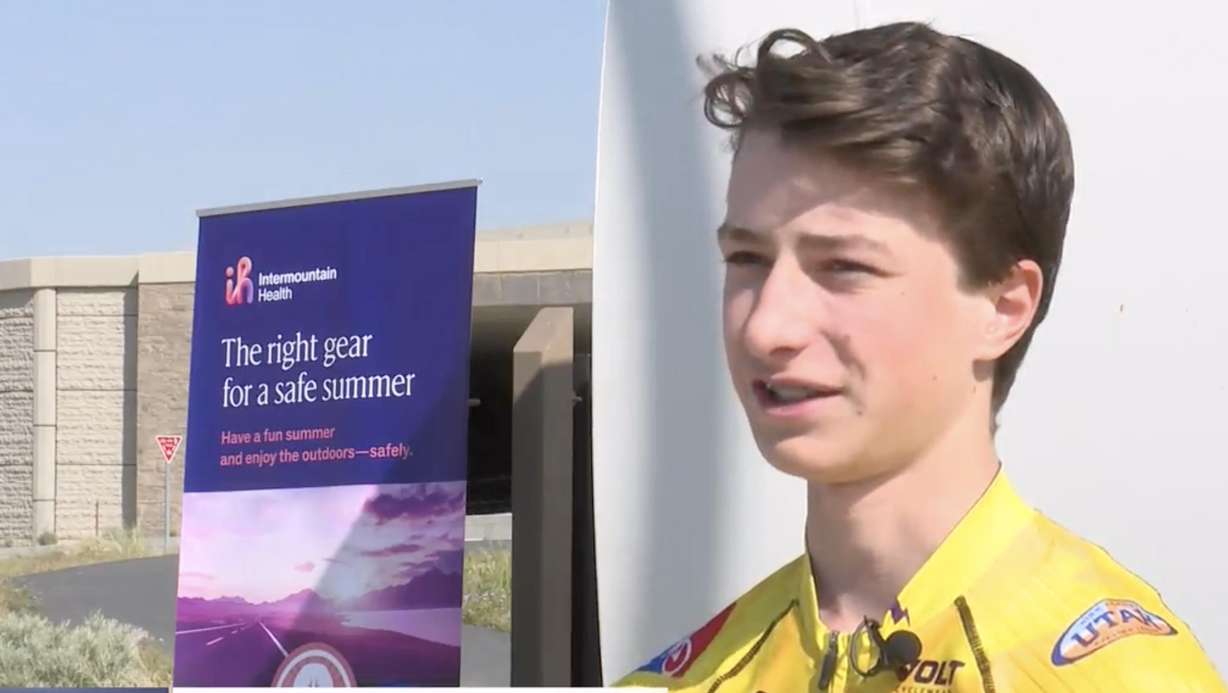
Stewart went to the medical tent after finishing the race and was sent to a doctor, where he was diagnosed with a concussion. His speech was slurred for a few days while he recovered.
"Wearing a helmet definitely prevented a more serious head injury from happening," he said.
His mom, Tiffany Stewart, agrees. She said the high school cycling teams have a rule that if a student's leg is over the bar, their helmet is buckled — and checking straps and adjusting the helmet is also important.
"It's a growing sport, and I think there's always opportunity to do a helmet check," she said.
Michelle Jamison, community health programs manager at Primary Children's Hospital, encouraged parents to make sure a helmet is readily available to their children by leaving it on the handles of their bike or scooter and to follow the "2-2-2 rule" for helmet fit. This means having the helmet two finger-widths above the eyebrows, with straps fitting like a V-shape with two fingers around the ear, and two fingers placed next to each other should be all that fits under the chin.
"It's important that every rider have a good-fitting helmet and parents should help their child put it on before every ride, every time," she said.
She said helmets expire, so they should be replaced, and they are also single-use — if there is a crash, the helmet should be replaced.
On Saturday, caregivers from Utah Valley Hospital, Intermountain American Fork and Primary Children's Hospital will be at four locations along the Murdock Canal Trail to help people make sure their helmets fit correctly and give information and safety demonstrations.
Millar said they are hoping to create a sense of awareness through the event and promote bike safety and wearing helmets for everyone, but especially for those on scooters and electric scooters, which have the same risk for injury but whose riders don't often wear protective gear.