'%3e%3cpath%20d='M34.1406%205.85938C30.3906%202.10547%2025.3047%200%2020%200C14.6953%200%209.60938%202.10547%205.85938%205.85938C2.10938%209.61328%200%2014.6953%200%2020C0%2025.3047%202.10547%2030.3906%205.85938%2034.1406C9.61328%2037.8906%2014.6953%2040%2020%2040C25.3047%2040%2030.3906%2037.8945%2034.1406%2034.1406C37.8906%2030.3906%2040%2025.3047%2040%2020C40%2014.6953%2037.8945%209.60938%2034.1406%205.85938ZM37.0117%2023.543H31.1602V13.5391H27.6328V19.9414C28.1211%2020.6914%2028.3711%2021.582%2028.3711%2022.5625V22.625C28.3711%2023.668%2028.1172%2024.6055%2027.6328%2025.4297V26.6094H36.082C33.4883%2032.9375%2027.2891%2037.3789%2020.0039%2037.3789C10.3711%2037.3789%202.62109%2029.6289%202.62109%2020C2.62109%2010.3711%2010.3711%202.62109%2020%202.62109C29.6289%202.62109%2037.3789%2010.3711%2037.3789%2020C37.3789%2021.1484%2037.2617%2022.2656%2037.0508%2023.3477C37.0391%2023.4141%2037.0234%2023.4766%2037.0117%2023.543Z'%20fill='white'/%3e%3cpath%20d='M22.3086%2018.5352C20.4336%2018.125%2019.9531%2017.8398%2019.9766%2017.1836V17.1406C19.9766%2016.6992%2020.3477%2016.2148%2021.4023%2016.2148C22.582%2016.2148%2023.8867%2016.6797%2025.0781%2017.4766L26.8516%2015.0195C25.4453%2013.8906%2023.707%2013.3398%2021.5547%2013.3398C18.5195%2013.3398%2016.4375%2015%2016.4063%2017.4766V17.5352C16.3633%2020.2617%2018.5859%2020.9805%2021.293%2021.6016C23.0391%2021.9766%2023.5703%2022.3164%2023.5703%2022.9609L23.5469%2022.9766C23.5469%2023.3906%2023.2578%2023.7031%2022.7852%2023.8359C22.5742%2023.9062%2022.1289%2023.9727%2021.5156%2023.9727C20.7617%2023.9727%2019.7539%2023.8633%2018.6328%2023.4844C18.0898%2023.2891%2017.4727%2023.0039%2016.8047%2022.6133L20.1406%2026.625C20.2813%2026.6602%2021.0977%2026.8516%2021.7734%2026.8516C25.0039%2026.8516%2027.0859%2025.2461%2027.1094%2022.6328V22.5703C27.1602%2020.1133%2025.2148%2019.1719%2022.3086%2018.5352Z'%20fill='white'/%3e%3cpath%20d='M5.24219%2013.5664V26.6133H8.75391V23.7578L10.2969%2021.9531L14.2031%2026.6133H18.3867L12.3555%2019.5195L17.4023%2013.5664H13.4531L8.75391%2019.0586V13.5664H5.24219Z'%20fill='white'/%3e%3c/g%3e%3cdefs%3e%3cclipPath%20id='clip0_97_2430'%3e%3crect%20width='40'%20height='40'%20fill='white'/%3e%3c/clipPath%3e%3c/defs%3e%3c/svg%3e)





Estimated read time: 4-5 minutes
This archived news story is available only for your personal, non-commercial use. Information in the story may be outdated or superseded by additional information. Reading or replaying the story in its archived form does not constitute a republication of the story.
SALT LAKE CITY — A tight-knit medical community in Utah is sharing its thoughts and talking about how to move forward after a well-known doctor in its field killed his son, then himself at his clinic.
In a place to promote healing, Dr. Emily Bullock offers the space for people to process at her psychotherapy clinic in Woods Cross.
"All different kinds of traumatic events that people have gone through, sometimes from long ago, sometimes current, sometimes accidents, sometimes sexual trauma, military trauma, things like that," Bullock explained.
The kinds of therapy found in her clinic include eye movement desensitization and reprocessing therapy, assisted psychotherapy, clinical yoga and ketamine.
"Ketamine is used as a tool to help people in their therapy to be able to accomplish whatever their goal is that they're working on in their treatment," she said.
She's seen clients who utilize ketamine as medicine and has found it brings "a lot of hope and promise" to their lives.
"These psychedelic medicines and ketamine specifically — which is the one that's FDA approved right now — have been incredibly beneficial and impactful for people in their lives when they're used as a tool to aid them in their recovery or their mental health journeys," Bullock said.
Something else has been impacting her this week, as those in the psychedelic medicine community talk, discuss and express emotions following what took place at a different clinic over the weekend.
"When you hear about a tragedy like this, it's very confusing. It's very distressing," Bullock said.
It's terribly upsetting for everyone in the psychology community, in the medical community, in the psychedelic medicine field.
–Dr. Emily Bullock
Police said Dr. Parth Gandhi died by suicide after shooting and killing his 16-year-old son inside Salt Lake City Psychedelic Therapy and Research on Saturday. It's unknown if any substances were used prior.
Gandhi was known in the healing world for his work with psychedelics, specifically as they relate to autism, concussions, addiction and depression.
"It's terribly upsetting for everyone in the psychology community, in the medical community, in the psychedelic medicine field," Bullock expressed.
Dr. Scott Allen, a physician and anesthesiologist who runs a psychedelic medicine clinic, knew Gandhi.
"Dr. Gandhi was a fairly influential educator within the psychedelic movement within Utah and sort of nationally to here," he said. "He led a fairly large training course that a lot of people attended."
He indicated how the people who are used to helping others are now working themselves to process this terrible event.
Related:

Father, teen son died in murder-suicide, Salt Lake police say
Salt Lake police say the bodies of two people found inside an office building Saturday are a father and son who died as a result of a murder-suicide."We're trying to figure out a way going forward in which we can help support each other," he said.
Allen said he and colleagues would host their next professional journal club in a couple of weeks and have been discussing ways to support each other's thoughts, feelings and emotions as they work to take care of other physicians.
"We've been discussing ways that we can offer services to people and have a venue for people to kind of talk about what they're feeling personally," he said.
He said this one tragic act does not represent the psychedelic medicine community as a whole.
"Psychedelics, in general, tend to promote a lot of feelings of love, of connectedness, oneness with the universe. That's usually what people experience is, is more love and more compassion for other people, more empathy. That's usually what we, what we see," Allen said. "And so, for somebody involved with the psychedelic community, I think it kind of compounds the shock of it because most of us who have engaged with it, we're like, 'Wow, these substances make us so loving towards others.'"
Bullock, who specializes in working with complex trauma and led the Traumatic Stress Response Team in the U.S. Air Force, explained that in horrible traumas like this, it's normal to experience a range of different emotions, and she talked about how crucial it is to reach out, get support, and speak with others.
"It's so, so important to be able to take care of yourself and your basic needs following a tragedy," she said. "But then also, getting the right kind of help and support immediately and thereafter."
For anyone wanting to reach out for services, Bullock said the Utah Psychological Association is always available and is currently on standby to be able to refer people affected by last weekend's events to the appropriate agency.
She said anyone in a dangerous or emergency situation should call 911, and there's also the 988 mental health emergency line. That line will link people to a crisis response center, and the center can deploy a team of mental health experts to intervene. The 24/7, free, confidential domestic violence hotline is also at 1-800-897-LINK.
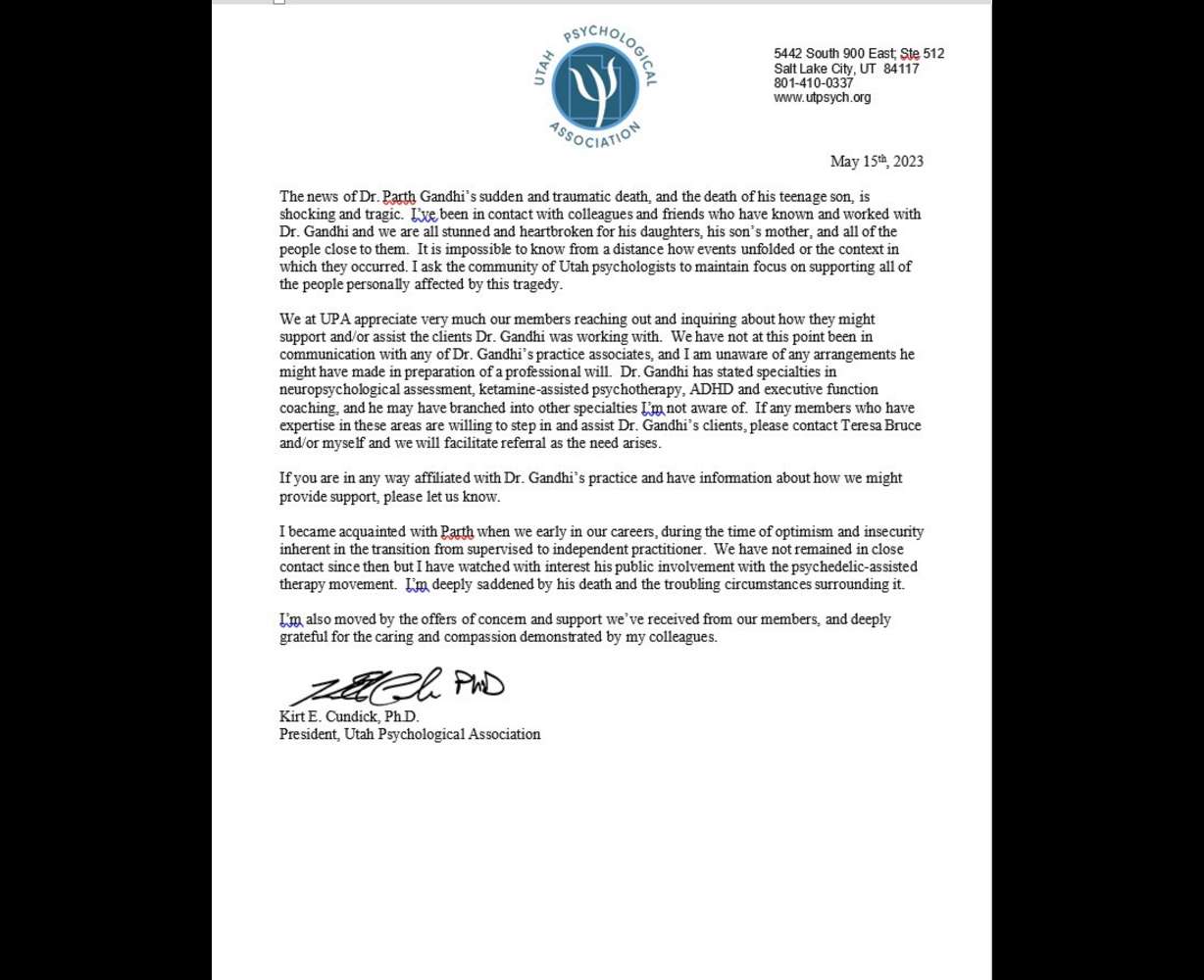
The Utah Psychological Association released the statement below in response to the situation. It explains the group's sorrow for Gandhi's daughters, his son's mother and others close to them, and how they're ready to help his clients.
Suicide prevention resources
If you or someone you know is struggling with thoughts of suicide, call 988 to connect with the 988 Suicide and Crisis Lifeline.
Crisis Hotlines
- Huntsman Mental Health Institute Crisis Line: 801-587-3000
- SafeUT Crisis Line: 833-372-3388
- 988 Suicide and Crisis LifeLine at 988
- Trevor Project Hotline for LGBTQ teens: 1-866-488-7386
Online resources
- NAMI Utah: namiut.org
- SafeUT: safeut.org
- Suicide Prevention Lifeline: www.suicidepreventionlifeline.org
- American Foundation for Suicide Prevention, Utah chapter: afsp.org/chapter/utah
Warning signs
Warning signs of suicide
- Talking about wanting to die
- Looking for a way to kill oneself
- Talking about feeling hopeless or having no purpose
- Talking about feeling trapped or in unbearable pain
- Talking about being a burden to others
- Increasing the use of alcohol or drugs
- Acting anxious, agitated or recklessly
- Sleeping too little or too much
- Withdrawing or feeling isolated
- Showing rage or talking about seeking revenge
- Displaying extreme mood swings
The more of these signs a person shows, the greater the risk. Warning signs are associated with suicide but may not be what causes a suicide.
Information from the American Foundation for Suicide Prevention.
What to do if you see warning signs of suicide
- Do not leave the person alone
- Remove any firearms, alcohol, drugs or sharp objects that could be used in a suicide attempt
- Call the U.S. National Suicide Prevention Lifeline at 800-273-TALK (8255)
- Take the person to an emergency room or seek help from a medical or mental health professional
Information from the American Foundation for Suicide Prevention.