'%3e%3cpath%20d='M34.1406%205.85938C30.3906%202.10547%2025.3047%200%2020%200C14.6953%200%209.60938%202.10547%205.85938%205.85938C2.10938%209.61328%200%2014.6953%200%2020C0%2025.3047%202.10547%2030.3906%205.85938%2034.1406C9.61328%2037.8906%2014.6953%2040%2020%2040C25.3047%2040%2030.3906%2037.8945%2034.1406%2034.1406C37.8906%2030.3906%2040%2025.3047%2040%2020C40%2014.6953%2037.8945%209.60938%2034.1406%205.85938ZM37.0117%2023.543H31.1602V13.5391H27.6328V19.9414C28.1211%2020.6914%2028.3711%2021.582%2028.3711%2022.5625V22.625C28.3711%2023.668%2028.1172%2024.6055%2027.6328%2025.4297V26.6094H36.082C33.4883%2032.9375%2027.2891%2037.3789%2020.0039%2037.3789C10.3711%2037.3789%202.62109%2029.6289%202.62109%2020C2.62109%2010.3711%2010.3711%202.62109%2020%202.62109C29.6289%202.62109%2037.3789%2010.3711%2037.3789%2020C37.3789%2021.1484%2037.2617%2022.2656%2037.0508%2023.3477C37.0391%2023.4141%2037.0234%2023.4766%2037.0117%2023.543Z'%20fill='white'/%3e%3cpath%20d='M22.3086%2018.5352C20.4336%2018.125%2019.9531%2017.8398%2019.9766%2017.1836V17.1406C19.9766%2016.6992%2020.3477%2016.2148%2021.4023%2016.2148C22.582%2016.2148%2023.8867%2016.6797%2025.0781%2017.4766L26.8516%2015.0195C25.4453%2013.8906%2023.707%2013.3398%2021.5547%2013.3398C18.5195%2013.3398%2016.4375%2015%2016.4063%2017.4766V17.5352C16.3633%2020.2617%2018.5859%2020.9805%2021.293%2021.6016C23.0391%2021.9766%2023.5703%2022.3164%2023.5703%2022.9609L23.5469%2022.9766C23.5469%2023.3906%2023.2578%2023.7031%2022.7852%2023.8359C22.5742%2023.9062%2022.1289%2023.9727%2021.5156%2023.9727C20.7617%2023.9727%2019.7539%2023.8633%2018.6328%2023.4844C18.0898%2023.2891%2017.4727%2023.0039%2016.8047%2022.6133L20.1406%2026.625C20.2813%2026.6602%2021.0977%2026.8516%2021.7734%2026.8516C25.0039%2026.8516%2027.0859%2025.2461%2027.1094%2022.6328V22.5703C27.1602%2020.1133%2025.2148%2019.1719%2022.3086%2018.5352Z'%20fill='white'/%3e%3cpath%20d='M5.24219%2013.5664V26.6133H8.75391V23.7578L10.2969%2021.9531L14.2031%2026.6133H18.3867L12.3555%2019.5195L17.4023%2013.5664H13.4531L8.75391%2019.0586V13.5664H5.24219Z'%20fill='white'/%3e%3c/g%3e%3cdefs%3e%3cclipPath%20id='clip0_97_2430'%3e%3crect%20width='40'%20height='40'%20fill='white'/%3e%3c/clipPath%3e%3c/defs%3e%3c/svg%3e)




Estimated read time: 5-6 minutes
This archived news story is available only for your personal, non-commercial use. Information in the story may be outdated or superseded by additional information. Reading or replaying the story in its archived form does not constitute a republication of the story.
SALT LAKE CITY – Sara Malohifo'ou and several other family members got her daughter Isa Malohifu'ou ready to receive her diploma at the 2021 Granger High School graduation. Due to the family's Tongan heritage, getting Isa ready included dressing her in a "ta'ovala," which is an ornamental cloth worn during formal occasions, as well as a lei around her neck and one under her cap.
Three years earlier, Sara Malohifo'ou's son, Finehafo'ou "Fine" Malohifo'ou, was dressed similarly for his own graduation ceremony at Westlake High School. His experience, however, was much different.
Fine was not allowed to wear any leis, and when it was time to receive his diploma, he was asked to remove his ta'ovala.
That incident in 2018 gained national attention, even prompting a school official to issue an apology, Sara Malohifo'ou said.
Even so, current rules at Westlake High School still prohibit leis worn at graduation. Due to that, parents and students have started a petition on Change.org that calls for schools to allow students to wear cultural attire at graduation.
The petition, which now has at least 11,000 signatures, features Finehafo'ou Malohifo'ou adorned in flower leis that were draped on him after his graduation.
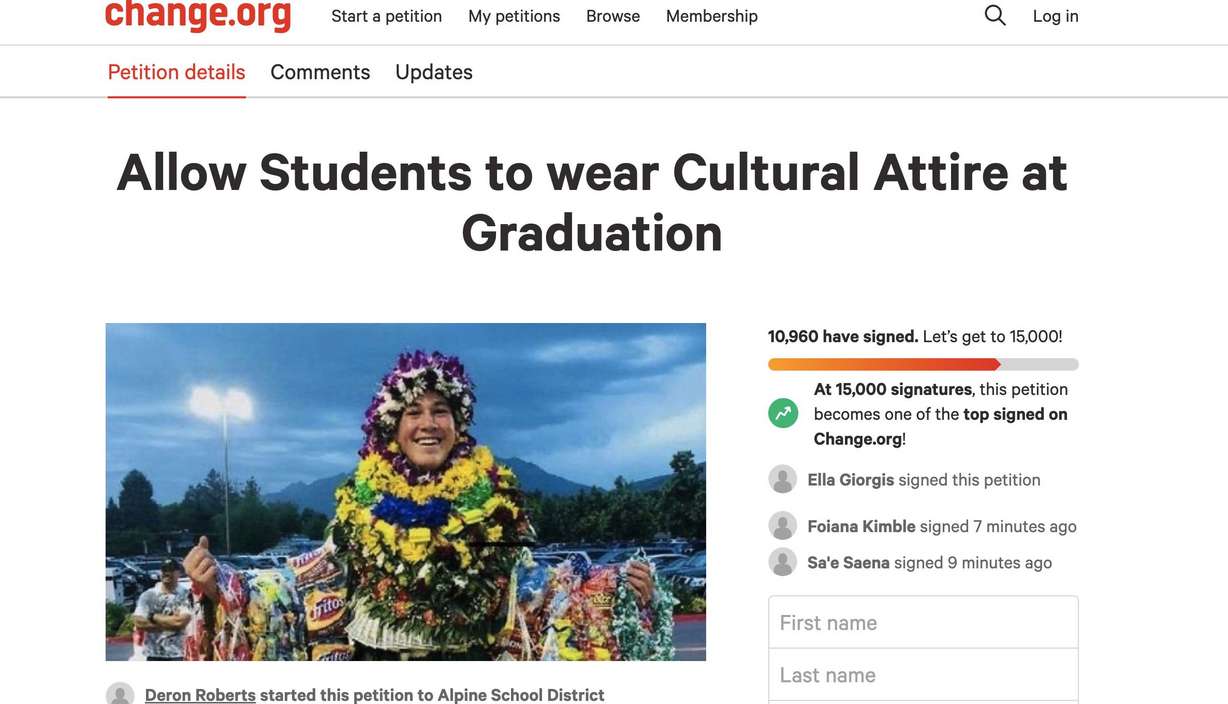
The petition says that a "no lei policy" affects many students with cultural heritage, specifically in the Alpine and Jordan school districts.
"This policy did not just affect Pacific Islander students; it affected anyone and everyone who tried to wear anything of their cultural identity like Natives who were not allowed to wear Regalia, which is something that is a part of their culture," the petition states.
And while neither district has such a policy, certain schools like Westlake High School have specified that "leis CANNOT be worn during graduation."
More than just flowers
Sara Malohifu'ou said that allowing students like her children to wear cultural attire, including leis, is not a fashion statement.
"Any time you put a lei on, it's showing love," Sara Malohifo'ou said. "It's family. It represents family — generations before you — who are there with you. It's a celebration for the entire family. It's a way of connecting generations, and having your ancestors there with you."
Sarah Malohifo'ou spoke about complying with the rule for no leis when her son graduated in 2018, but feeling upset that her son was silenced for wanting to represent his culture by still wearing his ta'ovala.
"The ta'ovala was under his gown, so nobody would have ever known," Sara Malohifo'ou explained. "When he opened up his gown, they told him to take it off, and he said, 'This is my culture. This is really important that I wear this.'
"When Fine came out holding the ta'ovala, it was upsetting to everybody. It was my first real taste, as a mother, of discrimination. Making him do something because it was different — because his culture was different. I was upset about it. These are 18-year-old graduating students who we are sending out into the world, but you aren't listening to what they're saying. It's just like, how are you going to take their voice away and expect them to have one going into adulthood?"
A stark contrast
Sara Malohifo'ou explained that Granger High School allowing cultural wear including leis to be worn at her daughter's graduation last year improved the overall experience.
"The Granger graduation was so diverse," Sara Malohifo'ou said. "There were so many different beautiful cultures. There were Latinas and Hispanics at Isa's graduation who had their leis and they had different headpieces, and it was so beautiful to sit there and watch all of these different cultures. It was completely embraced, and wow! What a difference!"
Sara Malohifo'ou again reiterated that for many of these students, a high school graduation is a family affair.
"At my daughter's graduation, they brought up an amazing point that there are a lot of students who are first-time graduates in their families," Sara Malohifo'ou said. "It is a family celebration."
"Even though Fine wasn't allowed to wear his ta'ovala and leis, after the graduation, all of his aunties surrounded him and just put it right back on, and started putting on lei after lei, and just really expressed so much love. It's beautiful."
Hopeful for change
The Change.org petition that seems to be picking up speed is asking schools to reevaluate their policies, and Sara Malohifo'ou says she is hopeful that things will change.
"This resurfaces every graduation; it's been an ongoing problem," she said. "With Fine coming forward with his story, he has sort of been the poster child for it, if you will. I think that it does need to be talked about and recognized. Change does need to happen."
KSL.com reached out to Alpine School District spokesman David Stephensen, who offered hints of encouragement.
"Alpine school administrators work with graduating seniors to allow appropriate cultural expression during graduation ceremonies," he said in a text message, while also encouraging students with questions to "check with their school principal."