'%3e%3cpath%20d='M34.1406%205.85938C30.3906%202.10547%2025.3047%200%2020%200C14.6953%200%209.60938%202.10547%205.85938%205.85938C2.10938%209.61328%200%2014.6953%200%2020C0%2025.3047%202.10547%2030.3906%205.85938%2034.1406C9.61328%2037.8906%2014.6953%2040%2020%2040C25.3047%2040%2030.3906%2037.8945%2034.1406%2034.1406C37.8906%2030.3906%2040%2025.3047%2040%2020C40%2014.6953%2037.8945%209.60938%2034.1406%205.85938ZM37.0117%2023.543H31.1602V13.5391H27.6328V19.9414C28.1211%2020.6914%2028.3711%2021.582%2028.3711%2022.5625V22.625C28.3711%2023.668%2028.1172%2024.6055%2027.6328%2025.4297V26.6094H36.082C33.4883%2032.9375%2027.2891%2037.3789%2020.0039%2037.3789C10.3711%2037.3789%202.62109%2029.6289%202.62109%2020C2.62109%2010.3711%2010.3711%202.62109%2020%202.62109C29.6289%202.62109%2037.3789%2010.3711%2037.3789%2020C37.3789%2021.1484%2037.2617%2022.2656%2037.0508%2023.3477C37.0391%2023.4141%2037.0234%2023.4766%2037.0117%2023.543Z'%20fill='white'/%3e%3cpath%20d='M22.3086%2018.5352C20.4336%2018.125%2019.9531%2017.8398%2019.9766%2017.1836V17.1406C19.9766%2016.6992%2020.3477%2016.2148%2021.4023%2016.2148C22.582%2016.2148%2023.8867%2016.6797%2025.0781%2017.4766L26.8516%2015.0195C25.4453%2013.8906%2023.707%2013.3398%2021.5547%2013.3398C18.5195%2013.3398%2016.4375%2015%2016.4063%2017.4766V17.5352C16.3633%2020.2617%2018.5859%2020.9805%2021.293%2021.6016C23.0391%2021.9766%2023.5703%2022.3164%2023.5703%2022.9609L23.5469%2022.9766C23.5469%2023.3906%2023.2578%2023.7031%2022.7852%2023.8359C22.5742%2023.9062%2022.1289%2023.9727%2021.5156%2023.9727C20.7617%2023.9727%2019.7539%2023.8633%2018.6328%2023.4844C18.0898%2023.2891%2017.4727%2023.0039%2016.8047%2022.6133L20.1406%2026.625C20.2813%2026.6602%2021.0977%2026.8516%2021.7734%2026.8516C25.0039%2026.8516%2027.0859%2025.2461%2027.1094%2022.6328V22.5703C27.1602%2020.1133%2025.2148%2019.1719%2022.3086%2018.5352Z'%20fill='white'/%3e%3cpath%20d='M5.24219%2013.5664V26.6133H8.75391V23.7578L10.2969%2021.9531L14.2031%2026.6133H18.3867L12.3555%2019.5195L17.4023%2013.5664H13.4531L8.75391%2019.0586V13.5664H5.24219Z'%20fill='white'/%3e%3c/g%3e%3cdefs%3e%3cclipPath%20id='clip0_97_2430'%3e%3crect%20width='40'%20height='40'%20fill='white'/%3e%3c/clipPath%3e%3c/defs%3e%3c/svg%3e)


Estimated read time: 4-5 minutes
This archived news story is available only for your personal, non-commercial use. Information in the story may be outdated or superseded by additional information. Reading or replaying the story in its archived form does not constitute a republication of the story.
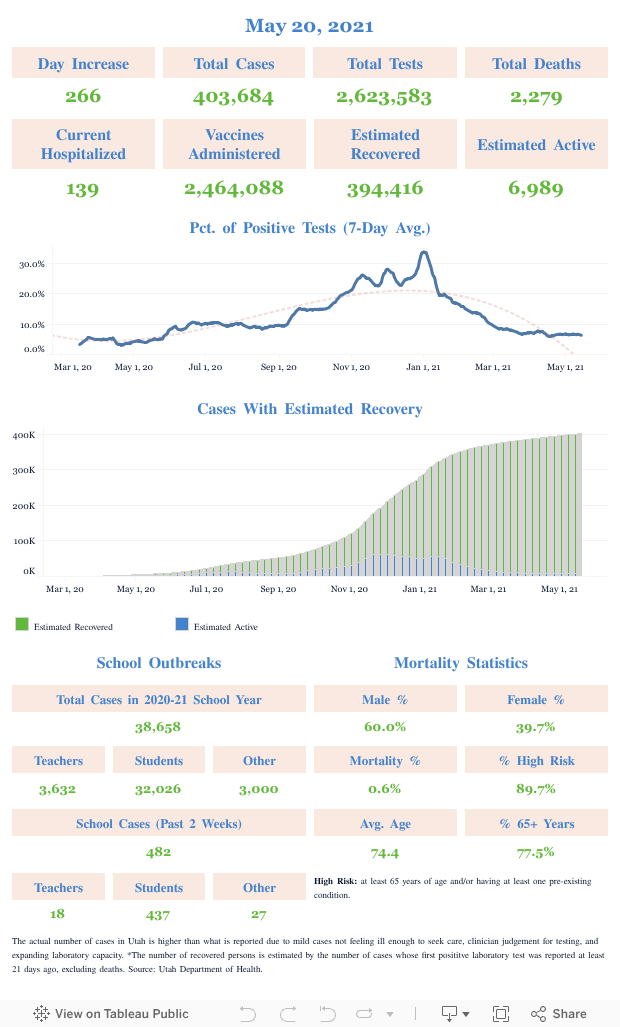
SALT LAKE CITY — Utah’s number of COVID-19 cases has increased by 141 from Wednesday, with one new reported death, according to the Utah Department of Health.
Thursday’s totals give Utah 2,683 confirmed cases, with 238 hospitalizations and 21 total deaths from the disease. Previously, there were 2,542 cases in the state and 20 deaths.
The person who died Thursday was a man in Salt Lake County who was over the age of 85, according to Utah Department of Health state epidemiologist Dr. Angela Dunn.
The man died at a hospital but was a resident at a long-term care facility prior to being hospitalized, she added. The health department is working to make sure everyone at the facility where the man lived is being tested for COVID-19.
Dunn discussed the current coronavirus situation in the state at the daily Utah Department of Health press conference on Thursday afternoon. Watch the replay of the event below.
The new numbers indicate a 5.5% increase in positive cases since Wednesday. Of the 49,678 people tested in Utah so far, 5.4% have tested positive for COVID-19.
The total number of cases reported by the health department includes all cases of COVID-19 since Utah’s outbreak began, including those who are infected now, those who have recovered from the disease, and those who have died.
As of Wednesday, the health department estimated that 357 people had recovered from COVID-19 in the state, according to state statistics. The health department considers anyone who was diagnosed with the disease three weeks ago or longer and who has not died to be recovered.
Though the daily number of new cases has been over 100 the last two days after several days of fewer cases, Dunn remained optimistic about Utah's coronavirus situation.
"We have seen really good signs here in Utah with our data in terms of a slowing of the growth rate in Utah," she said Thursday.
About 9% of people diagnosed with the disease are being hospitalized, Dunn said.
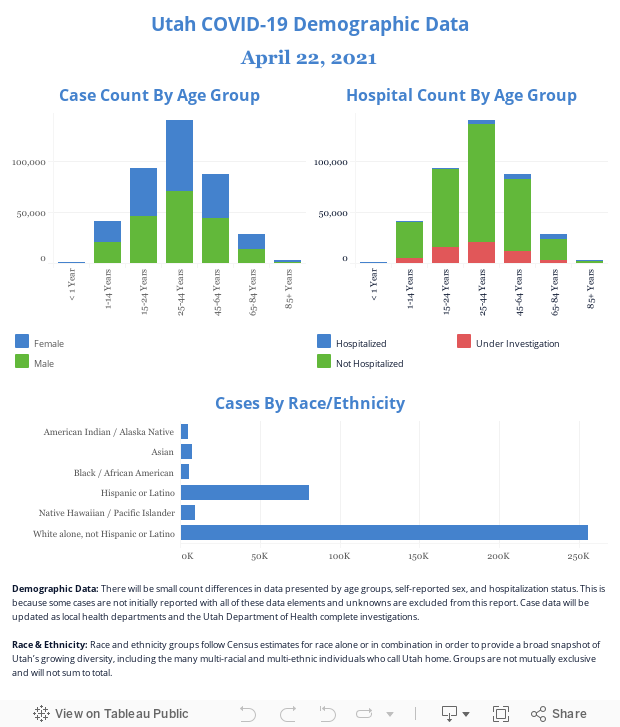
Hispanic Utahns are being infected and hospitalized at a disproportionate rate to other ethnic groups, according to Dunn.
State data shows among all cases of COVID-19 in Utah, just under 29% are among Hispanics, despite that group making up just 14% of the state's population overall, according to U.S. census data.
Health officials don't know if any certain demographic groups are getting tested at lower rates than other groups, Dunn said. However, that data is available and the health department will begin breaking down those numbers in the coming days.
The state still isn't reaching its capacity for testing. About 2,000 people were tested between Wednesday and Thursday, Dunn said, but the state has the ability to test over 4,000.
To try and conduct more tests, state officials began recommending this week that people should get tested if they are experiencing any number of the following six symptoms: fever, cough, shortness of breath, muscle aches, decreased sense of smell or taste, or sore throat.
For more information, go to coronavirus.utah.gov.
Teams of healthcare workers are ready to deploy to long-term care facilities in Utah in the event that there is an outbreak at such a facility, Dunn said. Those workers will make it possible for the regular staff members of a facility to properly isolate or quarantine themselves if there is an outbreak, she said.
The health department began preparing long-term care facilities, where people who are most at-risk for the COVID-19 live, for outbreaks in January, Dunn said. Officials also have made sure that workers at those facilities have necessary personal protective equipment, or PPE, to do their jobs, she added.
With lower growth rates in new COVID-19 cases over the past few weeks, there is a potential that Utah has begun to flatten the curve, Dunn said. However, officials want to see a consistent drop in new cases before they say for certain, she added.
Health department authorities need to see several weeks of a continuous downturn in the growth rates before they start making any assumptions about flattening the curve, she said.
Though Gov. Gary Herbert has said he wants to see the state's economy back to normal by late summer, there is still no set date for when Utah might see the economy start to reopen, Dunn said.
Officials are being flexible when considering how to reopen the economy, she said. They know the state needs to be in a position where authorities could reinstitute social distancing measures if they start to see potential for another outbreak.
"Any misstep could just set a wildfire off and we could start seeing a spike in cases again," Dunn said.

Most recent Utah stories
Related topics
 Jacob Klopfenstein