'%3e%3cpath%20d='M34.1406%205.85938C30.3906%202.10547%2025.3047%200%2020%200C14.6953%200%209.60938%202.10547%205.85938%205.85938C2.10938%209.61328%200%2014.6953%200%2020C0%2025.3047%202.10547%2030.3906%205.85938%2034.1406C9.61328%2037.8906%2014.6953%2040%2020%2040C25.3047%2040%2030.3906%2037.8945%2034.1406%2034.1406C37.8906%2030.3906%2040%2025.3047%2040%2020C40%2014.6953%2037.8945%209.60938%2034.1406%205.85938ZM37.0117%2023.543H31.1602V13.5391H27.6328V19.9414C28.1211%2020.6914%2028.3711%2021.582%2028.3711%2022.5625V22.625C28.3711%2023.668%2028.1172%2024.6055%2027.6328%2025.4297V26.6094H36.082C33.4883%2032.9375%2027.2891%2037.3789%2020.0039%2037.3789C10.3711%2037.3789%202.62109%2029.6289%202.62109%2020C2.62109%2010.3711%2010.3711%202.62109%2020%202.62109C29.6289%202.62109%2037.3789%2010.3711%2037.3789%2020C37.3789%2021.1484%2037.2617%2022.2656%2037.0508%2023.3477C37.0391%2023.4141%2037.0234%2023.4766%2037.0117%2023.543Z'%20fill='white'/%3e%3cpath%20d='M22.3086%2018.5352C20.4336%2018.125%2019.9531%2017.8398%2019.9766%2017.1836V17.1406C19.9766%2016.6992%2020.3477%2016.2148%2021.4023%2016.2148C22.582%2016.2148%2023.8867%2016.6797%2025.0781%2017.4766L26.8516%2015.0195C25.4453%2013.8906%2023.707%2013.3398%2021.5547%2013.3398C18.5195%2013.3398%2016.4375%2015%2016.4063%2017.4766V17.5352C16.3633%2020.2617%2018.5859%2020.9805%2021.293%2021.6016C23.0391%2021.9766%2023.5703%2022.3164%2023.5703%2022.9609L23.5469%2022.9766C23.5469%2023.3906%2023.2578%2023.7031%2022.7852%2023.8359C22.5742%2023.9062%2022.1289%2023.9727%2021.5156%2023.9727C20.7617%2023.9727%2019.7539%2023.8633%2018.6328%2023.4844C18.0898%2023.2891%2017.4727%2023.0039%2016.8047%2022.6133L20.1406%2026.625C20.2813%2026.6602%2021.0977%2026.8516%2021.7734%2026.8516C25.0039%2026.8516%2027.0859%2025.2461%2027.1094%2022.6328V22.5703C27.1602%2020.1133%2025.2148%2019.1719%2022.3086%2018.5352Z'%20fill='white'/%3e%3cpath%20d='M5.24219%2013.5664V26.6133H8.75391V23.7578L10.2969%2021.9531L14.2031%2026.6133H18.3867L12.3555%2019.5195L17.4023%2013.5664H13.4531L8.75391%2019.0586V13.5664H5.24219Z'%20fill='white'/%3e%3c/g%3e%3cdefs%3e%3cclipPath%20id='clip0_97_2430'%3e%3crect%20width='40'%20height='40'%20fill='white'/%3e%3c/clipPath%3e%3c/defs%3e%3c/svg%3e)





Estimated read time: 3-4 minutes
This archived news story is available only for your personal, non-commercial use. Information in the story may be outdated or superseded by additional information. Reading or replaying the story in its archived form does not constitute a republication of the story.
LOGAN — Last March, artist Michael Bingham was on a ladder painting the ceiling of his living room when he fell, landed on his head, broke his neck and almost died. He calls the incident not misfortune, but “an answer to a prayer.”
“I realized God was saying, 'Here you go, here’s the answer to your prayer,'” he says.
The story begins a few years ago when Bingham taught high school art and realized those art classes weren’t designed for everyone, not for students like Keyona Eccles. She uses an electric wheelchair, has limited use of her hands and has a hard time sketching or painting.
“I realized (that by asking her to paint), I was embarrassing her,” he said. “It wasn’t a level playing field.”
So he devised a way for Eccles to draw and eventually paint with a wheelchair.
“I realized that the power chair was her strength,” Bingham said. “It’s like an extension of her body.”
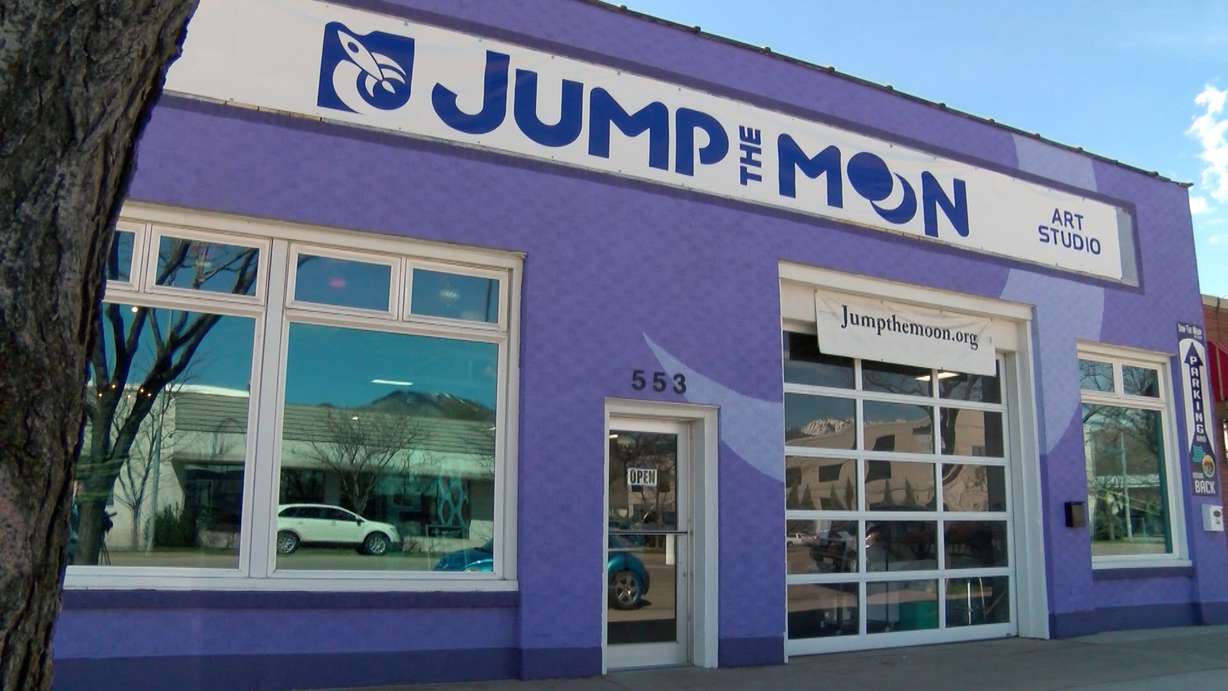
That idea grew into a Main Street studio and gallery called Jump the Moon. The name was inspired by Bingham’s Cow-a-Bunga sculpture — a cow using a jet pack to jump over the moon — on display a few years ago in downtown Salt Lake City as part of a public art program.
Just as the cow needs an assistive device to get over the moon, so, too, Bingham said, did Eccles need that painting wheelchair to make art.
“I knew that this was my mission in life,” he said.
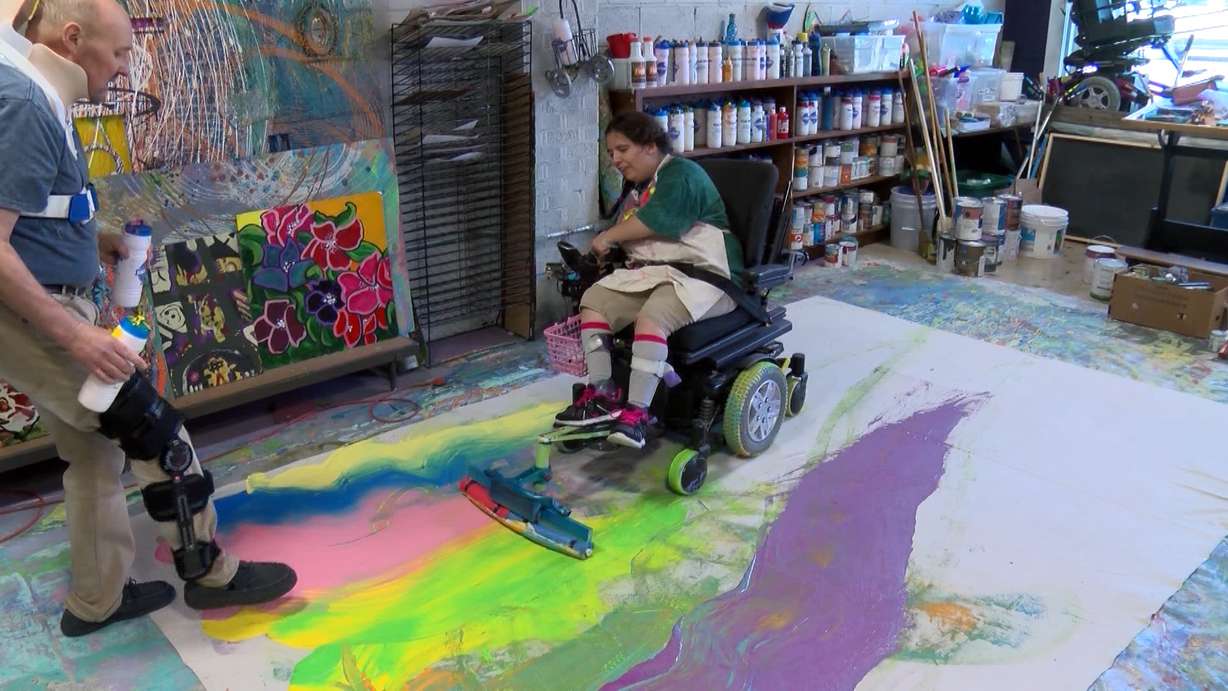
At Jump the Moon, Bingham devises new ways to help people make art. There’s a pendulum for painting, an easel that can be manipulated by someone without much strength, and that painting power chair. Foam brushes are attached to the bottom.
"We don’t see the differences. We see diversity in everybody."
When he fell, Bingham said he was just getting what he had prayed for.
“An answer to a prayer that I offered up about two years ago,” he said. “I asked God to help me better understand, on a much higher level, what people with disabilities went through."
Bingham said like some of the artists with disabilities, he had to relearn how to walk, how to talk and how to swallow.
“I’m grateful to know what unbearable pain feels like, as strange as that sounds,” he said.
Bingham said he now better understands Jump the Moon artists like Linda Loosle. A fall left her quadriplegic.
“When I talk my, my hands want to dance,” she said and then laughed at her hands involuntarily dancing in front of her.
Loosle and Keyona Eccles recently showed their art at a gallery on the Utah State University campus.
“I don’t see differences, so I think looking at differences is what robs us of joy,” Loosle said. “Michael feels the same way. We don’t see the differences. We see diversity in everybody.”
Bingham, unlike Loosle, is expected to recover. With the help of braces, he’s back working in the studio, albeit slowly and carefully. When people comment on his “horrible accident,” he corrects them.
“I can’t help but see it that way (as an answer to a prayer) and be grateful,” Bingham said. “I just I wake up in the morning and I’ve slept for a few hours and everything hurts in the morning. But I wake up and I just think, 'all right, there’s another day and there might not be very many hours I can spend today, but we can help somebody today.'”
On this day, Keyona Eccles visits the studio and, using that MacGyvered-power chair, paints a large canvas with long, bright streaks of color. A normally happy young woman is giddy.
Thanks to Michael Bingham, Keyona Eccles is over the moon.