'%3e%3cpath%20d='M34.1406%205.85938C30.3906%202.10547%2025.3047%200%2020%200C14.6953%200%209.60938%202.10547%205.85938%205.85938C2.10938%209.61328%200%2014.6953%200%2020C0%2025.3047%202.10547%2030.3906%205.85938%2034.1406C9.61328%2037.8906%2014.6953%2040%2020%2040C25.3047%2040%2030.3906%2037.8945%2034.1406%2034.1406C37.8906%2030.3906%2040%2025.3047%2040%2020C40%2014.6953%2037.8945%209.60938%2034.1406%205.85938ZM37.0117%2023.543H31.1602V13.5391H27.6328V19.9414C28.1211%2020.6914%2028.3711%2021.582%2028.3711%2022.5625V22.625C28.3711%2023.668%2028.1172%2024.6055%2027.6328%2025.4297V26.6094H36.082C33.4883%2032.9375%2027.2891%2037.3789%2020.0039%2037.3789C10.3711%2037.3789%202.62109%2029.6289%202.62109%2020C2.62109%2010.3711%2010.3711%202.62109%2020%202.62109C29.6289%202.62109%2037.3789%2010.3711%2037.3789%2020C37.3789%2021.1484%2037.2617%2022.2656%2037.0508%2023.3477C37.0391%2023.4141%2037.0234%2023.4766%2037.0117%2023.543Z'%20fill='white'/%3e%3cpath%20d='M22.3086%2018.5352C20.4336%2018.125%2019.9531%2017.8398%2019.9766%2017.1836V17.1406C19.9766%2016.6992%2020.3477%2016.2148%2021.4023%2016.2148C22.582%2016.2148%2023.8867%2016.6797%2025.0781%2017.4766L26.8516%2015.0195C25.4453%2013.8906%2023.707%2013.3398%2021.5547%2013.3398C18.5195%2013.3398%2016.4375%2015%2016.4063%2017.4766V17.5352C16.3633%2020.2617%2018.5859%2020.9805%2021.293%2021.6016C23.0391%2021.9766%2023.5703%2022.3164%2023.5703%2022.9609L23.5469%2022.9766C23.5469%2023.3906%2023.2578%2023.7031%2022.7852%2023.8359C22.5742%2023.9062%2022.1289%2023.9727%2021.5156%2023.9727C20.7617%2023.9727%2019.7539%2023.8633%2018.6328%2023.4844C18.0898%2023.2891%2017.4727%2023.0039%2016.8047%2022.6133L20.1406%2026.625C20.2813%2026.6602%2021.0977%2026.8516%2021.7734%2026.8516C25.0039%2026.8516%2027.0859%2025.2461%2027.1094%2022.6328V22.5703C27.1602%2020.1133%2025.2148%2019.1719%2022.3086%2018.5352Z'%20fill='white'/%3e%3cpath%20d='M5.24219%2013.5664V26.6133H8.75391V23.7578L10.2969%2021.9531L14.2031%2026.6133H18.3867L12.3555%2019.5195L17.4023%2013.5664H13.4531L8.75391%2019.0586V13.5664H5.24219Z'%20fill='white'/%3e%3c/g%3e%3cdefs%3e%3cclipPath%20id='clip0_97_2430'%3e%3crect%20width='40'%20height='40'%20fill='white'/%3e%3c/clipPath%3e%3c/defs%3e%3c/svg%3e)


Estimated read time: 10-11 minutes
This archived news story is available only for your personal, non-commercial use. Information in the story may be outdated or superseded by additional information. Reading or replaying the story in its archived form does not constitute a republication of the story.
SALT LAKE CITY — BMW recently announced plans to release 25 electrified models by the year 2025. A dozen of those will be full-electric cars.
The automaker currently offers several hybrid models and the fully electric i3 hatchback. BMW already uses renewable energy to power the plant where the i3 is manufactured and uses renewable materials in the car’s construction.
The 2017 X5 40e represents the automaker’s plan to bring electric and hybrid technology to existing models rather than creating obviously electric models with unfamiliar styling. For a brand with a rich history and instantly recognizable design, it should help ease current BMW owners into electrified cars going forward, while still attracting new buyers to the brand with vehicles such as the i3 and the i8 plug-in hybrid supercar.
According to Chris Durr, sales manager at BMW of Pleasant Grove, potential buyers may be put off by the lack of standard third-row seats for the 40e, compared to other X5 models.
“No question, the one drawback to this model is the lack of a third row, which isn’t possible due to the battery compartment located where the seats would normally fold into the floor,” Durr said.
Exterior styling
From the outside, there are only subtle clues this model is different than a typical X5 SUV. The charging port door is located on the front driver side fender and looks like a large gas filler door. A blue “i” logo sits below the door like the i3 and i8.
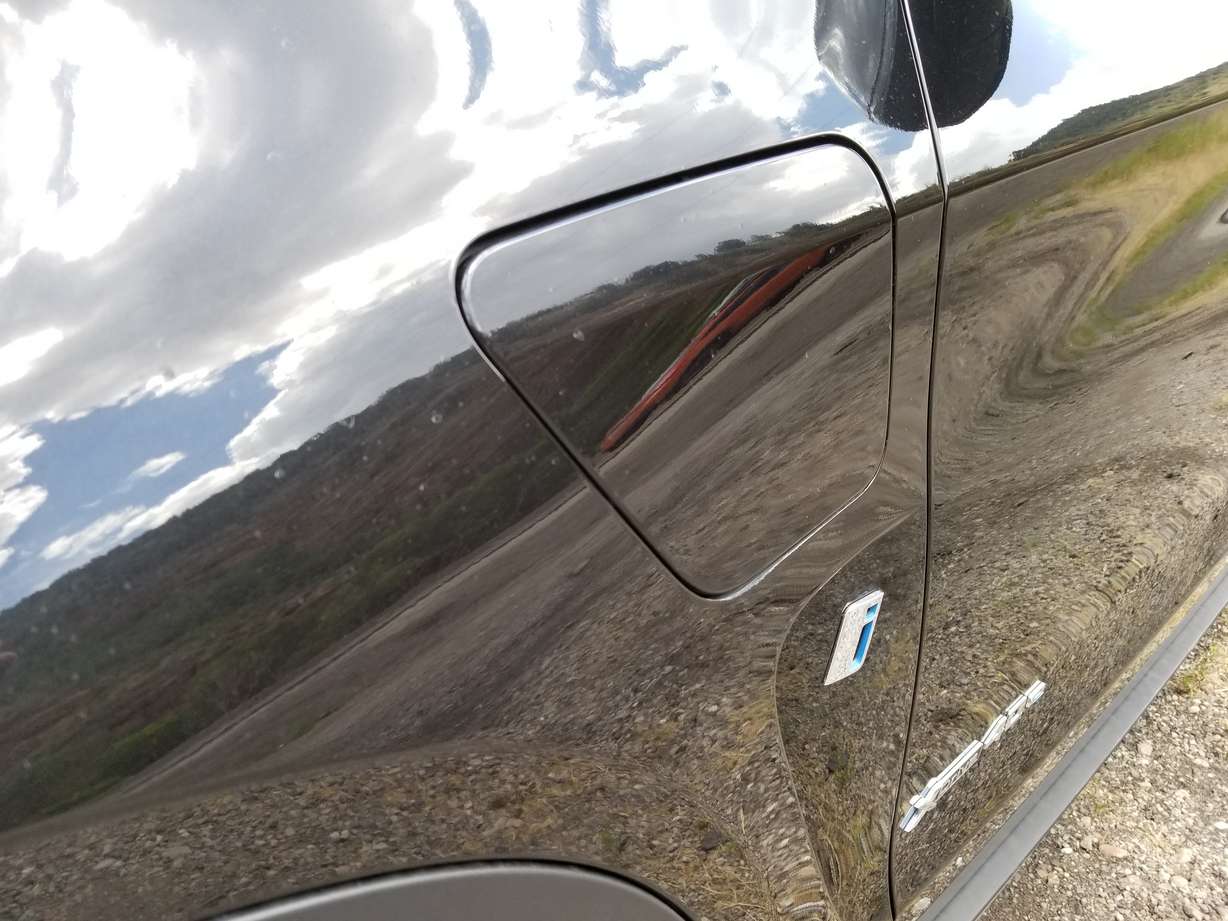
A larger “eDrive” badge is located above the rear fenders just behind the rear side windows. The blue trim that identifies the i3 and i8 as electrified vehicles is missing on the X5. At a glance, the X5 is nothing special, and that’s the point.
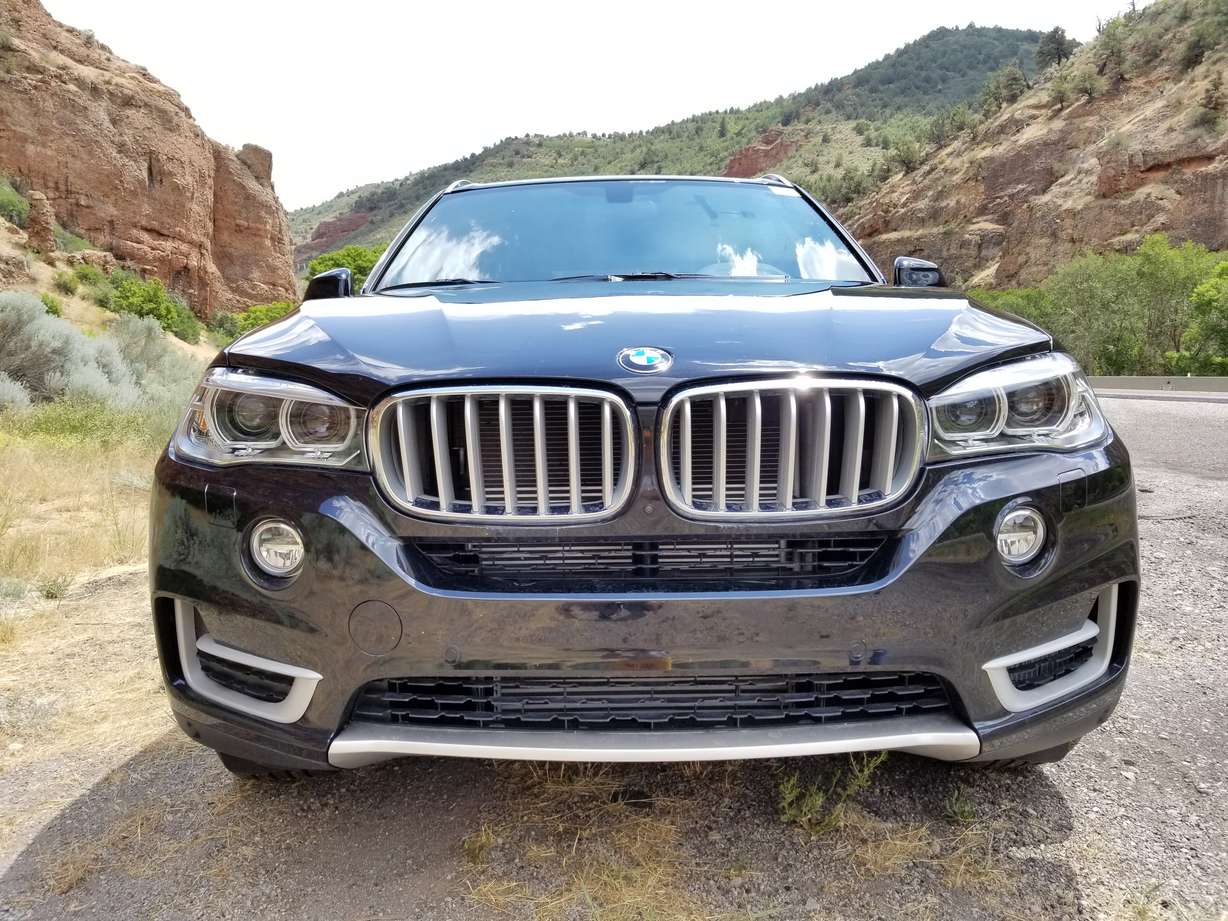
The test vehicle was black with chrome accents surrounding the windows, and gray molding filled part of the space below the doors. An aggressive line begins under the front door handles and moves rearward, growing in width as it reaches the rear fenders.
BMW’s familiar dual kidney grills are more aggressive this year, with the vertical spines protruding outward, and both grills are trimmed in chrome. The fog lights sit high and inward, just below the headlights. The outer air intakes are trimmed in gray, similar to the lower door trim.
From the rear, the X5 presents a wide stance with chrome-trimmed rectangular exhaust outlets sitting low and facing slightly outward. The bumper is pronounced and sits below a two-part, power liftgate. The gate swings upward, and a lower, narrow piece opens downward.
Interior styling
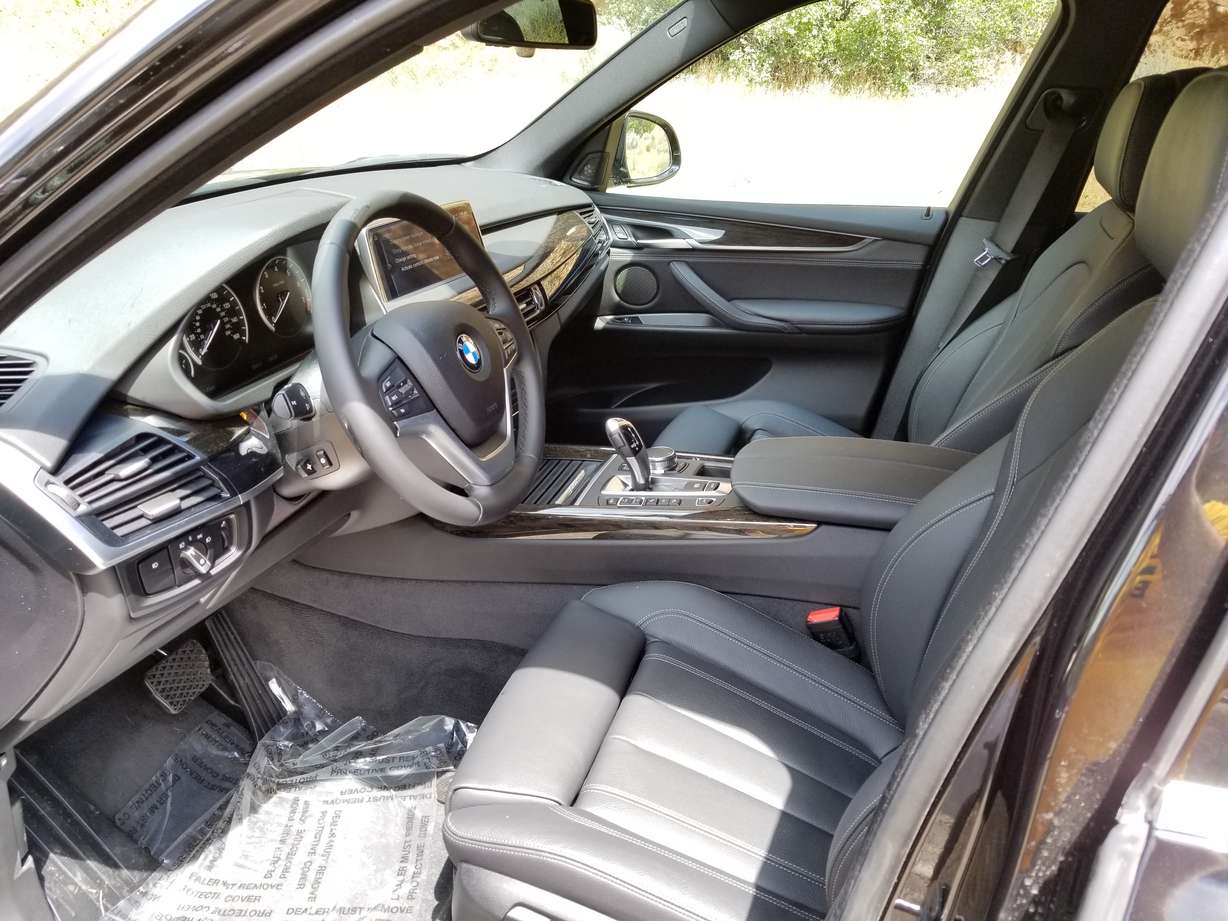
Inside, everything is familiar to BMW fans. While Mercedes and Audi interiors favor more luxury, BMW blends luxury and sportiness in a way that works well.
The typical rectangular air vents are complemented by a genius design for the outer vents, which are separated into an upper and lower half that can be adjusted separately. No longer do passengers have to decide between directing air to mostly the front seat or the rear or between their heads and bodies.
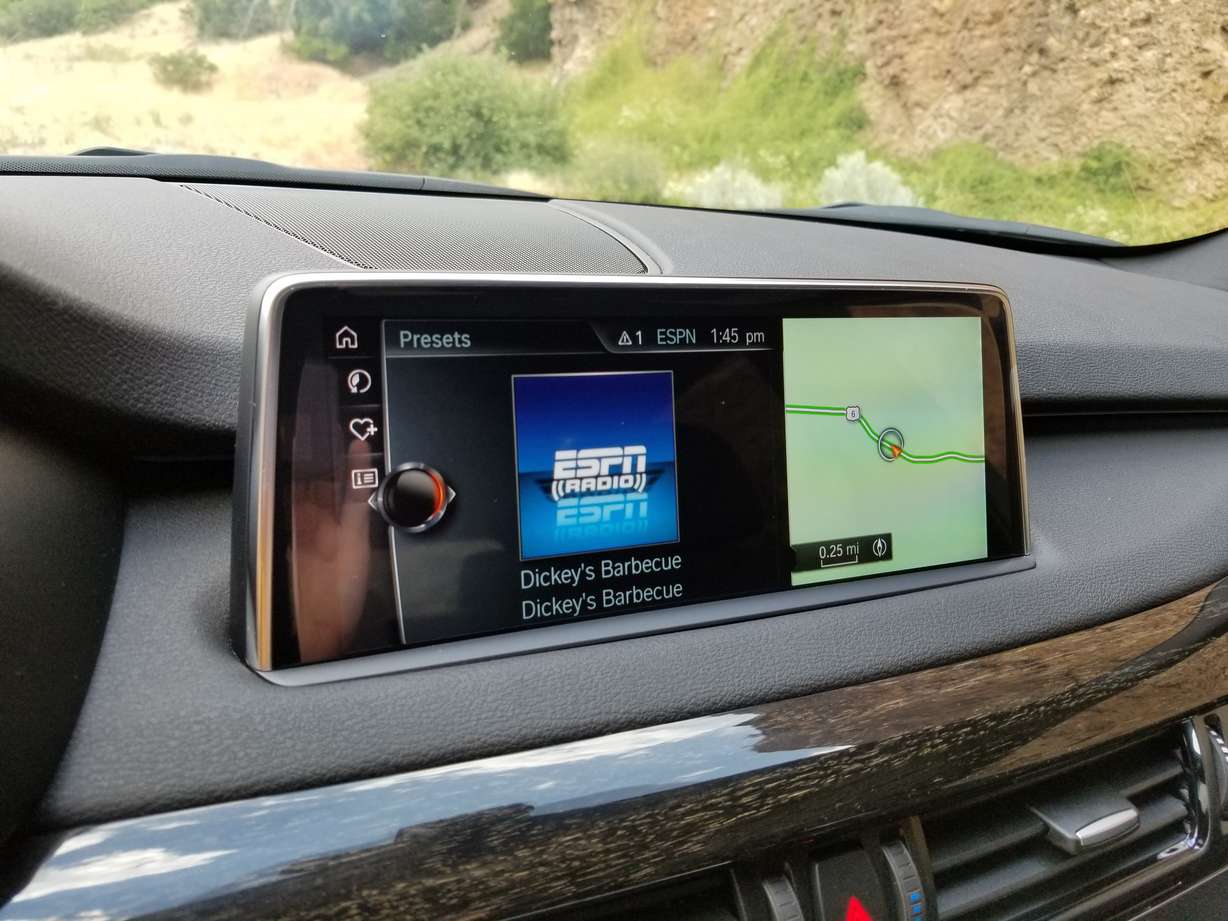
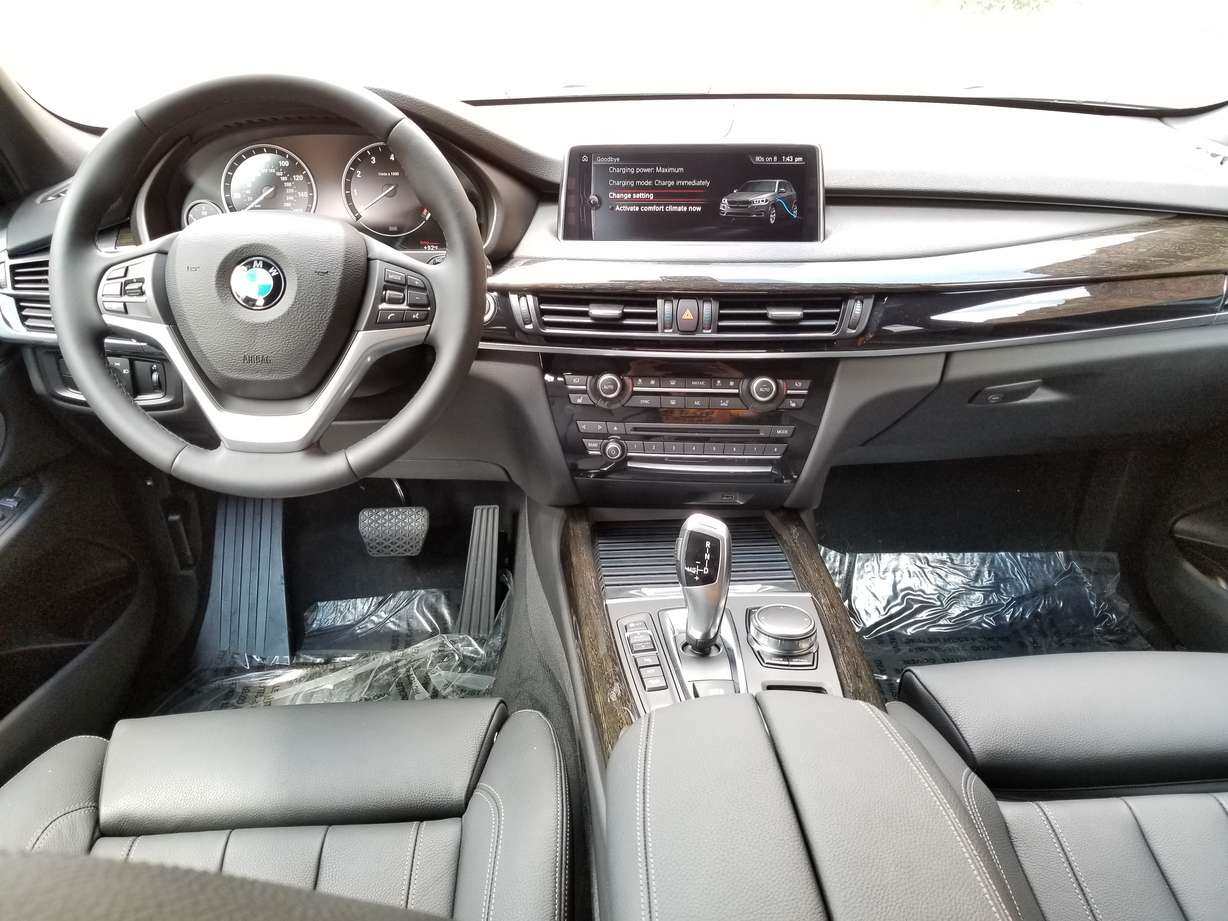
The 10.2-inch touchscreen is large and sits above the dash rather than being integrated into it. Media and climate controls sit below and the center console contains BMW’s iDrive controller, electronic shift lever and various controls for driving modes and park assist.
The center storage compartment, covered in leather with contrasting stitching, is massive and opens outward with two separate doors. That arrangement seemed strange at first, but it works well considering the passenger can access the compartment without the driver having to move their arm.
The leather and oak trim throughout is beautiful, and the soft-touch materials on the dash and door panels are excellent quality. I was not impressed to see glossy plastic trim surrounding the media and climate controls, but the buttons are matte finish and fingerprints weren’t as large a concern as I feared.
BMW design is always driver-centric, and the center controls and touchscreen are angled toward the driver. This year BMW has also moved the door lock controls to the door panel, where they belong, rather than the center of the dashboard.
The center console is cluttered, and BMW has fallen into the same trap many automakers have by including too many buttons and controls to accommodate increasing amounts of technology.
Touchscreens, voice controls, driver control dials and menus mean we should have less to look at on the dash. In the case of the X5, there are simply too many unnecessary buttons and controls cluttering an otherwise elegant dash.
There is plenty of space for passengers riding in the back, and cargo space — unlike the third row of seats — is not compromised by the batteries under the rear deck.
Technology
The test vehicle lacked the tech package that would include things like blind spot and lane travel monitors and adaptive cruise control, and I did wonder why a $70,000 vehicle lacked those features. BMW, similar to its luxury competitors, offers package-based pricing that allows a buyer to choose the vehicle they want.
“A BMW buyer has the choice to focus on the performance, luxury or safety features of their choosing without having a more expensive base price," Durr said. "The luxury and refinement already present, combined with top flight engine and body design, and the handling that comes with near perfect 50/50 percent weight balance is expensive. Buyers decide how to spend their money beyond that."
BMW’s iDrive driver control system is one of the best and gets better each year. Combined with a touchscreen for this year, it is more user-friendly than ever. A rotary dial offers the ability to search various menus and settings for media, climate, navigation and phone. Shortcut buttons surround the dial and the top of the dial can even be drawn on instead of using internal keyboards.
The X5 is all-wheel drive. BMW’s X-Drive system combines full-time rear-wheel drive — important for atypical SUV handling — with the computer's ability to constantly monitor road conditions and traction and redirect power to the wheels that need it.
The X5’s power plant combines a 2.0-liter twin-turbo four-cylinder engine with a 9.2-kilowatt hour lithium battery pack and 111 horsepower electric motor. BMW estimates a 15 mile, all-electric maximum range for the batteries. Depending on driver inputs, the electric and gas motors can supplement each other for more power.
Performance and handling
The power generated by the turbo-four and the electric motor creates 308 horsepower and 332 pound-feet of torque. While the two won’t always be working together, power is delivered smoothly and rarely seems lacking.
Under heavy acceleration, the system sometimes hesitates slightly while making up its mind on how to deliver the power needed. BMW reports a zero-to-60 mph time of 6.5 seconds, slower than a turbo six cylinder-equipped X5. While still a good time for a midsize SUV, it seems slower than expected, but the X5 40e is quick and handles well.
A stability control system is available to minimize body roll. The lateral stability while cornering is excellent, and braking and steering are responsive and predictable.
I set out to see what real-world, all-electric range I could achieve in the city and on the highway. While a 15-mile range seems paltry, it is more than enough for a short commute if you charge in between. It's also enough for running errands throughout the week. The combined gas and electric mileage is estimated at 56 miles per gallon gasoline equivalent. For an SUV, a 540-mile total range on a tank of gas is impressive.
The small battery pack also means that charging on a standard 110-volt outlet at the home or office is very efficient. I drove an i3 last summer and found that 110-volt charging overnight wasn’t practical at all. The X5 40e's overnight and workday charging is more than enough to charge the batteries fully.
With the cruise control set at 70 mph (the maximum speed for eco drive mode) and the air conditioning on, I actually exceeded the reported range and achieved 16.7 miles before the gas engine kicked in. I expected city driving to extend range further, since coasting and braking help recharge the batteries. Instead, the X5 only achieved 14.6 miles of range while I ran errands in the city with the air conditioning on.
The reported range of the X5 is very realistic and will vary depending on a multitude of factors and driving conditions.
Conclusions
The X5 40e offers excellent performance and handling and a luxurious interior. The extended electric range should please both those with short commutes and weekend errands.
Unlike many hybrid and electric options on the road today, BMW hasn’t sacrificed style and luxury in order to bring increased gas mileage. The X5 40e proves that electric doesn’t mean ugly and slow.
Specs
Vehicle type: 5-passenger, five-door, all-wheel drive SUV
Engine: 2.0-liter turbo, 4-cylinder gas engine and 9.2-kilowatt hours electric motor
Transmission: 8-speed Steptronic automatic with sport and manual mode
Power: 240 horsepower, 260 pound-feet of torque gas engine, 111 horsepower electric motor, 308 horsepower, 332 pound-feet of torque combined
Performance: 6.5-second, zero-to-60 mph, top speed 130 mph
Fuel Mileage: EPA 56 Miles per gallon gasoline equivalent combined
Warranty: 4 years, 50,000 miles bumper to bumper, rust 12 years, unlimited miles, roadside and Sirius XM trial and maintenance programs available
Price as tested: $70,370
I set out to see what real-world, all-electric range I could achieve in the city and on the highway. While a 15-mile range seems paltry, it is more than enough for a short commute if you charge in between. It's also enough for running errands throughout the week. The combined gas and electric mileage is estimated at 56 miles per gallon gasoline equivalent. For an SUV, a 540-mile total range on a tank of gas is impressive.
The small battery pack also means that charging on a standard 110-volt outlet at the home or office is very efficient. I drove an i3 last summer and found that 110-volt charging overnight wasn’t practical at all. The X5 40e's overnight and workday charging is more than enough to charge the batteries fully.
With the cruise control set at 70 mph (the maximum speed for eco drive mode) and the air conditioning on, I actually exceeded the reported range and achieved 16.7 miles before the gas engine kicked in. I expected city driving to extend range further, since coasting and braking help recharge the batteries. Instead, the X5 only achieved 14.6 miles of range while I ran errands in the city with the air conditioning on.
The reported range of the X5 is very realistic and will vary depending on a multitude of factors and driving conditions.
Conclusions
The X5 40e offers excellent performance and handling and a luxurious interior. The extended electric range should please both those with short commutes and weekend errands.
Unlike many hybrid and electric options on the road today, BMW hasn’t sacrificed style and luxury in order to bring increased gas mileage. The X5 40e proves that electric doesn’t mean ugly and slow.
Specs
Vehicle type: 5-passenger, five-door, all-wheel drive SUV
Engine: 2.0-liter turbo, 4-cylinder gas engine and 9.2-kilowatt hours electric motor
Transmission: 8-speed Steptronic automatic with sport and manual mode
Power: 240 horsepower, 260 pound-feet of torque gas engine, 111 horsepower electric motor, 308 horsepower, 332 pound-feet of torque combined
Performance: 6.5-second, zero-to-60 mph, top speed 130 mph
Fuel Mileage: EPA 56 Miles per gallon gasoline equivalent combined
Warranty: 4 years, 50,000 miles bumper to bumper, rust 12 years, unlimited miles, roadside and Sirius XM trial and maintenance programs available
Price as tested: $70,370