Estimated read time: 4-5 minutes
This archived news story is available only for your personal, non-commercial use. Information in the story may be outdated or superseded by additional information. Reading or replaying the story in its archived form does not constitute a republication of the story.
SALT LAKE CITY — Donald Trump's election as president has reverberated across the nation, resulting in exuberance in some states and anxiety in others.
In Utah, some local analysts are expressing concern about the potential impact of the president-elect’s policies on the state's economy, which is among the more robust in the country.
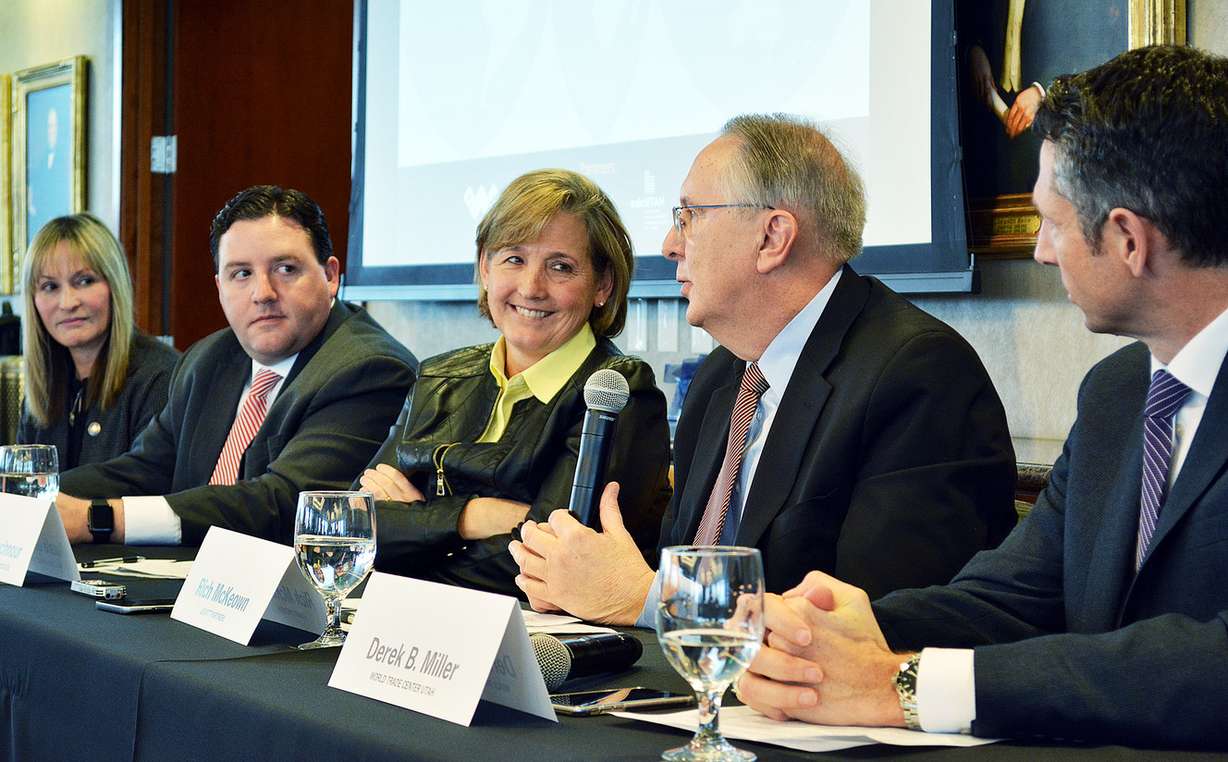
Derek Miller, president and CEO of World Trade Center Utah, said judging from Trump’s rhetoric regarding international trade, the Beehive State has “a lot to lose” if many of his policy proposals are implemented
“In a trade war, small businesses would lose,” Miller said Wednesday at a Thought Leader Symposium. “If (the U.S.) under President Trump starts putting tariffs in, (other countries) are going to do the same thing — taking retaliatory measures.”
It would be foolish, he said, to think that if the U.S. places a 35 percent tariff on China, that it wouldn’t do the same thing. With a consumer-based economy, Utah and the U.S. would be significantly impacted by increased costs of purchasing imported products if the new administration instigated antagonistic trade policies.
“We’re all out there doing Christmas shopping right now," Miller said. "Nobody that I know would be thrilled (by) having to pay 35 percent more for all those presents that you’re buying."
Miller said he understands that some states and individuals have suffered under this “new economy,” but Utah has done well at making the new economy work for its residents.
Utah could serve as an example for other states on how to develop strategies for long-term economic success without creating potentially harmful protectionist policies, he said. Chief among those strategies is retraining of the workforce.
“That is something we’ve done well in Utah is providing training for those who have been left behind in this transition to information technology and advanced manufacturing,” Miller said. “Utah has shown that this retraining solution works.”
During his campaign, Trump “blew on the flames” of concern regarding global trade, Miller said, by threatening tariffs and potential trade wars, along with withdrawing from trade agreements — all of which have negative implications for the Utah economy.
“My advice to the incoming president would be, ‘Let’s talk about fair trade, and let’s talk about level playing fields. Let’s not talk about protectionism and tariffs,'" he said.
Natalie Gochnour, director of the Kem C. Gardner Policy Institute, also expressed skepticism regarding President-elect Trump’s possible impact on the state economy, but she said she is “trying to have an open mind.”
“I say this because he’s going to be doing some things that are really needed, like regulatory reform, reducing the corporate income tax rate,” she said. “This is something that is needed in this country. It will help our international competitiveness.”
Gochnour added that while there are some positive aspects of the soon-to-be president’s proposed agenda, there are also some things that could be economically damaging.
“He’s talking about trade wars, which would be difficult for country and for our state,” she said. “His wall on the Mexican border is not helpful to our workforce needs in this country. I’m trying to keep an open mind, but there is a lot of uncertainty.”
Gochnour noted that Trump’s plans thus far lack specifics. Also, he could change his mind, she said, and Congress still has an important role to play.
“(Trump) needs their approval to do things — not everything, but a lot,” Gochnour said. “So we’re walking into the next four years with a terrific amount of uncertainty and the potential for some good things to happen and some potential for some bad things to happen.”
As a conservative, Gochnour said one thing that gives her optimism is that Republicans now have control of all three houses in Washington, D.C., so they have a chance to make changes that were previously precluded due to partisan politics.
“We now have the ability to get things done, but I just want them to be the right things,” she explained. “If we don’t pay attention to the debt, then that concerns me as a conservative. If we do some things that are inflationary, then that concerns me as an economist.”
Gochnour added that Congress and the executive branch will have to perform a delicate balancing act to manage the national economy, otherwise they risk another downturn.
“If you do tax cuts and (increase) spending without keeping an eye on the debt, then you can create all sorts of problems for the economy over the medium and long term,” she said.
Gochnour also noted that Trump has had a penchant for making inappropriate comments regarding many topics, including U.S. economic policy, that have already begun to impact financial markets. She said she hopes he learns to be more restrained in the future.
“I have a lot of concerns about what the president-elect says. He should give up his Twitter account (and) he should be much more measured in the things he says,” Gochnour said. “There is a responsibility and a trust that he has as our president. Some of his statements have not shown that he has that discipline yet, but I hope in this transition he’s learning that.”