Estimated read time: 4-5 minutes
This archived news story is available only for your personal, non-commercial use. Information in the story may be outdated or superseded by additional information. Reading or replaying the story in its archived form does not constitute a republication of the story.
BONNEVILLE SALT FLATS — In 1960, Mickey Thompson took his two-engine streamliner through the timing clocks on Bonneville Salt Flats at a speed of 406.6 miles per hour.
He failed to set a land-speed record because mechanical problems stopped him from making the required backup run. (In land-speed racing, drivers are required to make two runs with the average of the two being the registered speed.)
During the 2016 Speed Week, Thompson’s son, Danny, took this same twin-engine car over the same salt flat track at an average speed of 406.7 mph, which proved to be a record. His first run was 411 and his second was 402 for the 406.7-mph average.
This particular race had its beginning on 1988 when father and son made plans for a record run at Bonneville.
“Three months after dad and I made plans for a race, he was murdered. I made this run as a tribute to my father and my chance to go fast,’’ Danny said as crews worked on his streamliner.
Mickey Thompson, a racing legend, and his wife were killed by two men as they walked from their home in 1988. A former partner of Thompson’s was charged and convicted of planning the crime.
Danny Thompson has spent the past seven years updating the car and replacing old engines with two 520-inch Darin Hemis. At top speed, the car travels the length of two football fields every second.
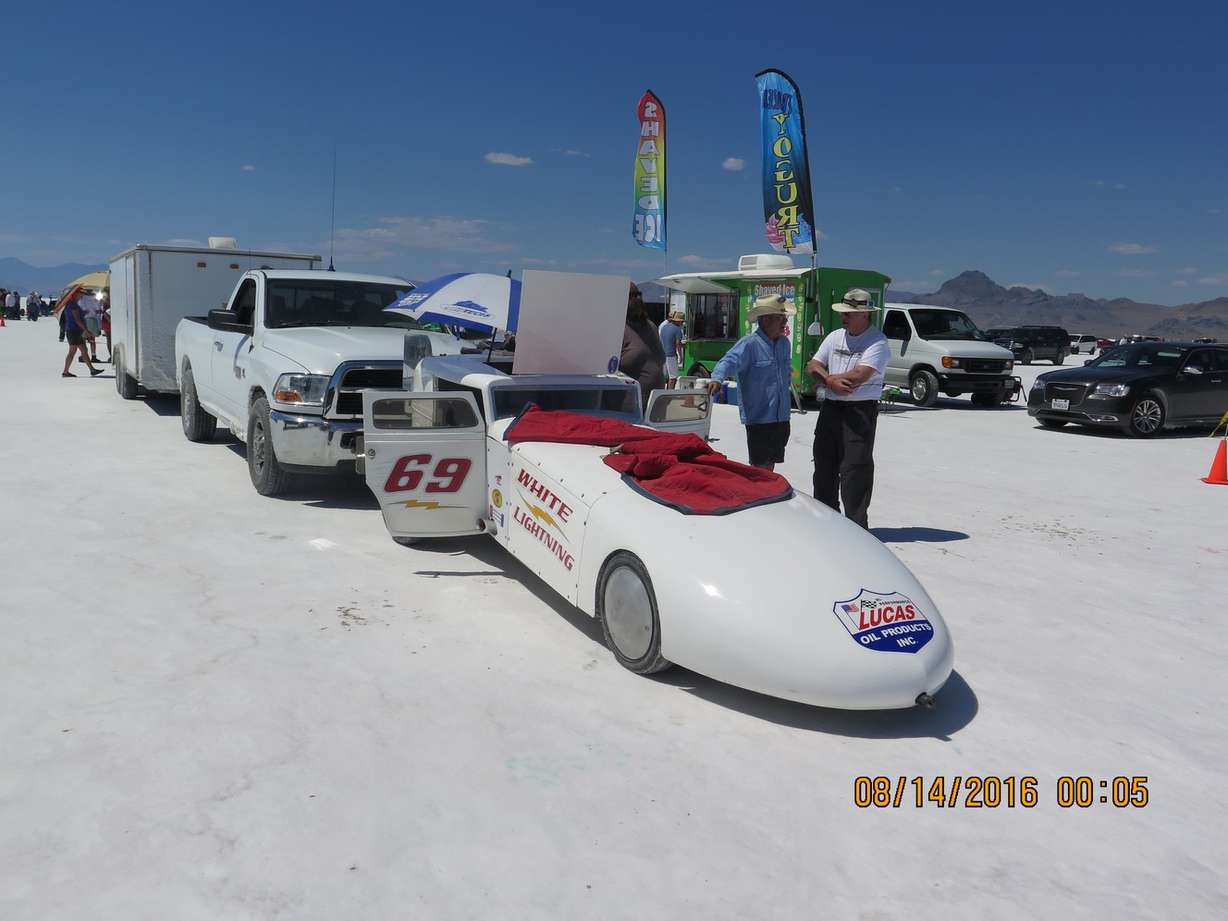
At latest count, nearly 500 cars and cycles came to this year’s Speed Week. This is the first time in three years Speed Week has been held. Thin salt conditions forced the Southern California Timing Association, the race organizers, to cancel events in 2014 and 2015.
The salty surface this year was considered adequate at best.
Mike Nish, driver of the 2000 Nish Streamliner, powered by an untested 520-inch Darin Hemi and shooting for Thompson’s record, had a disappointing 264 mph top speed on Sunday.
“We are not getting ahold of the track. On a test run Saturday, we were kicking up mud," Nish said. "They had to move the track over. The salt is still damp. Sunday, I was getting too much wheel spin. We had enough power at that speed (264 mph) to spin the tires. Everything said, the salt is still better than we’ve seen in the previous two years."
The streamliner has been set up to run over 440 mph.
Salt conditions have been an ongoing issue with racers for years. In the early years of racing, the salt surface was upwards of 5-feet thick. Wednesday, it measured in inches.
According to Terry Nish, patriarch of the Nish racing clan, the salt surface is barely adequate for speed runs.
“Somethings got to be done. We can’t seem to get anything done on a local level, so now we’re going to Washington (D.C.). I think we’re on a good path now,’’ he said.
Currently, a group spearheading recovery, Save the Salt Coalition, is working with Utah and Nevada politicians to get a bill passed through the Legislature that would direct the Bureau of Land Management, which oversees Bonneville Salt Flats, to take steps to restore the salt flats.
The bill would require the BLM to establish a management plan and restore salt conditions by 2026. Critics have complained that the BLM has been unable to fulfill promises made in the past to racers to protect the salt flats. The University of Utah is currently pursuing a science-based management plan on the salt flats.
Racing on the salt flats goes back to 1914 when Teddy Tetzlaff, a well known Indy 500 driver, set a record of 141.73 mph in a Blitzed-Benz. Soon after, Ab Jenkins, began setting long distance and endurance records on the salt flats in cars he named Mormon Meteor I, II and III.
This year, SCTA prepared three tracks for Speed Week drivers — an 8-mile track for high-speed records, a 5-mile short course for slower records and a 3-mile course for rookie drivers.
By Wednesday, the fastest run was turned in by George Potent from Tennessee, driver of the Speed Demon streamliner. He had a top speed of 442 mph and a two-run average of 416.5 mph. Reg Cook, the 70-year-old driver from New Zealand set a class record of 190.5 mph. The old record was 186.5 mph.
In all, more than a dozen world land speed records were set the first three days of racing. The event closes on Friday.
Three more land-speed events are scheduled at Bonneville this year. The first will be the Utah Salt Flats Racing Association’s World of Speed on Sept. 10-13. The second will be the Bonneville Shootout, which will feature five high-speed streamliners and five high-speed motorcycles on Sept. 15-20.
The last event of the year will be the SCTA’s World Finals on Sept. 27-30.
Ray Grass is a long time outdoor writer for the Deseret News and KSL.com. Contact him at grassfam@hotmail.com.