Estimated read time: 3-4 minutes
This archived news story is available only for your personal, non-commercial use. Information in the story may be outdated or superseded by additional information. Reading or replaying the story in its archived form does not constitute a republication of the story.
SALT LAKE CITY — It’s that time of year again.
The Neural Correlate Society recently named the winners of its “Best Illusion of the Year Contest,” meaning there are three fantastic, all-new illusions available to mess with our brains. The organization holds the contest every year to further research about sensory perception.
The first-, second- and third-place winners are selected by online voting, according to the organization. Those three, plus a bonus fourth illusion, can be found below. Let us know what your favorite illusion is in the comment section!
[“Motion Integration Unleashed: New Tricks for an Old Dog”
This mesmerizing illusion from the University of Nevada took first prize in the 2016 contest. It features a square that appears to be moving.](https://youtu.be/Jri0del_6t4)
“Previous illusions have demonstrated that drifting gabors that translate across the visual field can appear to move in the wrong direction (i.e. in a direction that is different than the actual translation),” the description reads. “Here we show that configurations of drifting gabors that are stationary can give rise to dramatic global motion percepts: a rotating square, oscillating chopsticks and rolling waves. Although the gabors themselves are not changing position, the drifting motion within them causes the illusion that the entire configuration is moving!”
“Ambiguous Cylinder Illusion” =============================
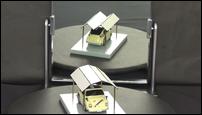
The 2016 second-place winner, “Ambiguous Cylinder Illusion” from Japan’s Meiji University, is somewhat reminiscent of 2015’s second place winner “Ambiguous Garage Roof.” In both, an object appears to change shape when reflected in a mirror.
“The direct views of the objects and their mirror images generate quite different interpretations of the 3-D shapes,” the description reads. “They look like vertical cylinders, but their sections appear to be different; in one view they appear to be rectangles, while in the other view they appear to be circles. We cannot correct our interpretations although we logically know that they come from the same objects. Even if the object is rotated in front of a viewer, it is difficult to understand the true shape of the object, and thus the illusion does not disappear.”
“Silhouette Zoetrope” =====================
The third-place winner, from the Nanyang Technological University in Singapore, pays homage to an early illusion device, the zoetrope. The description notes that zoetropes have been “tricking out senses since the Victorian Era,” but this device is new because it inverts the traditional structure.
“The renewal of pre-cinematic optical devices in contemporary times offers a possibility to the public to experience animation beyond the limits of the screen,” the description reads. “When the 'Silhouette Zoetrope' is rotated, the slots strobe behind the cutout images, animating them apparently inside the empty slotted cylinder, which creates the illusion of moving silhouettes placed into space.”
“Caught Inside a Bubble” ========================
This illusion didn’t win a prize, but it did make it into the contest’s top 10. It comes from the University of Leuven, Belgium.
“In this illusion you can see colors that are not presented on the screen,” the description reads. “An image of colored bullseyes is alternated with an image containing different sized grey scale bubbles. Although these bubbles are colorless, they will actually appear to be colored. These illusory colors are the after-images of the bullseyes’ colors. The intriguing thing is that the colors of the bubbles appear to be completely different, depending on the size of the bubble. Each bubble ‘captures’ the after-image of the bullseye color that matches the size of the bubble. One colored image causes multiple, completely different after-images.”
Related Story
Contact the author at ncrofts@ksl.com or find her on Twitter.