Estimated read time: 4-5 minutes
This archived news story is available only for your personal, non-commercial use. Information in the story may be outdated or superseded by additional information. Reading or replaying the story in its archived form does not constitute a republication of the story.
SALT LAKE CITY — On Monday night, the Utah Jazz honored Kobe Bryant, one of the game’s greatest all-time players with a video introduction, a pair of skis, a season pass to Snowbird and a photo of one of our states greatest natural features, Delicate Arch in Moab.
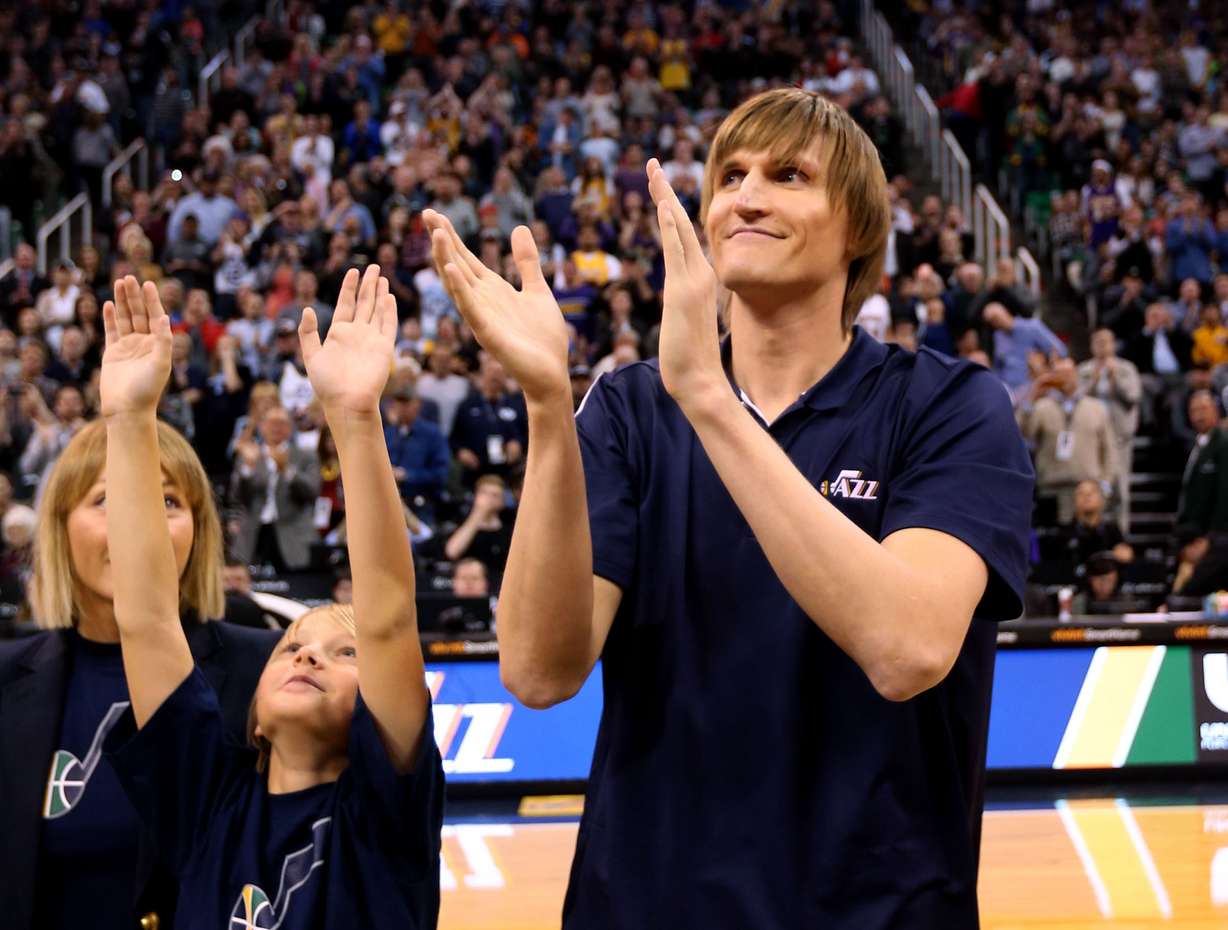
In the second quarter, the team celebrated another one-time NBA great, former Jazzman Andrei Kirilenko, who helped the franchise stay afloat after the departure of John Stockton and Karl Malone. Kirilenko had a photo opportunity at half court and got a special send-off from Kobe Bryant after a timeout.
Like any team that has failed to win a championship, fan bases are left to ask what if, what if in a series of made or missed baskets, draft picks, trades, or injuries, if one small element of basketball had gone differently, how would the team’s history look?
Kirilenko is the Jazz greatest what-if in regards to injury. Many great potentially great NBA players weren’t able to reach their peaks due to injury. Grant Hill, Brandon Roy, Yao Ming, Penny Hardaway, Ralph Sampson, and Bill Walton, all player who could achieved infinitely more with had they avoided a string of knee, and foot injuries.
While not to the extent that many of the franchises that housed the previously mentioned player, Kirilenko’s injuries altered the future of the Utah Jazz. After an All-Star appearance in 2004, Kirilenko suffered knee and wrist injuries that cost him 41 games in 2004-05, the first season of a six-year, $86 million contract. Though Kirilenko went on to have a productive 13-year NBA career, further injuries to his back prevented him from getting back to his astonishing 03-04 campaign when he ranked third in the NBA in blocked shots, fourth in steals and behind only Shaquille O’Neal, Tim Duncan and Kevin Garnett in plus-minus.
In two Finals runs for the Jazz, fans can look back at several plays on the floor that may have determined the outcome. Karl Malone’s missed free throws in Game 1 of the 1997 NBA Finals left the door open for a Michael Jordan game-winner, as did a Malone turnover in Game 6 of the 1998 Finals when Jordan stole the ball and hit a game-winner over Bryon Russell to send the Jazz reeling for a second straight season.
More so than a few plays on the floor, the what-if that may have cost the Jazz a championship or two was a failed move at the trade deadline that cost the Jazz a long-sought-after frontcourt mate for Karl Malone in Rony Seikaly. The Jazz traded Greg Foster, Chris Morris and a first-round draft pick to Orlando in exchange for Seikaly, who at the time of the trade averaged 15 points and 7.6 rebounds. The Jazz's starting center at the time was Adam Keefe, averaging an unspectacular 7.8 points and 5.5 rebounds. Seikaly refused to report to Utah, and the trade was voided.
In a series of close losses in the playoffs over the following seasons, Seikaly’s services unquestionably would have given a much-needed boost to the Jazz' Finals hopes.
While the Seikaly trade was one Jazz fans wished had gone through, there are two trades in Jazz history that Jazz fans should lament as some of the worst in NBA history.
In 1982, the Utah Jazz drafted Dominique Wilkins out of the University of Georgia, but out a need for money, and Wilkins' desire to stay in Georgia, the Jazz traded the nine-time All-Star, and future Hall of Famer, for John Drew, Freeman Williams and cash. Had the Jazz held onto Wilkins, they may have never had the opportunity to draft John Stockton in 1984 and Karl Malone in 1985, though if they had, they would have featured a three-headed monster of Hall of Famers and a roster that could have rivaled the great Lakers and Celtics teams of the 1980s.
The greatest what-if in team history occurred when the franchise was in New Orleans and signed guard Gail Goodrich away from the Los Angeles Lakers. In exchange for the rights to sign Goodrich, the Jazz sent two first-round draft picks to the Lakers, one of which became the top overall pick in 1979.
That pick became Magic Johnson.
Magic went on to become one of the greatest players in NBA history, winning three MVPs and five NBA championships in Los Angeles.
Goodrich played three seasons for the Jazz before retiring.
What-ifs can help or haunt every NBA team and the Jazz certainly have had their fair share of negative what-ifs.
As Jazz fans said goodbye to Kobe Bryant on Monday, remember the Charlotte Hornets traded him on draft night to Los Angeles for Vlade Divac.
Ben Anderson is the co-host of Gunther and Ben in the Afternoon with Kyle Gunther on 1320 KFAN from 3-7, Monday through Friday. Read Ben's Utah Jazz blog at 1320kfan.com, and follow him on Twitter @BenKFAN.