

Estimated read time: 5-6 minutes
This archived news story is available only for your personal, non-commercial use. Information in the story may be outdated or superseded by additional information. Reading or replaying the story in its archived form does not constitute a republication of the story.
MYTON, Duchesne County — Members of the Ute Indian Tribe say they don't need municipal approval to build a new community center in Myton. City officials disagree, however, questioning whether the new center is actually being built on tribal trust land.
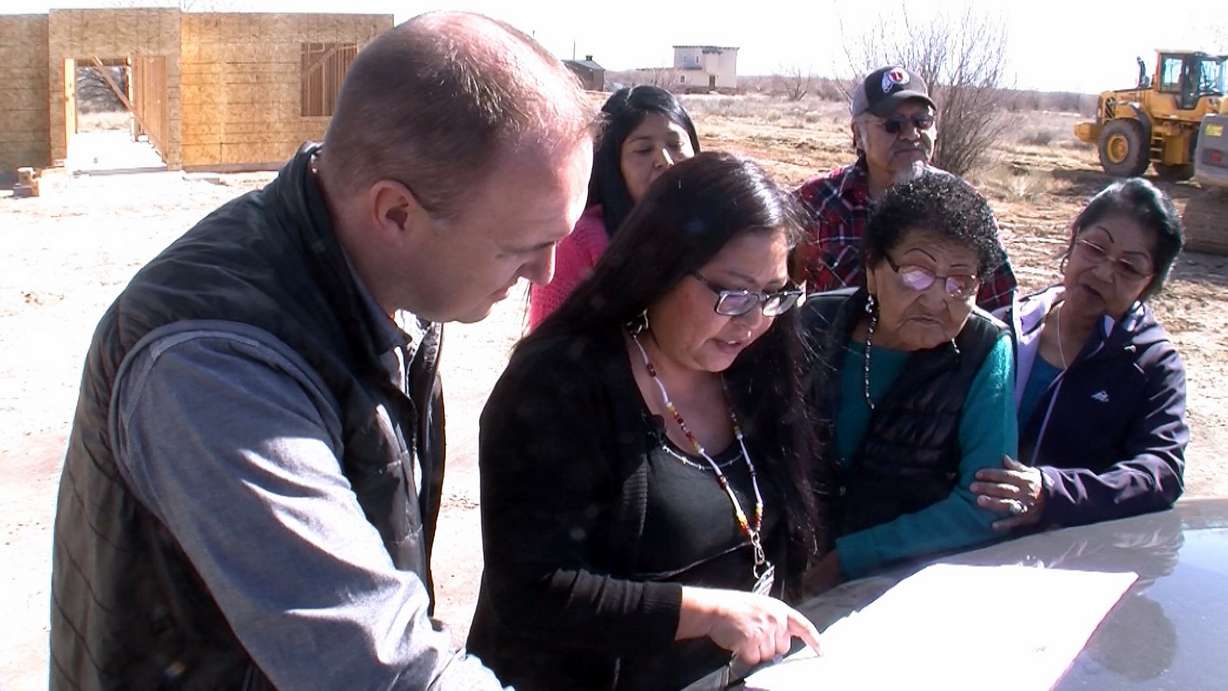
Valentina Sireech, who serves as president of the Ute tribal community group in Myton, has worked for more than three years to secure grant funding for the new center, which is under construction at 90 E. 100 South.
"No question, this is tribal land," Sireech said Wednesday, noting that the area around the center was a tribe-owned subdivision in the 1970s and is still home to a Ute Tribe Head Start campus.
Sireech's assertion appears to be backed up by a letter from the U.S. Bureau of Indian Affairs that shows the community center is being built on property held in trust for the Ute Tribe by the federal government.
"We have examined our plat book/land records and hereby verify that the land described above is within the area designated as Indian Country," the letter states.
That letter, dated Jan. 30, was written two days after U.S. District Judge Bruce Jenkins ruled that Myton is not Indian Country, as defined by federal law. As part of his ruling, Jenkins dismissed Myton as a defendant in a 40-year-old legal fight about who has criminal and civil jurisdiction over tribal members in northeastern Utah.
"The town wants to see the (tribal community) center built, but with this ruling of the court there are two questions," said J. Craig Smith, an attorney for Myton. "Ownership of the land is one question that's out there; the other is jurisdiction. Does the town have the responsibility … for enforcing building and zoning codes?
"That's all kind of up in the air," Smith said.
On Feb. 5, Smith sent a letter to the tribe asking for a meeting between Myton city officials and those involved in building the new community center.
"If the tribe wishes to construct a community center, it must obtain approval from the relevant municipal zoning and building authorities, and obtain a building permit as provided in city ordinance and state law," Smith wrote.
Any failure to obey the city's notice, he continued, would subject the tribe and its new community center to the "legal and practical consequences" of erecting a building without the proper approvals and on someone else's land. That could include "having the building subsequently belong to another person or torn down and the land restored to its original state," Smith wrote.
"We did ask them to hold up and meet with us so we could work out these issues, so the construction could go forward without these questions," Smith said Wednesday in a phone interview. "The tribe declined to meet with us."
Sireech said she viewed the city's letter as "a knife in the back."
"I was so shocked and so hurt," she said, noting that she has had numerous conversations about the new community center with Myton Mayor Kathleen Cooper over the past few years.
Ownership of the land is one question that's out there; the other is jurisdiction. Does the town have the responsibility … for enforcing building and zoning codes? That's all kind of up in the air.
–J. Craig Smith, attorney for Myton
"This has me questioning her ability to lead and make conscious decisions that are for the betterment of Myton," Sireech said, referring to Cooper, whom she considered a friend.
Tribal members agreed to relocate the center after Cooper informed them that their original site was in the middle of what Myton hopes will one day be a four-way intersection, Sireech said. They also made it clear that the community center will be open to everyone in Myton, regardless of whether they are a tribal member, she said.
Sireech said she believes Myton and its elected leaders are engaged in a "land grab" — using Jenkins' ruling to take control of tribal lands within the city limits.
"This is a time that we need to recognize that we're not going to be part of that," Sireech said. "We're going to stand strong and claim our land."
Myton has reached out to the Bureau of Indian Affairs for guidance, but has not yet received a response, Smith said. The city has no desire to tear down or take over the community center, he said.
"My understanding, from talking to the City Council, is that if we knew we were the owners of this site, we would probably just give a deed to the tribe to give them the property to do this," Smith said.
This is a time that we need to recognize that we're not going to be part of (the city's 'land grab'). We're going to stand strong and claim our land.
–Valentina Sireech, Ute tribal leader
The contentious legal fight between the tribe, the state of Utah, several counties and cities to define who has criminal and regulatory jurisdiction over tribal members in a region of Utah where the jurisdictional map resembles a checkerboard has been going on for four decades.
Originally filed in 1975, the case was dismissed in 2000, after the Ute Tribe, the state, and Duchesne and Uintah counties signed a trio of 10-year contracts that appeared to resolve their jurisdictional disagreements.
Tribal leaders succeeded in having the case reopened in April 2013 because the contracts had expired and efforts to renew them had failed. In court papers, they accused state and local law enforcement officers in eastern Utah of routinely engaging in racial profiling of tribal members. Law enforcement agencies and prosecutors in the region have flatly denied those claims.
Jenkins has issued several rulings since reopening the case. Appeals on some of those rulings are still pending before the 10th Circuit Court of Appeals in Denver. A status hearing in the case is set for Thursday.