Estimated read time: 2-3 minutes
This archived news story is available only for your personal, non-commercial use. Information in the story may be outdated or superseded by additional information. Reading or replaying the story in its archived form does not constitute a republication of the story.
Ed Yeates reportingMiniaturized internal ultrasound will soon measure and label exactly whether the plaque inside our arteries is harmless or life-threatening.
Doctors are using miniaturized internal ultrasound now to precisely fit stents inside clogged arteries, but the technology is about to take an even bigger leap.
There's been a lot of controversy lately over the safety of stents -- those little, implantable synthetic tubes that reopen clogged arteries. But how they're placed, how well they fit, is improving dramatically because doctors can see detail inside the artery like never before.
"Looking at this by the angiogram, we thought the stent was perfect. We couldn't tell there was any problem at all," explained Dr. Peter Casterella, of Intermountain Medical Center (IMC).
That's because instead of a view from a miniaturized internal ultrasound device, doctors were relying on a traditional angiogram. But with the ultrasound probe, Casterella and his colleagues could see the stent was not fully expanded.
The team went back with a larger balloon and reopened it even more. Then they took more ultrasound pictures. It may not seem like much, but from 2.8 to 4.8 square millimeters, the fit was tighter and more precise, much less likely to trigger blood clots.
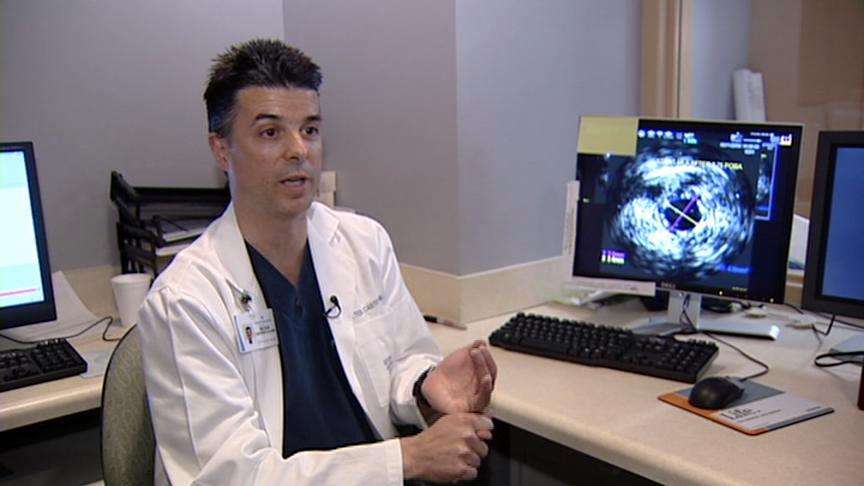
The internal ultrasound will pay off even more with the next generation stents. "We're expecting fully bioabsorbable stents to be available within the next two to three years, a stent that would dissolve in six months to a year," Casterella said.
The next big step is what is called "virtual histology." "The ultrasound can actually provide information about the plaque, whether it's a certain plaque with a lot of inflammation or whether it's a more quiescence plaque that may be more stable," Casterella said.
Once the ultrasound measures and identifies specific kinds of plaque, physicians will know what kind of tool they need to correct the problem. In some cases, they may not need to do anything at all.
E-mail: eyeates@ksl.com