
Estimated read time: 4-5 minutes
This archived news story is available only for your personal, non-commercial use. Information in the story may be outdated or superseded by additional information. Reading or replaying the story in its archived form does not constitute a republication of the story.
SALT LAKE CITY — Police, fire and emergency management teams responded to flames, costume wounds and carnage littering the ground during a mock incident Friday at the Salt Lake City International Airport.
The simulated Bowing 737 crash was part a mandatory Federal Aviation Administration full-scale drill conducted every three years.
"We plan these drills not only because we have to, but because we want to," said Bianca Shreeve, spokeswoman for the Salt Lake City Department of Airports.
Shreeve said the simulation is also about developing partnerships between federal, state, county and local agencies. "It allows us to enhance those partnerships and learn from one another and put those skills to good use."
Shreeve said simulations are different every three years and done in real-time. The only thing crews are told about the staged incident is that the plane was en route to the airport, reported a problem and crashed and there are survivors.
"Our airport rescue firefighters will be on site to put out the fire and then at that point it’s about medical triage, getting people to help they need, diagnosing what problems may be happening medically and then getting them transported to the right place," she said.
Salt Lake Fire Battalion Chief Jeff Thomas said it is important for various agencies to work together.
If Friday's scenario was real, it would "completely tax the Salt Lake City valley resources," he said. "No one single fire department can handle a large body aircraft incident alone. So it will be a valley-wide response and we will be overwhelmed."
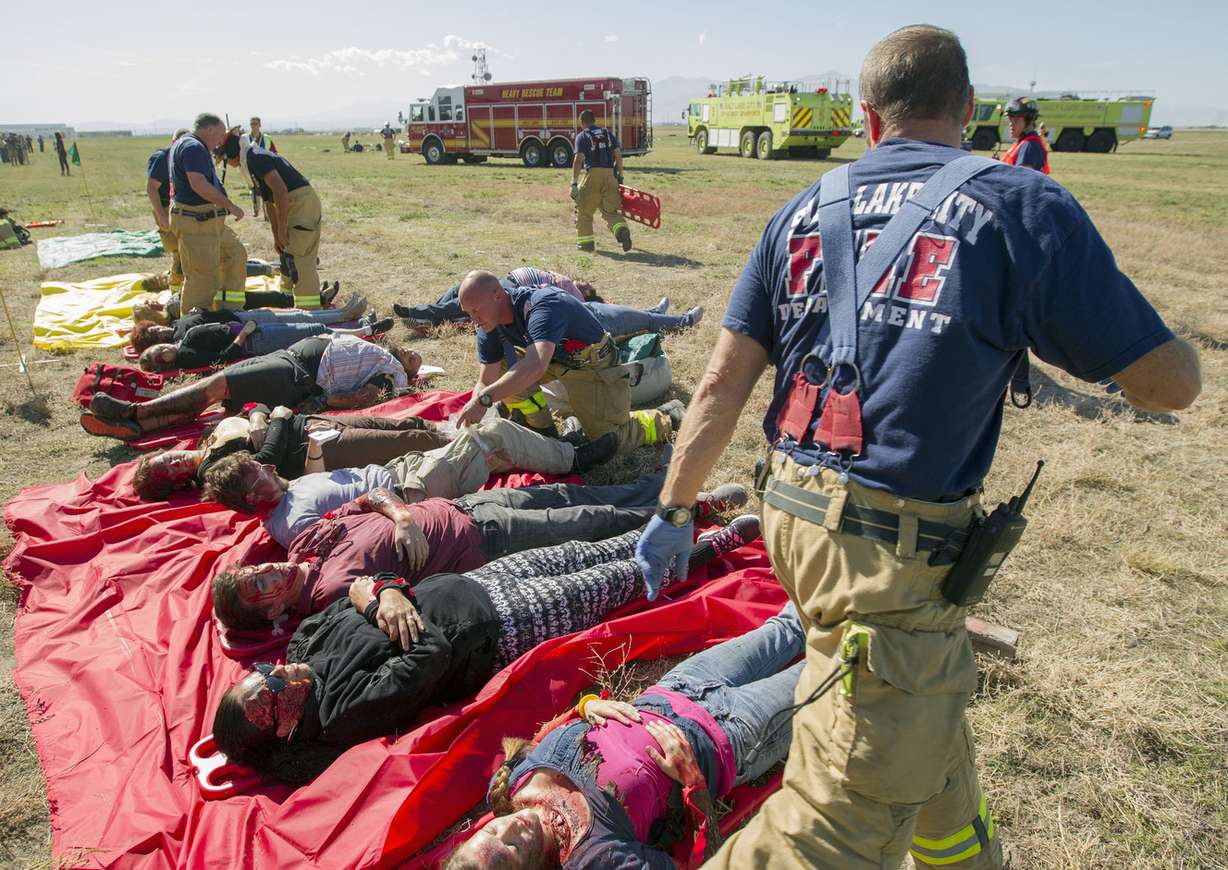
Thomas said Friday's scenario is as real as it can get.
"This is trying to create order during chaos and that’s our job, that’s our mission," he said. "We want to walk with a purpose and try and create confidence that we're here to do the job and to save and protect as many people and lives as we can."
Thomas said Friday's exercise is exactly the kind of training needed for his crew.
"We don’t want our guys coming in with too much pre-arranged information," he said. "We want them to come in as cold as possible so that they can get as close to a simulated or a real incident as possible."
Shreeve said several evaluators specializing in different areas will take note of the exercise. After the pseudo victims are treated, triaged and transported there will be a quick review with those involved and then follow-up review in the coming weeks.
"Every time we have one of these drills or scenarios, the first thing we identify as a problem is communication," Thomas said. "So we’re going to start there and work our way backwards. We’re going to identify holes and gaps in our response and then try to create solutions to resolve them in the future."
Before having a formal review, Thomas said Friday's response to the simulated exercise crew responded well.
No one single fire department can handle a large body aircraft incident alone. So it will be a valley-wide response and we will be overwhelmed.
–Jeff Thomas, Salt Lake Fire Battalion Chief
The last plane crash at the Salt Lake City International Airport was in 1965 when a plane crashed on the runway and 43 of the 91 on board died. Thomas said it's because there hasn't been an incident like that in almost 50 years that they need to do these kinds of exercises.
"It’s a matter of when, right? Not if. So we prepare," he said. "The flying public and the folks of Salt Lake City and those that visit our town through this airport deserve our constant vigilance and readiness to deal with this scenario."
Barbara Gann, spokeswoman for the Salt Lake City Department of Airports, said Friday's simulated crash did not deal with its potential responses to the spread of the Ebola virus.
Unlike new procedures in place at some U.S. airports to curb the outbreak, Gann said nothing has changed at the Salt Lake airport.
"It's a federal government responsibility to make those choices as to what is done and where it's done," Gann said. "Our plan is to support the federal government."
The airport is trained in hazardous materials responses and, similar to what was practiced Friday, Gann said airport officials have conducted practices and have forged relationships with different entities.
Gann said there are no nonstop flights from West Africa, but there are nonstop flights from Paris, Mexico and Canada.
"I think everybody's been very vigilant but the reality is we're all connected," she said. "So that's where the decisions have to come in. How much do we deploy and when?"