Estimated read time: 4-5 minutes
This archived news story is available only for your personal, non-commercial use. Information in the story may be outdated or superseded by additional information. Reading or replaying the story in its archived form does not constitute a republication of the story.
Marc Giauque and Tonya Papanikolas reporting You've heard a lot about our nation's economy lately, and maybe you've even felt some of the related pain. But how are we doing here in Utah? The answer may well depend on who you ask and what numbers they use.
Ted Hedgecock works in real estate. "I don't think it's as bad as everybody says it is," he said.
Andy Johnson is newly out of school and a year on his job. "It just fluctuates. Right now we're probably in the middle somewhere," he said.
And Kelly Nelson is a stay-at-home mom with a young child. "I think it's gonna be OK, but I still want to prepare," she said.
Every one of them has concerns about Utah's economy, but each is also confident they'll get through any stormy waters with jobs, homes and costs.
Because of our young population in the state and people coming into Utah to work, the state's economy is generally much more vibrant than the rest of the nation's. But that is starting to slow down.
President Bush said, "I don't think we're headed to a recession, but no doubt we're in a slow-down." Despite talk the country could be headed toward a recession, President Bush remains optimistic. So do some economists looking at Utah.
Jim Woods, of the University of Utah's Bureau of Economic and Business Research, might agree. "We've had a very good run. We've had expansions and retractions, and we've been through an expansion here in the last three years," he said.
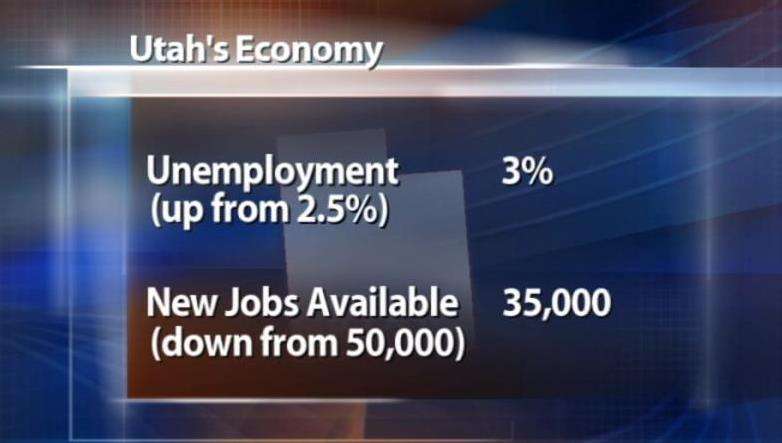
This year Woods expects slower but continued expansion, at least in our ability to create new jobs, and at least through 2008. "There's still economic activity and we're not falling off the edge," he said.
"The projection for '09, however, is for a little bit weaker growth," Woods said. "In the last six months, our economy in terms of job growth has slowed down considerably."
Though still low, unemployment rates have risen to 3 percent, and in the past six months the number of new jobs declined by about 15,000.
The biggest pains, of course, don't deal with jobs but with the housing industry. Nelson says she barely escaped the mess. "We were in an ARM (adjustable rate mortgage) and sinking quickly, and we sold the house but we were in a good neighborhood still, so we were able to get equity," she said.
Some in the mortgage industry tell us they think it's just the start of a trend that will see housing prices drop. But a report this week still lists the Salt Lake area with a slight increase in existing home values.
The housing market in Utah -- not long ago a very strong market -- is now the weakest sector of the economy. As home financing became tighter, the number of permits for single-family homes dropped fast.
"The single family homes have been hurt," Woods said. "They fell about 32 percent last year."
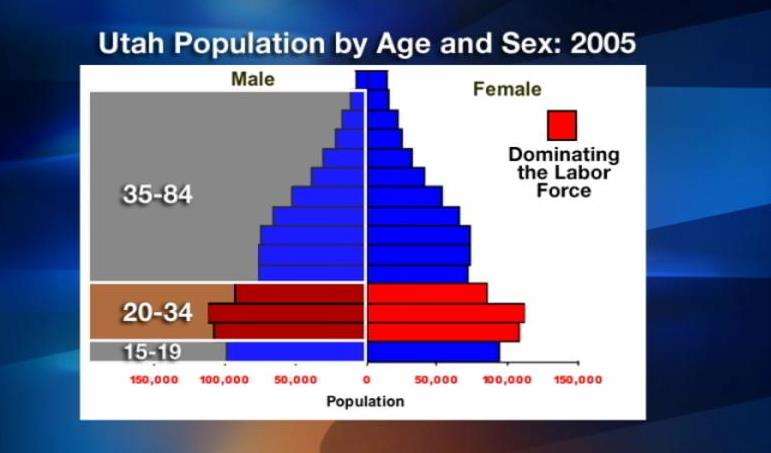
But economists say housing alone wouldn't likely cause a Utah recession. And Utah does have population in its favor. For the rest of the country, the dominant labor force is people between 40 and 59 years old. But in Utah, the largest bulk of workers is between 20 and 34, a group that will continue working and buying homes.
Mark Knold, chief economist for the Department of Workforce Services, said, "I don't see internal factors to Utah putting us into recession."
Economists say what could bring Utah's economy down, though, is a long, drawn-out national recession.
Woods sees the whole scenario as the latest attempt by Americans to finance their lifestyle, this time using their home values. "What's left for the consumer? There's not too many avenues to increase our household income now that we've gone through everybody working, and we're working longer hours, and we've got a lot of debt--so that's a real problem," Woods said.
And there's a cycle: problems can lead to uncertainty. That can lead to less spending, which in turn can lead to new problems not only for retailers, but for cities, towns and governments.
But there are also bright spots. In downtown Salt Lake City, for example, some $3 billion is expected to be spent over the next five years.
"We have many known and funded projects that will keep us clipping in 2008," said Natalie Gochnour, with the Salt Lake City Chamber of Commerce. "What it provides is certainty. If you just do the numbers, there's easily a million dollars being spent downtown every single day, every day of the year."
Woods says non-residential construction is at or near-record levels, but he expects that to peak within a year or two and cycle back, just like any other economic trend.