'%3e%3cpath%20d='M34.1406%205.85938C30.3906%202.10547%2025.3047%200%2020%200C14.6953%200%209.60938%202.10547%205.85938%205.85938C2.10938%209.61328%200%2014.6953%200%2020C0%2025.3047%202.10547%2030.3906%205.85938%2034.1406C9.61328%2037.8906%2014.6953%2040%2020%2040C25.3047%2040%2030.3906%2037.8945%2034.1406%2034.1406C37.8906%2030.3906%2040%2025.3047%2040%2020C40%2014.6953%2037.8945%209.60938%2034.1406%205.85938ZM37.0117%2023.543H31.1602V13.5391H27.6328V19.9414C28.1211%2020.6914%2028.3711%2021.582%2028.3711%2022.5625V22.625C28.3711%2023.668%2028.1172%2024.6055%2027.6328%2025.4297V26.6094H36.082C33.4883%2032.9375%2027.2891%2037.3789%2020.0039%2037.3789C10.3711%2037.3789%202.62109%2029.6289%202.62109%2020C2.62109%2010.3711%2010.3711%202.62109%2020%202.62109C29.6289%202.62109%2037.3789%2010.3711%2037.3789%2020C37.3789%2021.1484%2037.2617%2022.2656%2037.0508%2023.3477C37.0391%2023.4141%2037.0234%2023.4766%2037.0117%2023.543Z'%20fill='white'/%3e%3cpath%20d='M22.3086%2018.5352C20.4336%2018.125%2019.9531%2017.8398%2019.9766%2017.1836V17.1406C19.9766%2016.6992%2020.3477%2016.2148%2021.4023%2016.2148C22.582%2016.2148%2023.8867%2016.6797%2025.0781%2017.4766L26.8516%2015.0195C25.4453%2013.8906%2023.707%2013.3398%2021.5547%2013.3398C18.5195%2013.3398%2016.4375%2015%2016.4063%2017.4766V17.5352C16.3633%2020.2617%2018.5859%2020.9805%2021.293%2021.6016C23.0391%2021.9766%2023.5703%2022.3164%2023.5703%2022.9609L23.5469%2022.9766C23.5469%2023.3906%2023.2578%2023.7031%2022.7852%2023.8359C22.5742%2023.9062%2022.1289%2023.9727%2021.5156%2023.9727C20.7617%2023.9727%2019.7539%2023.8633%2018.6328%2023.4844C18.0898%2023.2891%2017.4727%2023.0039%2016.8047%2022.6133L20.1406%2026.625C20.2813%2026.6602%2021.0977%2026.8516%2021.7734%2026.8516C25.0039%2026.8516%2027.0859%2025.2461%2027.1094%2022.6328V22.5703C27.1602%2020.1133%2025.2148%2019.1719%2022.3086%2018.5352Z'%20fill='white'/%3e%3cpath%20d='M5.24219%2013.5664V26.6133H8.75391V23.7578L10.2969%2021.9531L14.2031%2026.6133H18.3867L12.3555%2019.5195L17.4023%2013.5664H13.4531L8.75391%2019.0586V13.5664H5.24219Z'%20fill='white'/%3e%3c/g%3e%3cdefs%3e%3cclipPath%20id='clip0_97_2430'%3e%3crect%20width='40'%20height='40'%20fill='white'/%3e%3c/clipPath%3e%3c/defs%3e%3c/svg%3e)


Estimated read time: 3-4 minutes
This archived news story is available only for your personal, non-commercial use. Information in the story may be outdated or superseded by additional information. Reading or replaying the story in its archived form does not constitute a republication of the story.
HANKSVILLE — The most severe extended drought in a century is threatening to draw Lake Powell down to record-low levels. Late last week, it forced the federal government to announce an unprecedented reduction in flows out of the lake.
Some say the announcement reflects more than just a short-term concern. It may be the beginning of a new era, when everybody along the colorado river, boaters, farmers, cities, may have to somehow adjust to life with less water.
The giant white bathtub ring near the Glen Canyon Dam is now well over a hundred feet high. It's getting worse; Lake Powell is dropping more than two inches a day.
"We live with mother nature and respect her whims," said Carl Elleard, with the National Park Service.
But this whim has lasted 14 years, with a few ups, but mostly downs. Pat Horning and Chris Weaver maintain the navigational buoys, making sure they're in the right place as the lake changes its stance. In this case they're moving a buoy closer to the main channel to keep boaters off areas that are now too shallow.
New hazards are created whether the lake is falling or rising. The experts say boaters themselves have the primary duty to pay attention and watch for underwater rocks.
"You know there are clues to tell when those things are coming," said Pat Horning, a dive team leader. "If you see a wave breaking out in the middle of open water, you should wonder why a wave breaks,"
The concrete launch ramp at Wahweap is now 1200 feet long. Four football fields. It's OK for awhile. But at Bullfrog and Antelope Point, there are big problems.
"See, the end of the concrete ramp, right here, is visible underwater," Elleard said. "We're down to three and a half feet of water on this ramp before it goes by."
Related:
Lake Powell sandstone absorbing huge amounts of water
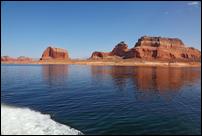
Evaporation isn't the only way Lake Powell loses water. A new study says the reservoir's porous sandstone banks absorb 380,000 acre-feet of water annually from Lake Powell - as much as Nevada's entire allocation from the Colorado River.The national park service is considering spending big money to extend the ramps so boat trailers don't wind up high and dry.
"It is costly. But it's a visitor service, and people want to get on the lake," Elleard said.
Last spring, they spent $500,000 to deepen a short-cut from Wahweap Marina to the lake. They dug the Castle Rock Cut seven feet deeper. But it never filled up with enough water for boats, so now they plan to cut it 20 feet deeper at a cost of over a million dollars, according to Elleard.
Here's the big picture of a dwindling Lake Powell, as forecast by the Bureau of Reclamation: It dropped about 50 feet in the last year, and it will go lower, probably recovering only a little through 2015. The best probable scenario goes higher. The worst probable scenario is a nearly steady downward trend.