Estimated read time: 2-3 minutes
This archived news story is available only for your personal, non-commercial use. Information in the story may be outdated or superseded by additional information. Reading or replaying the story in its archived form does not constitute a republication of the story.
SALT LAKE CITY — Grab a blanket and the family and head outside for a spectacular show tonight. There's scintillating play showing on a stellar stage - the Perseid meteor shower.
"Perseids are kind of like the Old Faithful of meteor showers," said Seth Jarvis, director of the Clarke Planetarium. "The Perseids happen every year at approximately August 12th plus or minus a day or two. That's when earth plows through a part of space where comet Swift Tuttle has deposited a lot of bits of rock from the size of sand to something the size of boulders.
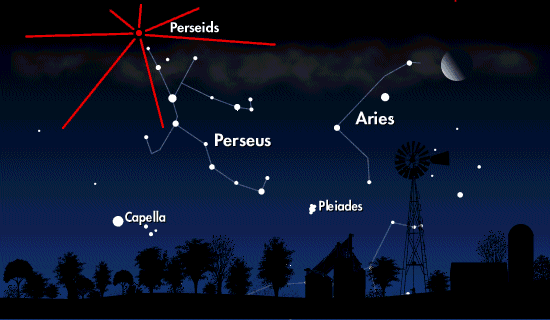
So why the name Perseid? Jarvis says it's because when you view the showers, they appear to be coming from the constellation Perseus, the famous hero of Greek mythology who slew Medusa.
"It's below the west of Caseopea, so if you look to the north-northeast and you see the west of Caseopia, then look about halfway between it and the horizon — That's looking in the direction of Perseaus," Jarvis said. "That's where this stream of space rocks is coming from when it encounters Earth's atmosphere."
You can see as many as 100 meteors per hour or one per minute. But look quick they're fast.
They're entering the atmosphere at 100,000 mph, and that extra speed sometimes makes for a brighter shooting star, brighter meteor, but it depends on how big it is," Jarvis said.
So, why do we always have to watch these showers so late?
"When you look up at 3 in the morning, that's looking forward in the same direction that the Earth is going thru space," Jowers said.
So how do you see the shower? The best way to see the Perseid meteor shower is to get away from the city if you can late on Aug. 11 or early on Aug 12. Get yourself either a sleeping bag or a really cozy chair, sit down, lay back and enjoy the show.