'%3e%3cpath%20d='M34.1406%205.85938C30.3906%202.10547%2025.3047%200%2020%200C14.6953%200%209.60938%202.10547%205.85938%205.85938C2.10938%209.61328%200%2014.6953%200%2020C0%2025.3047%202.10547%2030.3906%205.85938%2034.1406C9.61328%2037.8906%2014.6953%2040%2020%2040C25.3047%2040%2030.3906%2037.8945%2034.1406%2034.1406C37.8906%2030.3906%2040%2025.3047%2040%2020C40%2014.6953%2037.8945%209.60938%2034.1406%205.85938ZM37.0117%2023.543H31.1602V13.5391H27.6328V19.9414C28.1211%2020.6914%2028.3711%2021.582%2028.3711%2022.5625V22.625C28.3711%2023.668%2028.1172%2024.6055%2027.6328%2025.4297V26.6094H36.082C33.4883%2032.9375%2027.2891%2037.3789%2020.0039%2037.3789C10.3711%2037.3789%202.62109%2029.6289%202.62109%2020C2.62109%2010.3711%2010.3711%202.62109%2020%202.62109C29.6289%202.62109%2037.3789%2010.3711%2037.3789%2020C37.3789%2021.1484%2037.2617%2022.2656%2037.0508%2023.3477C37.0391%2023.4141%2037.0234%2023.4766%2037.0117%2023.543Z'%20fill='white'/%3e%3cpath%20d='M22.3086%2018.5352C20.4336%2018.125%2019.9531%2017.8398%2019.9766%2017.1836V17.1406C19.9766%2016.6992%2020.3477%2016.2148%2021.4023%2016.2148C22.582%2016.2148%2023.8867%2016.6797%2025.0781%2017.4766L26.8516%2015.0195C25.4453%2013.8906%2023.707%2013.3398%2021.5547%2013.3398C18.5195%2013.3398%2016.4375%2015%2016.4063%2017.4766V17.5352C16.3633%2020.2617%2018.5859%2020.9805%2021.293%2021.6016C23.0391%2021.9766%2023.5703%2022.3164%2023.5703%2022.9609L23.5469%2022.9766C23.5469%2023.3906%2023.2578%2023.7031%2022.7852%2023.8359C22.5742%2023.9062%2022.1289%2023.9727%2021.5156%2023.9727C20.7617%2023.9727%2019.7539%2023.8633%2018.6328%2023.4844C18.0898%2023.2891%2017.4727%2023.0039%2016.8047%2022.6133L20.1406%2026.625C20.2813%2026.6602%2021.0977%2026.8516%2021.7734%2026.8516C25.0039%2026.8516%2027.0859%2025.2461%2027.1094%2022.6328V22.5703C27.1602%2020.1133%2025.2148%2019.1719%2022.3086%2018.5352Z'%20fill='white'/%3e%3cpath%20d='M5.24219%2013.5664V26.6133H8.75391V23.7578L10.2969%2021.9531L14.2031%2026.6133H18.3867L12.3555%2019.5195L17.4023%2013.5664H13.4531L8.75391%2019.0586V13.5664H5.24219Z'%20fill='white'/%3e%3c/g%3e%3cdefs%3e%3cclipPath%20id='clip0_97_2430'%3e%3crect%20width='40'%20height='40'%20fill='white'/%3e%3c/clipPath%3e%3c/defs%3e%3c/svg%3e)


Estimated read time: 7-8 minutes
This archived news story is available only for your personal, non-commercial use. Information in the story may be outdated or superseded by additional information. Reading or replaying the story in its archived form does not constitute a republication of the story.
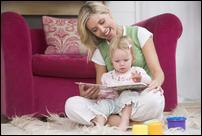
SALT LAKE CITY — Nothing makes my mommy heart happier than to sit with one of my babies on my lap as we read a book.
Bliss is my arms encircling a tiny, warm body, a round face close to mine and little eyes alight with discovery as we turn the pages. And my favorite part: when they scramble down to run and get another book.
Reading aloud and giving books to babies from their earliest days aids in brain and social development, encourages exploration, emphasizes the importance of reading and provides valuable bonding time.
You may wonder about the benefits of reading to your baby. An infant won't understand everything you're doing or why, but you wouldn't wait until your child could understand what you were saying before you started speaking to him or her, right?
–Laura L. Bailet, child psychologist
“You may wonder about the benefits of reading to your baby. An infant won't understand everything you're doing or why, but you wouldn't wait until your child could understand what you were saying before you started speaking to him or her, right? And you wouldn't bypass lullabies until your baby could carry a tune or wait until he or she could shake a rattle before you offered any toys," wrote Laura L. Bailet, licensed child psychologist and executive director of the Nemours BrightStart! Dislexia Initiative in Jacksonville, Fla.
“Reading aloud to your baby is a wonderful shared activity you can continue for years to come," she continued, "and it's an important form of stimulation.”
Here are 10 tips to enhance the reading experience for you and baby (ages 0-2 years):
1. Start early
I introduced books to all three of my babies (now ages 5, 3, and 1-year-old) at about 2 months. I would sit them on my lap against my chest, facing out, and flip through books with bright pictures, reading and talking. I would also lay them down on the floor on one side and prop a book up for them to look at.
At this stage, a baby’s brain is at work learning to distinguish colors. Babycenter.com recommends, “Encourage this development by showing (baby) pictures, photos, books, and toys.”
So not only are you introducing books, but also helping baby's brain and eye development.
2. Buy the right books
Babies need the right kind of books. For babies under 6 months, buy vinyl or cloth books that are easy to hold, chew and clean. After the 6-month mark, buy board books — which are designed to endure baby’s abuse and easy for her to hold and look at. Buy some books that are interactive and include things to touch and play with. Supplement your own collection by visiting the library.
Related:
Book Matters: Top 10 board books for kids to love and abuse
Here are the Book Matters top 10, must-have board books for little readers (0-5 years). Board books are durable, easy to read and a staple for young children.3. Always make books available
At about 4 months, babies begin grasping and holding objects. Hand them small books and allow them to chew on, play with and throw (why tip No. 2 is important).
Carry a book or two in your diaper bag to offer at times baby needs a distraction. For tummy-time play place a book and a few toys on the floor in front of baby’s hands.
When baby can sit up, put books in a basket with several other toys and let him explore. Also, it’s a good idea to have a kids’ bookshelf — something low, sturdy and easy for mobile baby to access books from anytime she wants to play or read. To see my kids’ bookshelf CLICK HERE.
4. Read aloud
For a baby, the sound of a parent’s voice is soothing and comforting. Mom and dad can begin reading aloud to baby from day one. Not only is this a way to bond, but as baby gets older reading aloud helps with important skills.
“Reading aloud teaches a baby about communication, introduces concepts such as stories, numbers, letters, colors, and shapes in a fun way, builds listening, memory, and vocabulary skills, and gives baby information about the world around (her),” Bailet says.
5. Snuggle time
As important as the sound of your voice is the feel of your touch and your closeness. Reading time is also snuggle time. As you read, hold, cuddle, kiss and hug your baby. Adding your loving touch to book time ensures valuable bonding as well as teaching the importance and enjoyment of reading.
When your baby is older and can bring a book and climb in your lap, try not to turn her away. It only takes a few minutes and it will reinforce her worth as well as reading.
- Starry Night Books: Local author Nicole Grane, Aug. 20, 2 p.m., 1193 Main Street, Tooele, Utah
- Parry Lodge Old Barn Theater: National Cowboy Poetry Rodeo, Aug. 19-20, 89 E Center St., Kanab, Utah
- Deseret Book: Author Tyler Whitesides, Aug. 20, 3 p.m., 1110 Fort Union Blvd., Midvale, Utah
- Sam Weller's Bookstore: Author Alexandra Fuller, Aug. 26, 7 p.m., Salt Lake City Library, 210 E. 400 South.
- The King's English Bookshop:
- Winnie the Pooh's 90th birthday story time, Aug. 20, 11 a.m.
- Author Alice LaPlante, Aug. 24, 7 p.m., 1511 S. 1500 East, Salt Lake City
- The Utah Book Festival September 10, 10 a.m. - 3 p.m., University of Utah.
6. Don’t read word for word
Reading to babies is about interaction more than plot. Don’t worry about reading books start to finish. The PBS Reading Milestones page suggests, “Although you can read the story, most babies will be more interested in looking at the pictures and turning the pages than in hearing you read a story. Even older babies may be more interested in asking, ‘What's that?’ to pictures in a book than in hearing an entire story. Don't worry if your baby loses interest before you look at all the pages. Reading a little bit on a regular basis is more important than reading for extended periods of time.”
7. Make it fun
To add to the interaction and baby’s fun point to the pictures, sing, use funny voices, make animal sounds, etc. My husband is particularly good at this and can trip giggle fits with the first word. (For more on dad’s important role in reading, CLICK HERE.)
Ask engaging questions about the pictures such as, “Where is the black cat? There it is! What a funny black cat.” Encourage baby to touch and feel the book, point to pictures and repeat your sounds. Make reading a fun experience and baby will come back to it again and again.
8. Repeat, repeat, repeat
Baliet encourages, “Babies love — and learn from — repetition, so don't be afraid of reading the same books over and over. When you do so, repeat the same emphasis each time as you would with a familiar song.”
I’ve probably read a handful of our board books a thousand times, but I know it’s worth it when I see one of my kids sit down with their favorite book and “read” it to themselves, pointing to all the same pictures or making all the same noises I do.
Don’t be surprised and don’t discourage baby when she brings you the same book several times a day, every day. This is her way of learning and identifying with things she likes.
9. Take your baby to the library
My 1-year-old loves the library, and she knows exactly where to go to find the board books and the tiny bench to sit on. Although not an easy task, taking a baby to the library will help establish the importance of books. Allow your baby to pick out a few board books, play with toys and wander around a bit (make sure to replace all the books she will, undoubtedly, pull off the shelves).
10. Let your baby see you read
A parent’s example of reading for pleasure is one of the most powerful ways to encourage a child to read. Our young children see my husband and I read on a daily basis, and have since their births. They understand that we love to read and books are important. Every day I see how our love of reading and our efforts to read to our children has fostered a love of books and learning in all of them, even at such young ages.
Next week: Read a classic book and like it
Teri Harman writes and reads from home amid the chaos of three young children.
For more book reviews and book fun, visit her blog at book-matters.blogspot.com You can also follow Teri on Facebook (Book Matters) or Twitter (@bookmattersblog)