
Estimated read time: 2-3 minutes
This archived news story is available only for your personal, non-commercial use. Information in the story may be outdated or superseded by additional information. Reading or replaying the story in its archived form does not constitute a republication of the story.
HERRIMAN -- Using robotic imaging inside what is called a "hybrid" operating room, two teams of surgeons have given a Herriman mother the use of her arms again.
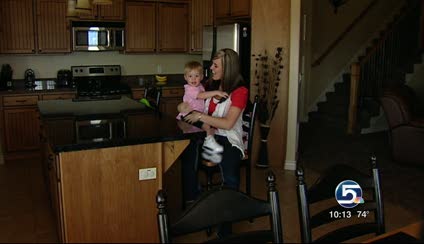
Marty Cranfill-Morton can now lift and hold her son because two teams of surgeons were able to do surgeries on both her arms at the same time.

"The main thing was to be able to play with my son more and be able to hold him, and I can do that now," Marty says.
The Herriman mother has a rare blood disease called Takayasu's arteritis, where scarred arteries restrict blood flow to her upper extremities. The condition produces pain and weakness in her arms. She had difficulty doing things around the house, even washing and combing her hair.
But inside the new hybrid operating room at the University of Utah, surgeons were able to inflate two angioplasty balloons in a graft in her upper aorta at exactly the same time.
University of Utah vascular surgeon Larry Kraiss told KSL, "The key is to do this in a simultaneous, coordinated fashion so that both balloons go up at exactly the same time, so that both channels stay open."
The new hybrid OR allows surgeons room to work together and also provides a unique robot that takes impeccable images in real time. Though big and sophisticated, the robot remains tucked away in a corner until needed. Then, on command, it moves gracefully to the operating table.
In Marty's case, the robot provided rotational images of her arteries in both arms, producing images for each team of surgeons. Via catheters, they inflated the two balloons at exactly the same time, implanting stents to restore blood flow.
Had Marty developed life-threatening complications -- which she didn't -- the teams could have stayed in the same room to do major full-blown surgery.
The robot and the operating table work together, remembering where they are in space and time.
"You can actually save that position, then send the robot back to the corner," Kraiss says. "We can then do a procedure that may take another two hours."
The hybrid OR is everything surgeons need. They can do minimally invasive procedures, using the best and most versatile of imaging -- all in one place -- and if needed, simultaneously on different locations of the body.
Marty says, "It was the easiest surgery to date. Awesome! They just went in, leaving a barely noticeable scar on each arm."
Marty's disease will most likely plague her for the rest of her life and she'll need more surgeries. But now, instead of flying all the way to Cleveland to stay for weeks, she'll go to the Salt Lake hybrid OR for what could be a lot less money.
E-mail: eyeates@ksl.com