'%3e%3cpath%20d='M34.1406%205.85938C30.3906%202.10547%2025.3047%200%2020%200C14.6953%200%209.60938%202.10547%205.85938%205.85938C2.10938%209.61328%200%2014.6953%200%2020C0%2025.3047%202.10547%2030.3906%205.85938%2034.1406C9.61328%2037.8906%2014.6953%2040%2020%2040C25.3047%2040%2030.3906%2037.8945%2034.1406%2034.1406C37.8906%2030.3906%2040%2025.3047%2040%2020C40%2014.6953%2037.8945%209.60938%2034.1406%205.85938ZM37.0117%2023.543H31.1602V13.5391H27.6328V19.9414C28.1211%2020.6914%2028.3711%2021.582%2028.3711%2022.5625V22.625C28.3711%2023.668%2028.1172%2024.6055%2027.6328%2025.4297V26.6094H36.082C33.4883%2032.9375%2027.2891%2037.3789%2020.0039%2037.3789C10.3711%2037.3789%202.62109%2029.6289%202.62109%2020C2.62109%2010.3711%2010.3711%202.62109%2020%202.62109C29.6289%202.62109%2037.3789%2010.3711%2037.3789%2020C37.3789%2021.1484%2037.2617%2022.2656%2037.0508%2023.3477C37.0391%2023.4141%2037.0234%2023.4766%2037.0117%2023.543Z'%20fill='white'/%3e%3cpath%20d='M22.3086%2018.5352C20.4336%2018.125%2019.9531%2017.8398%2019.9766%2017.1836V17.1406C19.9766%2016.6992%2020.3477%2016.2148%2021.4023%2016.2148C22.582%2016.2148%2023.8867%2016.6797%2025.0781%2017.4766L26.8516%2015.0195C25.4453%2013.8906%2023.707%2013.3398%2021.5547%2013.3398C18.5195%2013.3398%2016.4375%2015%2016.4063%2017.4766V17.5352C16.3633%2020.2617%2018.5859%2020.9805%2021.293%2021.6016C23.0391%2021.9766%2023.5703%2022.3164%2023.5703%2022.9609L23.5469%2022.9766C23.5469%2023.3906%2023.2578%2023.7031%2022.7852%2023.8359C22.5742%2023.9062%2022.1289%2023.9727%2021.5156%2023.9727C20.7617%2023.9727%2019.7539%2023.8633%2018.6328%2023.4844C18.0898%2023.2891%2017.4727%2023.0039%2016.8047%2022.6133L20.1406%2026.625C20.2813%2026.6602%2021.0977%2026.8516%2021.7734%2026.8516C25.0039%2026.8516%2027.0859%2025.2461%2027.1094%2022.6328V22.5703C27.1602%2020.1133%2025.2148%2019.1719%2022.3086%2018.5352Z'%20fill='white'/%3e%3cpath%20d='M5.24219%2013.5664V26.6133H8.75391V23.7578L10.2969%2021.9531L14.2031%2026.6133H18.3867L12.3555%2019.5195L17.4023%2013.5664H13.4531L8.75391%2019.0586V13.5664H5.24219Z'%20fill='white'/%3e%3c/g%3e%3cdefs%3e%3cclipPath%20id='clip0_97_2430'%3e%3crect%20width='40'%20height='40'%20fill='white'/%3e%3c/clipPath%3e%3c/defs%3e%3c/svg%3e)



Estimated read time: 2-3 minutes
This archived news story is available only for your personal, non-commercial use. Information in the story may be outdated or superseded by additional information. Reading or replaying the story in its archived form does not constitute a republication of the story.
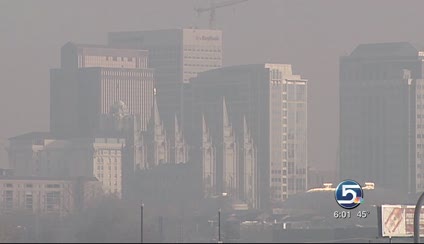
SALT LAKE CITY -- Three places in Utah ranked in the top 25 -- the worst 25, that is -- for short-term air pollution. And all got a grade of "F" Wednesday from the American Lung Association.
Nearly six out of 10 Americans live in areas with unhealthy levels of air pollution. -American Lung Assoc.
But there are some important qualifiers to the bad news.
Virtually all experts agree our air is sometimes unhealthy, dangerously so. But many Utahns don't realize our air is cleaner than it used to be, and the bad air comes and goes.
Last year Salt Lake City had about 50 days with bad small-particle pollution. Seven days were bad enough to be labeled "red" days.
Janice Nolen, assistant vice president of the American Lung Association said, "Particle pollution can be harmful, even if you breathe it at very high levels for just a few days."
The American Lung Association ranked cities with the worst short-term particle pollution. Bakersfield led the list, followed by such cities as Pittsburgh and Los Angeles. The Salt Lake City-Ogden area ranked seventh. Provo-Orem was 13th nationally, and Logan came in 18th. All were awarded F's.
"This should be taken very seriously," Nolen said. "We are actually putting people's lives at risk."
Utah Director of Air Quality Cheryl Heying expressed discomfort with the annual report card. "We look at it, but we don't need it to tell us we have a problem with particulate pollution," she said.
Breathing in particle pollution can increase the risk of early death, heart attacks, strokes and emergency room visits for people with asthma, cardiovascular disease and diabetes. -American Lung Assoc.
Heying says the report helps foster a strong public misimpression that air quality is getting worse. In fact, the Environmental Protection Agency last week reported the nation's air is 40 to 50 percent cleaner than a few decades ago, despite big growth in population, cars and miles driven.
"Cars are getting cleaner, and we're seeing the results of the fact that they are getting cleaner," Heying said.
Nolen feels differently. "Well, the numbers are fortunately lower for the kind of pollution generally that we produce today because we've taken steps to clean it up. But don't kid yourself, a lot of people are dying," she said.
Both agree recent medical studies justify even tougher regulation.
"The pollution levels that we used to think were acceptable are no longer acceptable," Heying said. "We have a lot more information that we're being impacted at much smaller levels than we thought were harmful before."
If you look at particle pollution all year long, Salt Lake looks better -- 34th in the nation. But the Lung Association says even a few bad days can be literally life-threatening.
And, clean-air advocates point out that plans for new development threaten the quality of air we're breathing now.
E-mail: hollenhorst@ksl.com