- Three videos of Charlie Kirk's shooting were submitted as evidence in court Monday.
- Defense attorneys objected to evidence as hearsay lacking foundational credibility.
- The judge rejected most objections except edited video, requiring unedited version submission.
PROVO — Three videos of Charlie Kirk being shot, each taken from a different angle, were submitted as evidence in 4th District Court on Monday.
But 4th District Judge Tony Graf agreed with both the prosecution and defense attorneys that the videos were too graphic to be shown in the courtroom and only allowed the videos to be shown on monitors at the tables where attorneys were sitting and at the judge's podium. Nevertheless, Erika Kirk and Charlie's parents, Robert and Kathryn Kirk, voluntarily left the courtroom while the videos were played.
Although the videos were not displayed for the entire courtroom to see, the audio could be heard. The video monitors at the table where Tyler Robinson was sitting appeared to be turned off. Robinson sat expressionless as the audio — which included a loud gunshot followed by people screaming — was played.
Monday was the first day of Robinson's preliminary hearing. He faces 10 charges, the most serious being aggravated murder, a capital offense. The Utah County Attorney's Office says it will seek the death penalty if Robinson is convicted on that charge. During a preliminary hearing, a judge will decide if there is sufficient probable cause to go to trial on the charges levied against a defendant. The bar prosecutors must meet to show probable cause, however, is very low at a preliminary hearing. A judge will not determine guilt or innocence during a preliminary hearing.
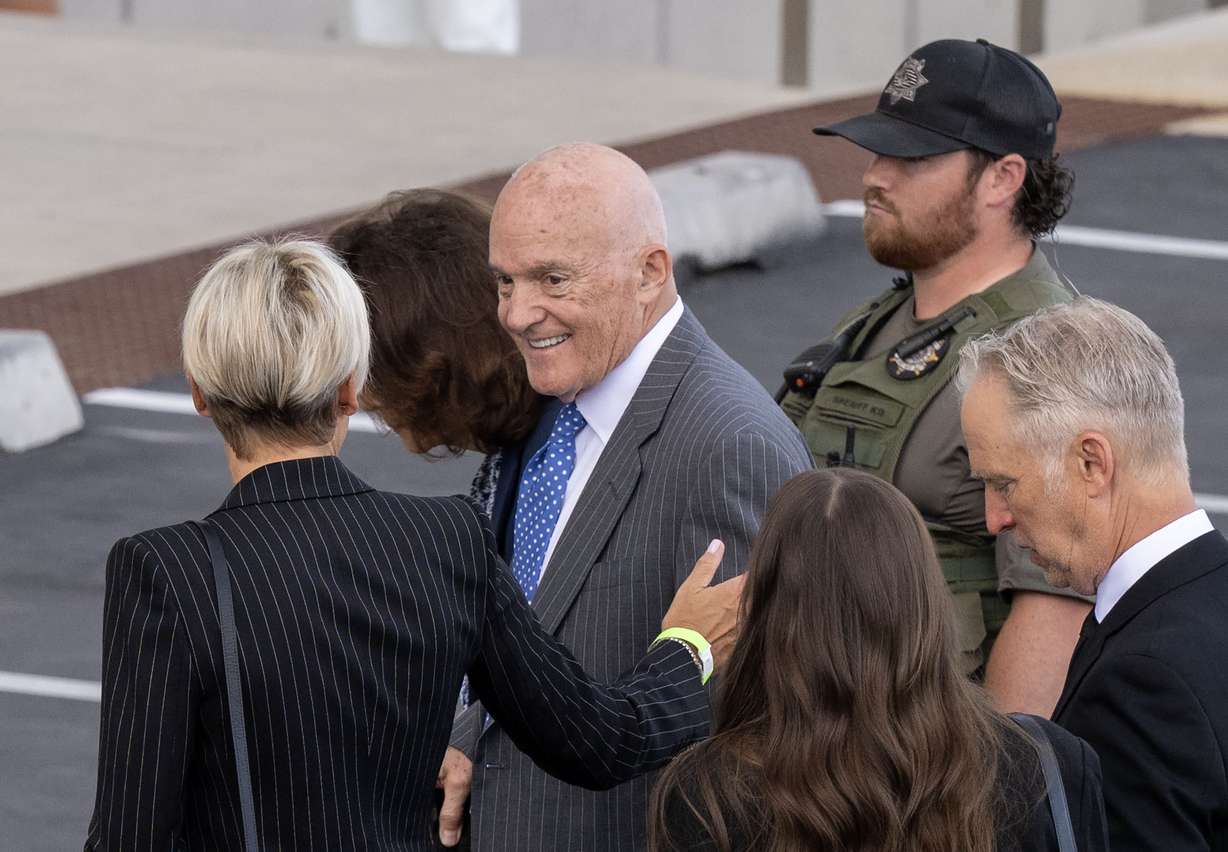
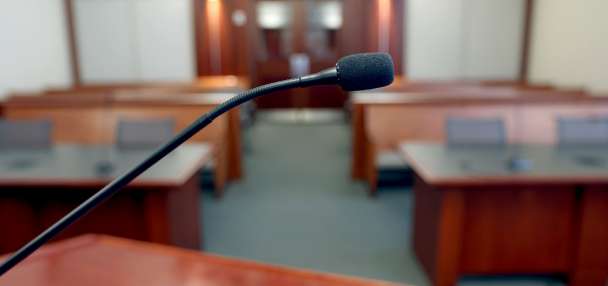
Security was exceptionally tight both in and outside the courthouse. Also present in the courtroom gallery on Monday was Donald Trump Jr. Seating inside Graf's courtroom was extremely limited with only 14 spots available to the general public on a first come, first served basis. Some people began lining up outside the 4th District courthouse at 1 a.m. Monday to make sure they got a seat.
During Monday's hearing, prosecutors called two law enforcers to the witness stand to testify. They laid the groundwork to show Kirk was shot and killed on the campus of Utah Valley University on Sept. 10, 2025, and that Robinson was on campus during that time.
The first witness called by the state was officer Chris Bagley, who currently works for the Spanish Fork Police Department but was working with the UVU department last September. His assignment that day was to secure the Hall of Flags near the amphitheater on campus, where Charlie Kirk was speaking.
Shelby Lofton, KSLBagley testified that while he was working, "I heard a shot fired," and recalled how it turned into a "chaos situation" because the thousands of people attending the Turning Point U.S.A. event "started getting up and (were) starting to run."
But just 30 seconds later, an alleged gunman was taken into custody, Bagley said. He recalled thinking it was "surprising" someone was arrested so fast. But as Bagley started preserving the crime scene, he found an empty holster for a handgun. Although it is unclear who owned the holster, Bagley said the discovery prompted him to take a second look at what was happening.
"I realized I heard a rifle shot, not a pistol shot," he testified. Bagley says he then realized the roof of the Losee Center provided a direct line of sight to where Kirk was sitting when he was shot.
Bagley later reviewed surveillance video, which showed a man gain access to the roof of the Losee building, run across the roof, crouch down and then run off again after the shot was fired and drop down from the north end of the roof. When he inspected the roof, Bagley says he found a red and black screwdriver, and the gravel rooftop was disturbed in a way that looked like someone had laid down on the roof.
"To me, it looks like a sniper's pad," Bagley testified.
Davis Hull, with the State Bureau of Investigation who ended up being the lead investigator in Kirk's killing, took the witness stand during the afternoon session. He introduced several videos as evidence that his team had collected, including videos of Kirk being shot, Ring doorbell footage of Robinson allegedly parking on a residential street near campus late that night and a report of the Utah Medical Examiner's Office following Kirk's autopsy.
Hull stated that identifying the person seen on the roof of the Losee building became a top priority in the investigation, and he explained how a team of investigators reviewed hundreds of hours of surveillance video. After his office received word that Robinson had surrendered in Washington County, his team pulled up all the information they could on Robinson from databases from places like the Department of Motor Vehicles and the Utah Driver's License Division in order to get a picture of Robinson and retrace his steps.
Investigators learned that Robinson was on the UVU campus a total of four times that day, including twice prior to Kirk being shot and once late that evening into the early hours of Sept. 11.
But also on Monday, Robinson's defense attorneys objected to every piece of evidence submitted to the court. The defense contends that the evidence being presented by the state is all hearsay. Hearsay evidence is any statement of video clip that a person, such as a police officer, collects from another person — such as a witness or another officer — and presents at the hearing.
Prior to Monday's hearing, Robinson filed a "standing objection" over the weekend that includes photographs and video recordings, the Utah State Medical Examiner's autopsy report without the testimony of the medical examiner, and testimony from police officers who talking about statements they received from other officers not in the courtroom.
Without the people who actually gave the statements or shot the videos on their phones, lead defense attorney Kathy Nester argued that a foundation to determine the credibility of each piece of evidence cannot be established, and attorneys are unable to do cross-examination.
"This is an expert report without an expert present," she objected to the medical examiner's report being submitted as evidence.
Nester also objected to Hull being asked to identify Robinson in the courtroom, calling it "unduly suggestive court identification."
Graf rejected all of Robinson's objections except one. The state had planned on introducing a video compilation taken from security cameras of Robinson's trek on the UVU campus. Prosecutors admitted, however, that parts of the video had been edited by enhancing portions of the video "circling" other parts of the video. Robinson's defense team objected to the video, however, saying there was no way to verify its authenticity if the people who allegedly edited the video couldn't be called as witnesses.
In this case, Graf agreed. Prosecutors say they will call Hull back to the witness stand first thing on Monday and submit an unedited version of the video.
Prosecutors are expected to call two more law enforcers to the witness stand after Hull and submit a video recorded interviewing with Robinson's roommate at the time Kirk was killed, Lance Twiggs. Robinson's attorneys are expected to call three expert witnesses of their own.
Contributing: Shelby Lofton and Daniel Woodruff