Estimated read time: 5-6 minutes
This archived news story is available only for your personal, non-commercial use. Information in the story may be outdated or superseded by additional information. Reading or replaying the story in its archived form does not constitute a republication of the story.
SALT LAKE CITY — Former Utah Attorney General Mark Shurtleff is scheduled to be in court Monday as the public corruption case against him slowly moves forward.
A five-day preliminary hearing is on the calendar, but it's possible that Shurtleff may take the same route as his successor, resigned Attorney General John Swallow, who last month decided to waive his evidence hearing.
At a preliminary hearing, a judge hears witness testimony and evidence. If the judge finds probable cause to believe the crimes were committed and the defendant likely committed them, the case goes to trial. If the judge finds the evidence insufficient, the case is dismissed. Charges also may be amended at the hearing.
"I think it would be unusual not to have at least evidence to the point of probable cause if you're going to go after a public official like that," said former Salt Lake County prosecutor Kent Morgan. "What evidence is there? Isn't it striking to everyone here that nobody's heard what the evidence is?"
And if Shurtleff waives his preliminary hearing, it could be some time before prosecutors have to spell out exactly what proof they have against him or Swallow.
Shurtleff faces nine felonies and Swallow 13 felonies and a misdemeanor in the alleged pay-for-play scandal in the attorney general's office. Prosecutors have only generally described the alleged crimes in court documents since charging the pair last July.
Swallow waived his preliminary hearing by filing a written motion. But Morgan said waivers are usually sought in person because a judge wants to determine if it's voluntary.
Morgan, who now is in private practice, said if Shurtleff skips the preliminary hearing it could be both a legal strategy and a way to avoid a public spectacle.
I think it would be unusual not to have at least evidence to the point of probable cause if you're going to go after a public official like that. What evidence is there? Isn't it striking to everyone here that nobody's heard what the evidence is?
–former Salt Lake County prosecutor Kent Morgan
"As a defense attorney, I would consider a waiver to be an advantage if I believed my case was so high profile that it would taint a future jury," he said.
Waiving the hearing also is often a "pretty good indicator" that plea negotiations are contemplated if not started, Morgan said.
Prosecutors charged Shurtleff with bribery, accepting gifts, improper use of position and evidence tampering. He face up to 30 years in prison if convicted.
Both former Republican attorneys general have maintained their innocence and say the charges are politically motivated.
Swallow has kept a low profile since being arrested and charged. But Shurtleff, 57, keeps his name and face in the public domain. He advertised his legal services on YouTube and is active on Twitter and Instagram, mostly posting about his family.
Prosecutors initially charged Shurtleff and Swallow as co-defendants but a judge separated the case after their lawyers objected. Davis County Attorney Troy Rawlings is prosecuting Shurtleff, while Salt Lake County District Attorney Sim Gill is prosecuting Swallow.
The charges against Shurtleff and Swallow stem from a nearly two-year investigation into relationships they had with several Utah businessmen, including one in prison and another indicted for fraud.
Shurtleff is accused of making two trips to the lavish Pelican Hill Resort near Newport Beach, California, paid for by Marc Sessions Jenson, a Salt Lake businessman the attorney general's office had prosecuted for selling unregistered securities and who was on probation at the time.
Shurtleff personally arranged a plea deal for Jenson that was so lenient that a judge rejected it, the charges state. The judge accepted a second plea agreement that also allowed Jenson to avoid jail but imposed $4.1 million in restitution. Jenson failed to repay investors and is now serving a 10-year prison sentence.
A businessman named Darl McBride also figures into the criminal charges against Shurtleff. McBride was involved in a dispute over a $200,000 loan he made to businessman Mark Robbins but was not repaid. McBride created a website attacking Robbins.
Related:
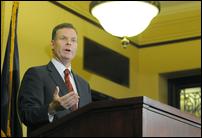
Swallow waives evidence hearing
Former Utah Attorney General John Swallow, who is fighting more than a dozen felony public corruption charges, decided to waive a week-long preliminary hearing that was scheduled to begin next week. (Photo: Matt Gade/Deseret News)Shurtleff intervened and in a May 2009 meeting at Mimi's Cafe with McBride, which McBride secretly recorded and turned over to criminal investigators, asked what he could do. McBride told him he needed $2 million to back off Robbins. Shurtleff told him he could get the money from Jenson.
A month later, Shurtleff met with Jenson in Southern California where Jenson was living. Jenson, who had yet to pay $4 million in restitution as part of his plea deal, told Shurtleff he didn't have the money.
According the charges, Shurtleff and Swallow told Internet marketer Jonathan Eborn that contributing to Shurtleff's election campaign would benefit him if he were investigated. Eborn, who owned Infusion Media, subsequently donated $30,000. The Federal Trade Commission filed a civil complaint against the company in 2009.
Shurtleff allegedly accepted gifts from indicted businessman Jeremy Johnson, who contributed to the former attorney general's campaign. Specifically, prosecutors say he used Johnson's personal jet to fly to California for a campaign fundraiser. Johnson's trial on 86 counts of fraud is scheduled for September.
The charges also say Shurtleff benefitted from the role he played in the state's litigation with Bank of America to obtain settlements for Utahns who had lost their homes in the mortgage crisis.
Shurtleff pulled the state out of the case as one of his last acts in office in December 2012 and then went to work for Troutman Sanders, an international law firm that holds Bank of America as a major client. He quit six months later.
Mark Shurtleff charges:
• Three counts of receiving or soliciting a bribe, a second-degree felony
• Two counts of accepting a gift, a second-degree felony
• Improper use of position, a second-degree felony
• Witness tampering, a third-degree felony
• Evidence tampering, a third degree felony
• Obstructing justice, a third-degree felony