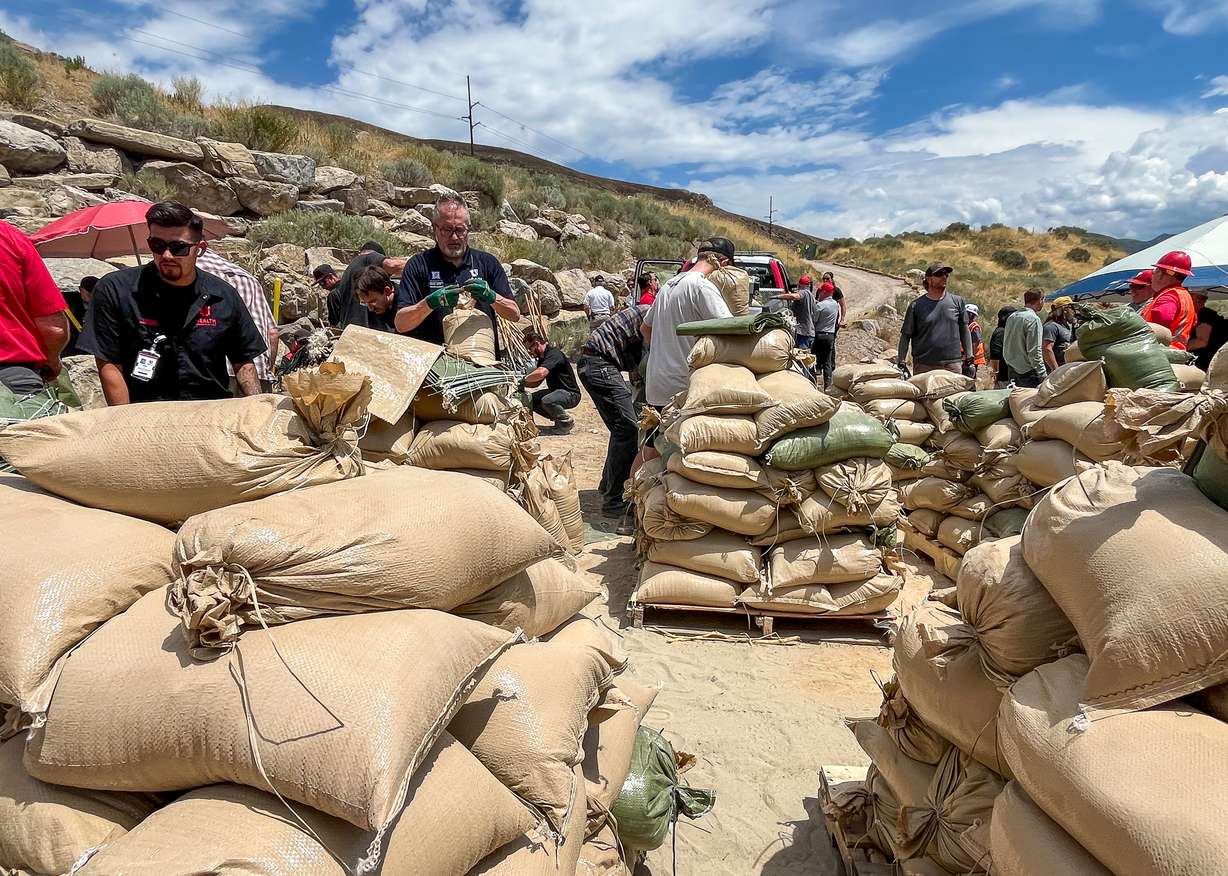
- Volunteers filled 2,000 sandbags while barriers were also installed next to Bonneville Fire burn scar.
- Flash flooding risk follows the fire, which burned 566 acres of foothills land near the University of Utah last month.
- Sandbags and barriers are temporarily solution after the fire.
SALT LAKE CITY — Firefighters last month were able to stop the Bonneville Fire from crossing the final shoreline trail dividing a popular foothills recreation space from several University of Utah Health facilities.
However, stopping flames is only half of the battle. The area is now prone to flash flooding, a threat that is shaping up this weekend and could last over the next few years.
It's why more than 100 volunteers braved the summer heat on Thursday to fill 2,000 sandbags that will be strategically placed along the burn scar over the next few days. They will be paired with 500 to 700 feet of concrete barriers that were also set up on the trails, seeking to slow down and redirect floodwaters and debris flows to nearby stormwater drainage spaces.
Monsoonal moisture has already sparked some flooding at burn scars in southern Utah. The odds of storms hitting the Salt Lake Valley increase on Friday and persist over the weekend into next week, leading to some concerns for buildings near the fire, said Phil Chaffee, director of emergency management for University of Utah Health.
"We've got four levels of mitigation that we're putting into place in anticipation that this burn scar (could be at risk)," he said as volunteers stacked sandbags to be hauled up toward the burn scar for placement. "We hope things don't happen, but in emergency management, hope is never a plan."
It's still unclear what caused the Bonneville Fire, which ultimately burned 566 acres after sparking on June 20.
Thankfully, because the fire burned through vegetation quickly, soils were "very minimally changed," said Salt Lake City Fire Capt. Tom Simons, who oversees the department's emergency management,
Alex Cabrero, KSL"The fire was quick. It passed through the area very quickly (and) we didn't see that deep, hard heat that tends to change the soil," he said. "While we have lost some of the plant structure, while we may see some debris and water come down, it's certainly a lot better than it could have been."
U.S. Forest Service and U.S. Geological Survey recently assessed the area for flood risks. Their models indicated that only 7% of the area was at moderate flooding, while about 70% of the land is at low risk, and the rest has no risk.
However, they also found there's a 40% to 60% chance that a moderate monsoonal downpour would spark flooding if it fell over the burn scar. Huntsman Cancer Institute's easternmost facilities, along with some University of Utah medical buildings in the area, are at highest risk, Chaffee said.
There is also some concern about flooding near Red Butte Creek, although he didn't expect much risk for the Red Butte Garden Amphitheatre. That could impact the city's watershed, something Salt Lake City Public Utilities is monitoring.
Homes in the area aren't considered at risk of burn scar flooding. The same is the case for homes near the Sandhurst Fire in 2024 and last month's Sandhurst 2 Fire, each of which burned near Ensign Peak, Simons said.
Salt Lake City firefighters weren't planning to hold a similar event for the area, but plan to communicate with residents about risks.
In the meantime, it's unclear how long the barriers will be set up near the Bonneville Fire. Long-range models list Utah as having a stronger probability of above-normal moisture this summer, which means the risks of monsoonal downpours could linger for weeks or months.
Trails were closed on Thursday and will remain closed on Friday while crews place the sandbags and barriers. It's a temporary solution until local, state and federal crews reseed in the area, although neither Chaffee nor Simons knew when that could begin.
"It really all depends on how the burn scar recovers," he said. "Where the impact was lower, it could recover much quicker. We look for vegetation to come back and some of those root structures to come back."