Estimated read time: 6-7 minutes
This archived news story is available only for your personal, non-commercial use. Information in the story may be outdated or superseded by additional information. Reading or replaying the story in its archived form does not constitute a republication of the story.
SALT LAKE CITY — The relentless cycle of the presidential race is finally nearing an end, with just over two weeks to go before a candidate is elected president of the United States. And yet, many Americans struggle to make it to Election Day without losing their sanity.
On May 11, 2011, the presidential race officially began when former speaker of the House Newt Gingrich threw his name in the ring as a candidate for the Republican Party. Shortly after — eight days later to be exact — I wrote my first article on the presidential race, which started the never ending election coverage.
Republican candidates quickly followed in Gingrich's footsteps, declaring their bid for the White House. And what followed? The search for the likely Republican candidate to dethrone incumbent President Barack Obama and his "failed policies," which included a myriad of tactics to discredit the other candidates along the way.
For months, Americans endured the infinite debates, polls and negative campaigning before Mitt Romney was nominated as the Republican candidate to take on President Obama. Since then, we've had to endure numberless assault tactics to sway voters.
If the general election could be summarized, it might sound something like this: constant bickering, flip-flopping, pandering to voters, gaffes, secret videos, the media bias, campaign slogans, October surprises, negative political ads, super PACs, fundraising, candidate endorsements, misguided statements, polling (with or without bias), more fundraising, nitpicking of candidates and what they say or don't say (from the media and the opposing campaign), policy issues and the dividing and conquering of voters.
#poll
Following Tuesday's debate, the country focused more on Romney's comments of "binders full of women" more than the actual policies discussed. Even after the first debate the focus was more on Big Bird than what Romney was trying to say. There were over 400,000 tweets about Big Bird, while only 260,000 tweets were about jobs.
Earlier in the race, President Obama's comments about "you didn't build that" were used to say government is the only means for creating businesses and jobs. While the comments make for some fun talking point in the weeks after, they ultimately have no relevance to the actual election or the policies the candidates hope to promote. Instead, these comments are often used as distractors from the real issues.
Do any of these things really help us vote and keep us interested in the presidential race? Even those who immerse themselves in politics (myself included) get tired of it at some point. Policy issues and reasonable plans for the presidency are thrown out of the window for gotcha moments, zingers and how well or not a candidate argues his point.
Democrats counted down the days till former President George W. Bush was out of office. The same holds true for Republicans and President Obama. Is this the way we should be thinking? Is this how we want our country governed? Of course no one president will have the backing of everyone, but isn't there something better? Candidates are lining up, chomping at the bit to kick out the president, because America is on its last breath with (insert one of any of the last few presidents) in office.
- 1960: 62.77%
- (John F. Kennedy vs. Richard Nixon)
- 1964 : 61.92%
- (Lyndon B. Johnson vs. Barry Goldwater)
- 1968: 60.84%
- (Richard Nixon vs. Hubert Humphrey)
- 1972: 55.21%
- (Richard Nixon vs. George McGovern)
- 1976: 53.55%
- (Jimmy Carter vs. Gerald Ford)
- 1980: 52.56%
- (Ronald Reagan vs. Jimmy Carter)
- 1984: 53.11%
- (Ronald Reagan vs. Walter Mondale)
- 1988: 50.15%
- (George H.W. Bush vs. Michael Dukakis)
- 1992: 55.23%
- (Bill Clinton vs. George H.W. Bush)
- 1996: 49.08%
- (Bill Clinton vs. Bob Dole)
- 2000: 51.30%
- (George W. Bush vs. Al Gore)
- 2004 : 55.27%
- (George W. Bush vs. John Kerry)
- 2008 : 57.48%
- (Barack Obama vs. John McCain)
It seems the sole purpose nowadays is to divide the country for a solitary vote. We consider 51 percent as a victory and the means of deciding a president. However, how is that a victory when 49 percent of Americans lost in the election. Americans were outraged when Romney spoke of the 47 percent. But how come no one talks about the roughly 49 percent who will be dissatisfied with the results of the election on Nov. 7? Even some of the 51 percent will be less than satisfied with their selection.
In 2008, only 57.5 percent of the voting-age population turned out to vote, which was the highest turnout in a presidential election since 1968 (60.8%) when Richard Nixon beat Hubert Humphrey.
We watch for months as the two political parties fight and tell us how the opposing party doesn't have our interests at stake. After all, don't you know that if President Obama is reelected it's the end of America as we know it? And if Romney is elected, the middle class will essentially be fending for themselves as the wealthy get wealthier and do little to help those below them?
Nevertheless, we're supposed to be united as one homogeneous society after a president is declared?
In a close presidential race there really is no victory. Voters stop going to the polls because their vote "doesn't count" or they're choosing between the "lesser of two evils." As a result, voters grow tired of the election even before they begin. As the race continues, the disdain and apathy increases and Americans turn away from the voting process.
Others, likely take part in early voting as a way to be done with the election process. The bickering and the negativity can continue all around them, but the early voter doesn't have to be bogged down by it and can move on with their life — they've performed their civic duty. Still, Americans struggle to cast a vote.
Many argue that neither candidate or party has their interest at heart. For some, choosing between the lesser of two evils is not even an option. For others, America lost its way long ago, so voting for one of the candidates is only promoting the madness; it sustains the problems and promotes growth.
Related:
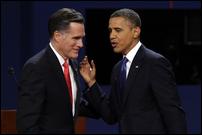
Obama up, Romney down in polls — does it matter?
Voters will be inundated with polling data suggesting the election is moving in one direction or another. But does polling data really have an impact on the presidential race, especially with so many firms coming up with different numbers?Simply, Americans lose interest and grow tired of the candidates, the parties and elections because many believe their voice isn't being heard. As a representative democracy we are not being heard. As long as the approval rating of Congress hovers around 13 percent, voters will continue to lose interest. Of course, this is not the only reason for voter apathy, but it is a major contributor to the problem.
Many will argue that there is more interest in politics and the elections today. The two presidential debates had a large TV viewing audience, with approximately 67.2 million tuning in to the first presidential debate and approximately 65.6 million tuning in to the second presidential debate. However, that only accounts for approximately 25 percent of the U.S. population that is eligible to vote.
While the interest may be there, watching a debate does not necessarily translate into votes on Election Day. Americans may be interested in the debate, but feel as though their voice isn't heard and will skip out on voting.
If you're not satisfied with your representatives, don't skip out on voting; that only allows for a disproportionate vote to be cast. Go out and vote, make your voice heard and participate in the change. Don't just be another statistic of Americans dissatisfied with the way the country is moving who don't vote. If you participate, you can and will make a difference. And isn't that better than sitting on the sidelines anyways?