'%3e%3cpath%20d='M34.1406%205.85938C30.3906%202.10547%2025.3047%200%2020%200C14.6953%200%209.60938%202.10547%205.85938%205.85938C2.10938%209.61328%200%2014.6953%200%2020C0%2025.3047%202.10547%2030.3906%205.85938%2034.1406C9.61328%2037.8906%2014.6953%2040%2020%2040C25.3047%2040%2030.3906%2037.8945%2034.1406%2034.1406C37.8906%2030.3906%2040%2025.3047%2040%2020C40%2014.6953%2037.8945%209.60938%2034.1406%205.85938ZM37.0117%2023.543H31.1602V13.5391H27.6328V19.9414C28.1211%2020.6914%2028.3711%2021.582%2028.3711%2022.5625V22.625C28.3711%2023.668%2028.1172%2024.6055%2027.6328%2025.4297V26.6094H36.082C33.4883%2032.9375%2027.2891%2037.3789%2020.0039%2037.3789C10.3711%2037.3789%202.62109%2029.6289%202.62109%2020C2.62109%2010.3711%2010.3711%202.62109%2020%202.62109C29.6289%202.62109%2037.3789%2010.3711%2037.3789%2020C37.3789%2021.1484%2037.2617%2022.2656%2037.0508%2023.3477C37.0391%2023.4141%2037.0234%2023.4766%2037.0117%2023.543Z'%20fill='white'/%3e%3cpath%20d='M22.3086%2018.5352C20.4336%2018.125%2019.9531%2017.8398%2019.9766%2017.1836V17.1406C19.9766%2016.6992%2020.3477%2016.2148%2021.4023%2016.2148C22.582%2016.2148%2023.8867%2016.6797%2025.0781%2017.4766L26.8516%2015.0195C25.4453%2013.8906%2023.707%2013.3398%2021.5547%2013.3398C18.5195%2013.3398%2016.4375%2015%2016.4063%2017.4766V17.5352C16.3633%2020.2617%2018.5859%2020.9805%2021.293%2021.6016C23.0391%2021.9766%2023.5703%2022.3164%2023.5703%2022.9609L23.5469%2022.9766C23.5469%2023.3906%2023.2578%2023.7031%2022.7852%2023.8359C22.5742%2023.9062%2022.1289%2023.9727%2021.5156%2023.9727C20.7617%2023.9727%2019.7539%2023.8633%2018.6328%2023.4844C18.0898%2023.2891%2017.4727%2023.0039%2016.8047%2022.6133L20.1406%2026.625C20.2813%2026.6602%2021.0977%2026.8516%2021.7734%2026.8516C25.0039%2026.8516%2027.0859%2025.2461%2027.1094%2022.6328V22.5703C27.1602%2020.1133%2025.2148%2019.1719%2022.3086%2018.5352Z'%20fill='white'/%3e%3cpath%20d='M5.24219%2013.5664V26.6133H8.75391V23.7578L10.2969%2021.9531L14.2031%2026.6133H18.3867L12.3555%2019.5195L17.4023%2013.5664H13.4531L8.75391%2019.0586V13.5664H5.24219Z'%20fill='white'/%3e%3c/g%3e%3cdefs%3e%3cclipPath%20id='clip0_97_2430'%3e%3crect%20width='40'%20height='40'%20fill='white'/%3e%3c/clipPath%3e%3c/defs%3e%3c/svg%3e)




- A Deseret News-Hinckley Institute poll shows 53% of Utahns oppose the Stratos Project.
- Kevin O'Leary's proposed Box Elder data center faces backlash over water and energy use.
- Politicians and experts debate AI infrastructure's impact, with opposition crossing party lines.
SALT LAKE CITY — The massive changes needed to support an artificial intelligence revolution have polarized the nation and Utah, turning the debate over AI infrastructure into a political powder keg.
A new Deseret News-Hinckley Institute of Politics poll conducted by Morning Consult reveals a majority of Utah voters are opposed to a proposed data center in Box Elder County backed by celebrity investor Kevin O'Leary.
Almost immediately after it was announced, the project spurred a dramatic public response that pressured state leaders to slow down the fast-tracked steps they had initiated.
Utah candidates for Congress have already felt the need to weigh in on the process, while others have made their stance in favor of or against the project a central talking point of their campaigns.
The data center debate has created a coalition of voters united around concerns about its impacts on water, energy and local control, while many remain unsure if Utah leaders should welcome, postpone or reject an AI future.
New poll on data center
The Deseret News-Hinckley Institute poll asked Utah voters if they support the "Stratos Project," recently approved by the Box Elder County Commission for 40,000 acres across three sites in Hansel Valley.
A majority of voters, 53%, said they either somewhat or strongly oppose the project, while 30% say they somewhat or strongly support it, according to the Morning Consult poll conducted May 15-18 among 802 voters.
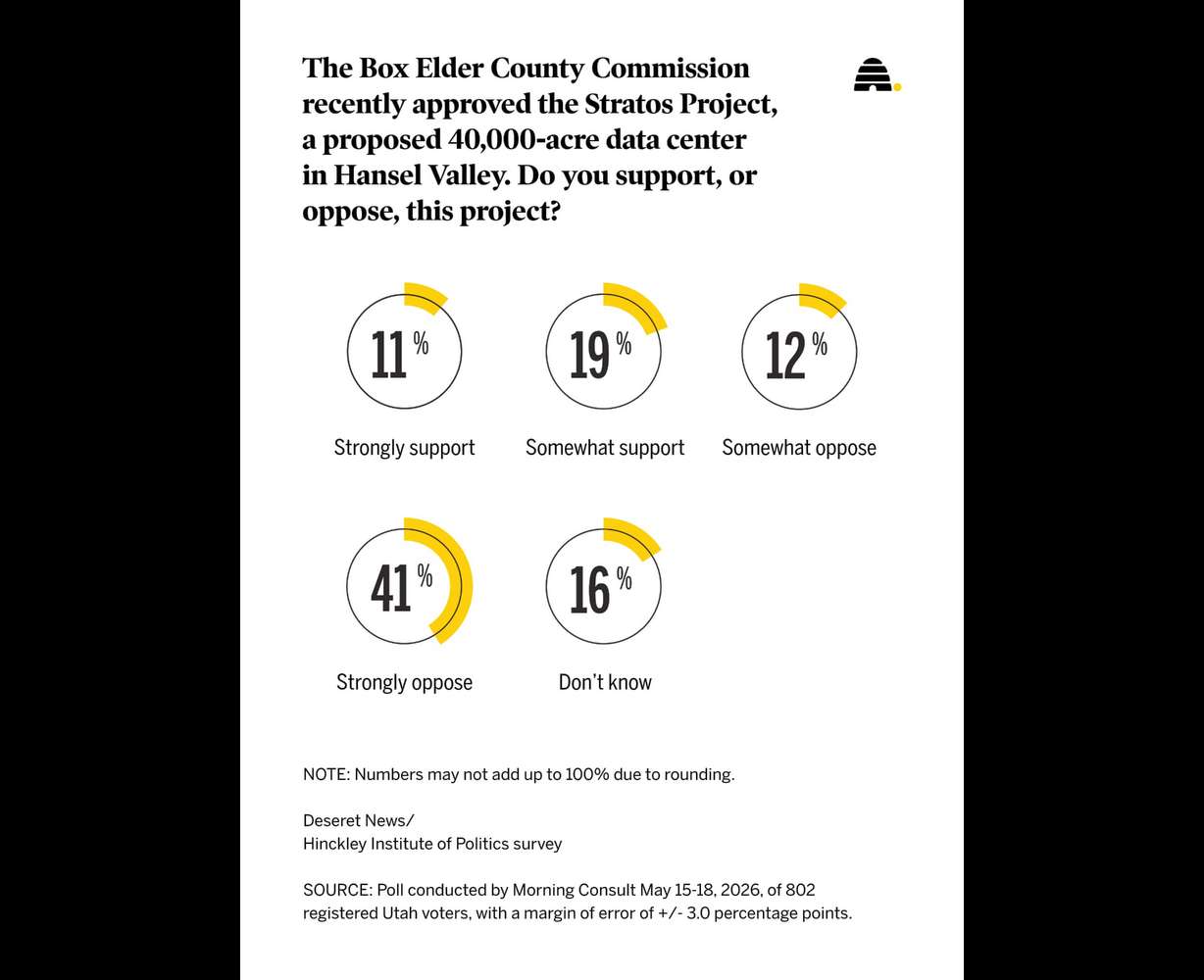
Hinckley Institute director Jason Perry noted the "remarkably low" level of undecided Utahns for such a complex project.
"Utahns do not appear to be waiting around to learn every detail before forming an opinion," Perry told the Deseret News. "What is unusual here is how quickly the Stratos project became a statewide conversation."
The share opposing the project was highest among self-identified Democrats and suburban voters.
Nearly 85% of Democrats oppose the project, compared to 62% of independents and 36% of Republicans. The largest share of GOP voters (45%) support the project, while 1 in 5 say they don't know, according to the survey.
Opposition held steady across age groups but varied by region: 52% of urban residents support it; 42% oppose. Just 20% of suburban and 22% of rural residents support it, with 61% suburban and 53% rural opposing.
Anti-data center sentiment can be observed nationwide, with local backlash leading to project moratoriums in 69 jurisdictions, with efforts underway to expand that by another 78, as the Deseret News previously reported.
What is the Stratos Project?
O'Leary met with Utah Gov. Spencer Cox to discuss the project in January. O'Leary presented details of the plan to Utah's Military Installation Development Authority, which approved special zoning incentives on April 24.
MIDA wields municipal authority to accelerate projects with local permission. On May 4, Box Elder County commissioners approved the first step of MIDA's project plan, allowing it to proceed to the permitting process.
O'Leary has advertised the Stratos Project as one of the world's largest data centers — a campus of warehouse-size buildings filled with computer servers, used to train and operate large language models like ChatGPT.
At full build-out, the data center is projected to consume more than 7.5 gigawatts, twice the peak energy consumption of the state, and 619 million gallons of water — enough for several thousand homes.
Phase I will be limited to 1 gigawatt and 3.6 million gallons of water on less than 2,000 acres. Regulators say water depletion will be less than current agricultural use and emissions will comply with the Clean Air Act.
While it was granted 100% property tax relief, the project committed $16 million upfront to offset county services, $30 million in energy tax revenue for Phase I and $100 million, plus 2,000 jobs, upon completion.
Is it worth it?
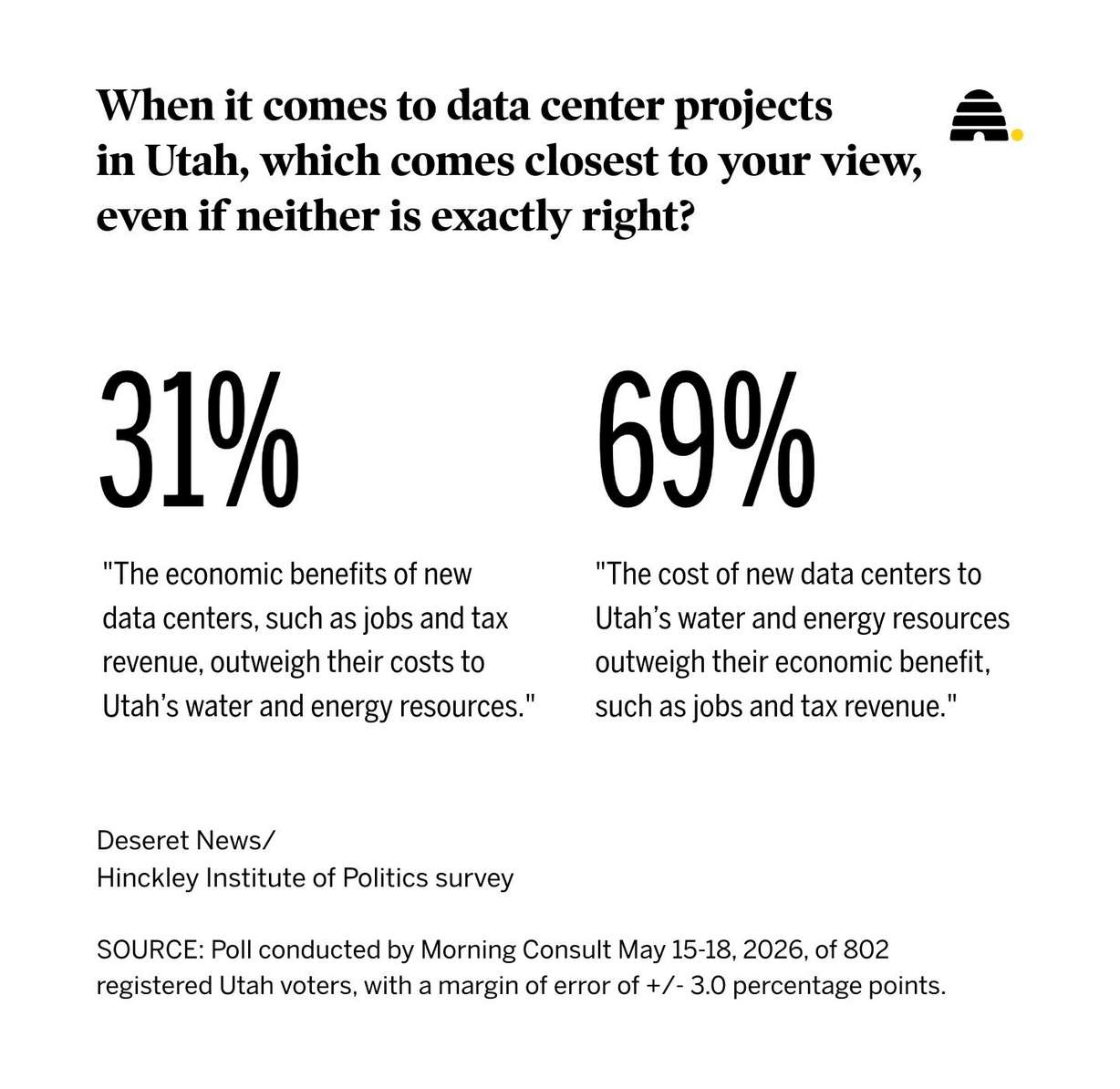
The Deseret News-Hinckley Institute poll also asked voters whether they thought the economic benefits of new data centers, like jobs and tax revenue, outweigh their costs to Utah's water and energy resources.
Nearly 7 in 10 voters, representing a majority across every party, age and regional group, said they did not, including 60% of Republicans, 82% of Democrats, 60% of voters under 35 and around 75% of voters 35 and older.
"The way it's been handled have all the hallmarks of a bad deal for Utahns, and the people nearest to it, at least in terms of perception," Brady Young, the state's former lead AI policy analyst, told the Deseret News.
Regardless of what people think about AI, it seeds public distrust when a group of wealthy individuals utilizes a little-known government entity to green-light a transformative AI installation, Young said.
Utah economic opportunity director Jefferson Moss said he takes ownership of the state, not communicating better on the project. MIDA might not be the best body to approve these kinds of projects, he acknowledged.
"We've not come out and said we're anti-data centers. We're not out there shouting from the rooftops, 'Come to Utah.' We believe in the process," Moss told the Deseret News. "You have to go through all these steps."
What candidates have said
Despite Utah's reputation as one of the most friendly states for innovative tech and energy startups, the hostility toward AI infrastructure has sent politicians scrambling to find a balanced approach on the issue.
At a Deseret News/Atlantic event last week, Cox reiterated the national security imperative of building AI capacity, but he also recognized "people are right to push back" because he said, "The process wasn't great."
Meanwhile, Jason Chaffetz, who confirmed with the Deseret News he is considering a bid for governor, received pushback for a post last week explaining why his consulting firm helped bring the project to the state.
Rep. Blake Moore, who represents northern Utah, told the Deseret News he trusts the county to make the choice. His GOP primary challenger, Karianne Lisonbee, said Box Elder deserved more transparency from MIDA.
In Deseret News editorial board meetings, Rep. Celeste Maloy said Utah data centers should be air-cooled to limit water use, while her opponent, Phil Lyman, said the project is an example of harmful government favoritism.
Democratic candidates for Congress all came out opposed, with Ben McAdams claiming the project is in the wrong place, Nate Blouin lambasting O'Leary's involvement and Liban Mohamed calling for a ban.
"AI data centers are going to become a much bigger political issue in Utah," Perry said. "Once you start seeing concern cut across party lines, it usually means the issue is going to have staying power."
What national experts say
Tension in Utah over data centers may feel new, but it is on its way to becoming a common feature of politics.
Corey Young, who directs research into local government and data centers at Washington & Jefferson College in Pennsylvania, said large data centers will soon be "ubiquitous" at the state level.
Around 700 large data centers are under construction across the U.S., including 10-gigawatt projects in Texas and Wyoming, with more than 3,000 data centers expected to take 10-25% of America's energy by 2030.
This has unified "a lot of odd bedfellows" from across the political spectrum, Young said, around anxiety that data centers might speed up AI threats to society, have uncertain benefits or directly harm nearby communities.
"We've seen a unified front on the anti-data center side of the argument of both environmentalists, who have tended to be more progressive folks, with much more conservative folks," Young told the Deseret News.
Far from being unprecedented, AI boosters believe data center outrage is just part of an old pattern.
Major changes spark "a moment of technopanic" before people understand the connection between the services they rely on and the infrastructure, said Neil Chilson, head of AI Policy at the Abundance Institute.
"History has shown that technology has been the primary driver of widespread human prosperity. And I think AI is well poised to continue that. We've just got to tell that story better," Chilson told the Deseret News.
But he doubts the political dynamic will improve quickly because, as AI benefits remain abstract, "fear sells."