
Estimated read time: 3-4 minutes
This archived news story is available only for your personal, non-commercial use. Information in the story may be outdated or superseded by additional information. Reading or replaying the story in its archived form does not constitute a republication of the story.
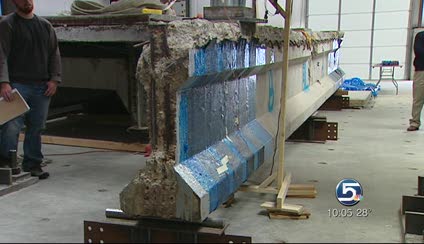
LOGAN -- Utah State engineers smashed a bridge beam Monday to find out how to strengthen bridges across the state. What they discover should help the Utah Department of Transportation save money and make our bridges safer.
The destruction was part of the university's SMASH Lab -- that's Systems, Materials and Structural Health Laboratory.
The professors and students tested concrete girders salvaged from dismantled Utah bridges by gradually loading pressure of more than 300,000 pounds. They want to find out if carbon fiber used to strengthen the girder can add life to the structure.
"You won't get to see a bridge fail like this out in the field, so you get to do it here to understand the consequences," said Kevin Womack, director of the Utah Transportation Center at Utah State.
With tight budgets, the state wants to find ways to strengthen bridges and make them last longer without replacing them.
The massive girder tested Monday used to support the 4500 South bridge over Interstate 215 in Salt Lake County. You may remember UDOT replaced the steep bridge using an innovative off site building technique that became somewhat routine on Interstate 80 reconstruction.
These tests examine the capacity of bridges and how we can continue to drive over them without problems.
"Anything we can do to make those bridges last longer in the field saves us, the taxpayers. It [also] saves UDOT a lot of money in the end," said Paul Barr of the Department of Civil Engineering at Utah State.
In the lab, the huge hammer driving force onto the girder created above 35,000 pounds of pressure. At nearly 400,000 pounds of pressure, the carbon fiber finally snapped. The concrete and the steel within reached their capacity and crumbled. All the while, monitors recorded the loads, stresses and strains.
"We have so many bridges that we need to replace in this state that we can't replace them all," Barr said.
Freezing, thawing and salt deteriorate the girders. Replacement is expensive, takes time and costs motorists time on the road.
In these tests, the carbon fiber helped carry the load at a minimal cost compared to replacement.
"If we add this carbon fiber to it, we are getting an increase in capacity somewhere around 25 to 40 percent, depending on the configuration we're using with the carbon fiber," Barr said.
The carbon fiber could be applied prior to construction, or later in the life of the girder.
The testing is done through the Utah Transportation Center at Utah State, which receives federal and state funding for this kind of testing.
"Ultimately, the people of the state of Utah benefit because this is information that will be given to UDOT," Womack said. "They'll be able to better repair their bridges, better maintain their assets, and ultimately save the taxpayers money."
Every Utah bridge gets a check every two years. The professors said we should not worry about bridge failure as we drive throughout the state. Our bridges, they said, are in better shape than the average nationwide.
E-mail: jboal@ksl.com