- Sen. John Curtis emphasizes Taiwan's defense as crucial against China's annexation threat.
- Curtis recently led a bipartisan delegation to Taiwan discussing U.S. support against China.
- Curtis also introduced a bill to enhance U.S.-Taiwan cooperation on drone production.
SALT LAKE CITY — As conflicts rise across the world, Sen. John Curtis is urging his colleagues to focus their attention on what he considers to be the greatest threat to the global economy: China's stated desire to eventually annex Taiwan.
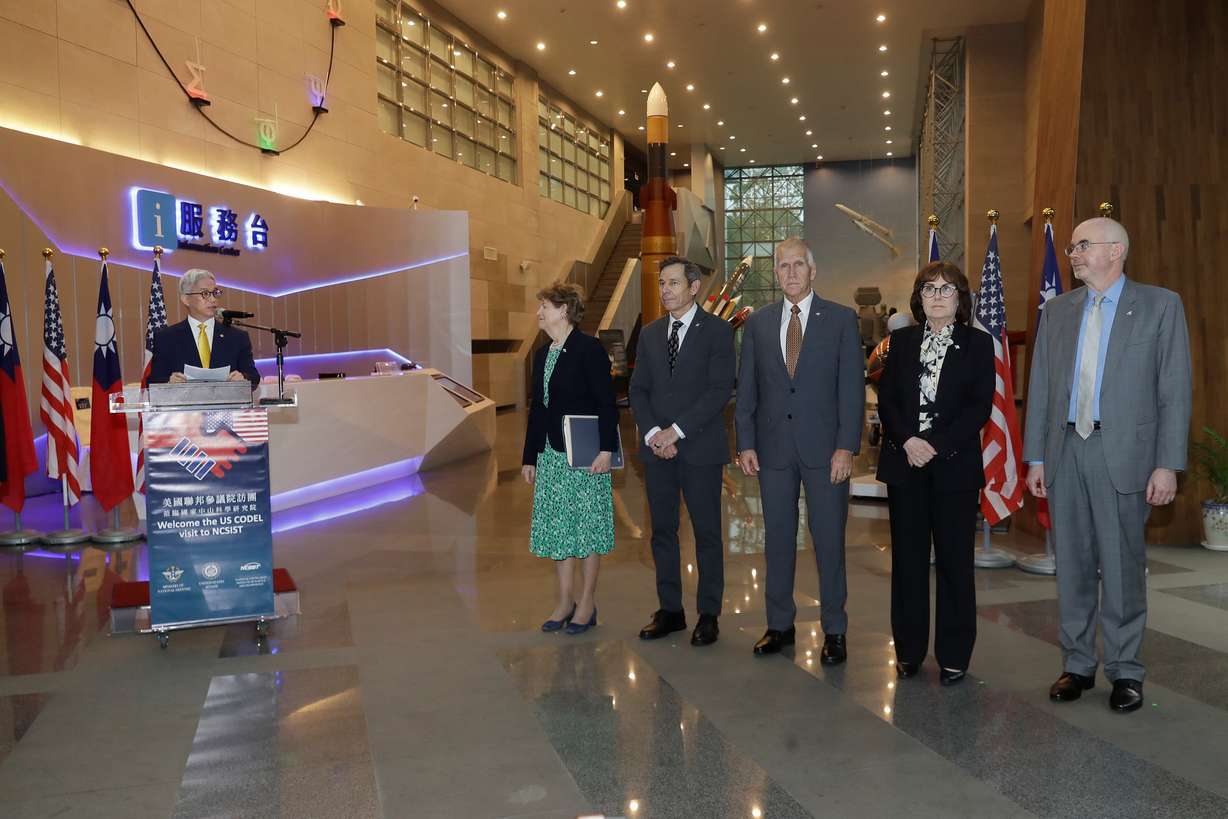
Curtis led a bipartisan congressional delegation to Taiwan last week, during which lawmakers met with top country leaders to discuss Congress's role in affirming U.S. support to defend itself against future attempts by China to invade the country. Curtis and other senators also toured National Chung-Shan Institute of Science and Technology, where country leaders are working to enhance their defense production.
"If China invades Taiwan, which they have said they will, that will have a massive impact on the United States," Curtis told the Deseret News in an interview. "It's estimated that it would impact our GDP by 10% worldwide."
Chinese leaders have said for decades they plan to invade Taiwan in pursuit of unification. Despite the People's Republic of China government never controlling Taiwan, top country leaders claim the country is a "breakaway province" that belongs to China. As recently as 2022, President Xi Jinping has reiterated his desire to be ready to invade Taiwan by 2027 — a timeline that Taiwanese leaders are working to deter.
When Curtis first traveled to Taiwan four years ago on a different congressional trip, the Utah Republican said there was a "sense of inevitability" that China would invade and Taiwan "would succumb" to its force. But now, he said, that sentiment has shifted.
"In just the four years since I've been there, it's fascinating to see how that has changed, and there's a real optimism now that they can push back on China, and it's not inevitable anymore," Curtis said.
Curtis specifically pointed to the country's special defense budget that is currently under consideration that would allocate $40 billion over the next eight years to supplement Taiwan's regular defense budget. That money would bolster Taiwan's recent efforts to adopt what is known as "symmetric defense production," a strategy that smaller countries use to offset a stronger adversary's capabilities.
But Congress has a role in support in the country as well, Curtis argued.
Defending Taiwan's sovereignty and denouncing Chinese aggression has long been a priority for the Utah senator — and a personal one. Curtis served his two-year mission for The Church of Jesus Christ of Latter-day Saints in Taiwan, and he considers it a global interest to protect the country's autonomy.
"It's easy to get distracted because there are some very substantial and important conflicts going on in the world right now," Curtis said. "But I think if you ask people who monitor this closely, 'What's our biggest threat?' it is China. There's not even a close second."
Days after Curtis returned from his trip to Taiwan, which also included stops in Tokyo and Seoul for other meetings, the Utah senator introduced a bill that would expand cooperation between the United States and Taiwan to bolster drone production. Doing so, Curtis said, would help with the development of Taiwan's asymmetric defense strategy.
"We'll likely be asked to make policy decisions based on that part of the world," Curtis said. "And having been there in person, having talked with those nations' leaders, obviously prepares us much better to be policymakers when those decisions come before us."
Meanwhile, Taiwan's opposition leader could meet with Xi sometime in the next week, which would mark the first-ever meeting between the Chinese president and the leader of Taiwan's main opposition party, the Kuomintang.
President Donald Trump is also set to meet with Xi later this summer, when Taiwan is expected to be a topic of discussion.
The meetings also come as the military is engaged in operations in Iran, which could reshape the conversation — and give China less resistance if it decided to go through with invading Taiwan.
As a result, Curtis argued, the U.S. should ensure that Taiwan remains a top priority.
"I would call this an all hands on deck" situation, Curtis said. "And what I mean by that is everybody has a role here: the executive branch, the legislative branch. Just small things, like us being able to work with Taiwan to increase their defense budget is just a tiny little piece of the role that we can play in protecting the United States' interests."