'%3e%3cpath%20d='M34.1406%205.85938C30.3906%202.10547%2025.3047%200%2020%200C14.6953%200%209.60938%202.10547%205.85938%205.85938C2.10938%209.61328%200%2014.6953%200%2020C0%2025.3047%202.10547%2030.3906%205.85938%2034.1406C9.61328%2037.8906%2014.6953%2040%2020%2040C25.3047%2040%2030.3906%2037.8945%2034.1406%2034.1406C37.8906%2030.3906%2040%2025.3047%2040%2020C40%2014.6953%2037.8945%209.60938%2034.1406%205.85938ZM37.0117%2023.543H31.1602V13.5391H27.6328V19.9414C28.1211%2020.6914%2028.3711%2021.582%2028.3711%2022.5625V22.625C28.3711%2023.668%2028.1172%2024.6055%2027.6328%2025.4297V26.6094H36.082C33.4883%2032.9375%2027.2891%2037.3789%2020.0039%2037.3789C10.3711%2037.3789%202.62109%2029.6289%202.62109%2020C2.62109%2010.3711%2010.3711%202.62109%2020%202.62109C29.6289%202.62109%2037.3789%2010.3711%2037.3789%2020C37.3789%2021.1484%2037.2617%2022.2656%2037.0508%2023.3477C37.0391%2023.4141%2037.0234%2023.4766%2037.0117%2023.543Z'%20fill='white'/%3e%3cpath%20d='M22.3086%2018.5352C20.4336%2018.125%2019.9531%2017.8398%2019.9766%2017.1836V17.1406C19.9766%2016.6992%2020.3477%2016.2148%2021.4023%2016.2148C22.582%2016.2148%2023.8867%2016.6797%2025.0781%2017.4766L26.8516%2015.0195C25.4453%2013.8906%2023.707%2013.3398%2021.5547%2013.3398C18.5195%2013.3398%2016.4375%2015%2016.4063%2017.4766V17.5352C16.3633%2020.2617%2018.5859%2020.9805%2021.293%2021.6016C23.0391%2021.9766%2023.5703%2022.3164%2023.5703%2022.9609L23.5469%2022.9766C23.5469%2023.3906%2023.2578%2023.7031%2022.7852%2023.8359C22.5742%2023.9062%2022.1289%2023.9727%2021.5156%2023.9727C20.7617%2023.9727%2019.7539%2023.8633%2018.6328%2023.4844C18.0898%2023.2891%2017.4727%2023.0039%2016.8047%2022.6133L20.1406%2026.625C20.2813%2026.6602%2021.0977%2026.8516%2021.7734%2026.8516C25.0039%2026.8516%2027.0859%2025.2461%2027.1094%2022.6328V22.5703C27.1602%2020.1133%2025.2148%2019.1719%2022.3086%2018.5352Z'%20fill='white'/%3e%3cpath%20d='M5.24219%2013.5664V26.6133H8.75391V23.7578L10.2969%2021.9531L14.2031%2026.6133H18.3867L12.3555%2019.5195L17.4023%2013.5664H13.4531L8.75391%2019.0586V13.5664H5.24219Z'%20fill='white'/%3e%3c/g%3e%3cdefs%3e%3cclipPath%20id='clip0_97_2430'%3e%3crect%20width='40'%20height='40'%20fill='white'/%3e%3c/clipPath%3e%3c/defs%3e%3c/svg%3e)




- Emerald Hills Institute hosted a Ramadan dinner to promote unity, drawing a cross-section of community and religious leaders.
- Participants noted Monday's attack on the imam of the Utah Islamic Center, who was uninjured, but the event was nevertheless festive and upbeat.
- Ramadan is the holiest month for Muslims and speakers at the event stressed the importance of respect and unity.
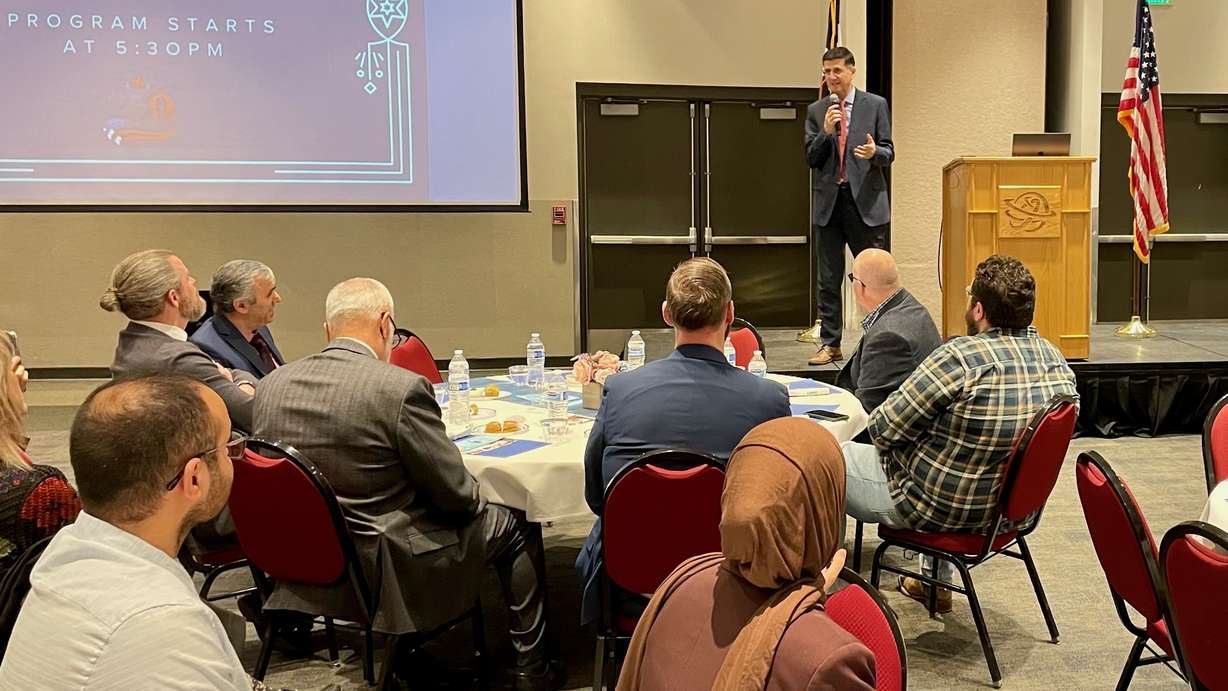
SANDY — As Muslims around the world mark Ramadan, a gathering of people from a mix of faiths unfolded on Thursday with the aim of promoting unity and recognizing the Muslim community in Utah.
"When people sit down together, especially people who don't always cross paths, we remember each other's humanity, we listen actively, differently, we make room for a stranger," said Sergazi Nurbavliyev, executive director of Cottonwood Heights-based Emerald Hills Institute.
"Our hope is that an evening like this becomes a bridge between faiths, cultures, neighborhoods and perspectives because strong communities are not built by everyone thinking the same. They are built when people choose respect, curiosity and connection."
Ramadan, a holy time for Muslims, started Feb. 18 and lasts about a month. Muslim practitioners go without food or drink from sunup to sundown during the period and gather for an evening meal. The Special Interfaith Ramadan Dinner on Thursday in Sandy, an annual Emerald Hills Institute event, expanded on what would be a typical Ramadan gathering, involving a cross-section of community and faith leaders and speakers.
Utah's Muslim population ranges from an estimated 25,000 to 60,000, depending on the source,
"The institute's efforts to encourage empathy, kindness and social cohesion contribute to a more inclusive and compassionate community for us here in Utah," said Lizzy Jensen, interfaith engagement coordinator at Utah Valley University and the emcee for the event. "Through these initiatives, Emerald Hills Institute strengthens community bonds and inspires positive change."
Thursday's gathering comes three days after the attack Monday night on a Sandy street on Shuaib Din, the imam of the Utah Islamic Center, a West Jordan-based mosque. Nurbavliyev referenced the turn of events, which left Imam Din physically unscathed, though police say his car was hit seven or eight times by gunfire.
"We are grateful that he was not physically injured, but we pray for his healing because even without physical harm, an experience like that can weigh heavily on a person's heart and mind," Nurbavliyev said. "We also want to say something clear and loudly — we condemn violence against anyone of any faith, any background, anywhere."
Imam Din attended Thursday's gathering but didn't address the group. Monday's incident notwithstanding, the tone of the Ramadan dinner was festive and upbeat.
Elder Bruce Boucher, representing The Church of Jesus Christ of Latter-day Saints, addressed the group, noting the connection of the Christian, Jewish and Muslim faiths as Abrahamic religions.
"We're all related. We're all family. I wonder sometimes if we couldn't have more of that feeling toward one another, where we would walk together and celebrate each other and also think about things that are difficult to support one another," said Elder Boucher, a Utah Area Seventy.
Faruk Taban, president of North American University in Houston, served as the keynote speaker. He said Ramadan gatherings are more than just an opportunity to get a good meal. "It's a moment of pause, a moment of gratitude, a moment to remember that despite our many differences, we are united by something very simple and very human — the desire for meaning, dignity and connection," he said.
The even deeper intent of Ramadan is to promote empathy, Taban went on. "It reminds us of those who are hungry, those who are struggling and those who feel unseen, and in today's America, that spirit of empathy, especially across faiths and cultures, is not just meaningful, it is essential," he said.