'%3e%3cpath%20d='M34.1406%205.85938C30.3906%202.10547%2025.3047%200%2020%200C14.6953%200%209.60938%202.10547%205.85938%205.85938C2.10938%209.61328%200%2014.6953%200%2020C0%2025.3047%202.10547%2030.3906%205.85938%2034.1406C9.61328%2037.8906%2014.6953%2040%2020%2040C25.3047%2040%2030.3906%2037.8945%2034.1406%2034.1406C37.8906%2030.3906%2040%2025.3047%2040%2020C40%2014.6953%2037.8945%209.60938%2034.1406%205.85938ZM37.0117%2023.543H31.1602V13.5391H27.6328V19.9414C28.1211%2020.6914%2028.3711%2021.582%2028.3711%2022.5625V22.625C28.3711%2023.668%2028.1172%2024.6055%2027.6328%2025.4297V26.6094H36.082C33.4883%2032.9375%2027.2891%2037.3789%2020.0039%2037.3789C10.3711%2037.3789%202.62109%2029.6289%202.62109%2020C2.62109%2010.3711%2010.3711%202.62109%2020%202.62109C29.6289%202.62109%2037.3789%2010.3711%2037.3789%2020C37.3789%2021.1484%2037.2617%2022.2656%2037.0508%2023.3477C37.0391%2023.4141%2037.0234%2023.4766%2037.0117%2023.543Z'%20fill='white'/%3e%3cpath%20d='M22.3086%2018.5352C20.4336%2018.125%2019.9531%2017.8398%2019.9766%2017.1836V17.1406C19.9766%2016.6992%2020.3477%2016.2148%2021.4023%2016.2148C22.582%2016.2148%2023.8867%2016.6797%2025.0781%2017.4766L26.8516%2015.0195C25.4453%2013.8906%2023.707%2013.3398%2021.5547%2013.3398C18.5195%2013.3398%2016.4375%2015%2016.4063%2017.4766V17.5352C16.3633%2020.2617%2018.5859%2020.9805%2021.293%2021.6016C23.0391%2021.9766%2023.5703%2022.3164%2023.5703%2022.9609L23.5469%2022.9766C23.5469%2023.3906%2023.2578%2023.7031%2022.7852%2023.8359C22.5742%2023.9062%2022.1289%2023.9727%2021.5156%2023.9727C20.7617%2023.9727%2019.7539%2023.8633%2018.6328%2023.4844C18.0898%2023.2891%2017.4727%2023.0039%2016.8047%2022.6133L20.1406%2026.625C20.2813%2026.6602%2021.0977%2026.8516%2021.7734%2026.8516C25.0039%2026.8516%2027.0859%2025.2461%2027.1094%2022.6328V22.5703C27.1602%2020.1133%2025.2148%2019.1719%2022.3086%2018.5352Z'%20fill='white'/%3e%3cpath%20d='M5.24219%2013.5664V26.6133H8.75391V23.7578L10.2969%2021.9531L14.2031%2026.6133H18.3867L12.3555%2019.5195L17.4023%2013.5664H13.4531L8.75391%2019.0586V13.5664H5.24219Z'%20fill='white'/%3e%3c/g%3e%3cdefs%3e%3cclipPath%20id='clip0_97_2430'%3e%3crect%20width='40'%20height='40'%20fill='white'/%3e%3c/clipPath%3e%3c/defs%3e%3c/svg%3e)


- University of Utah and Utah State University undergraduate students showcased their research at the Utah Capitol.
- Research topics included water quality in Bolivia, the impact of social connectedness on misogyny, and much more.
- Utah Sen. Ann Millner highlighted research's benefits, supporting HB373 for higher education funding.
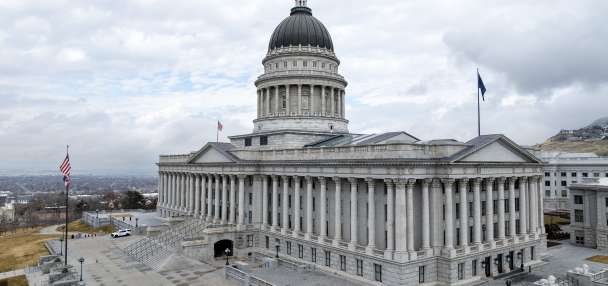
SALT LAKE CITY — Water quality issues faced by Indigenous Bolivian communities, and the role decreased social connectedness plays in misogynistic thoughts and behaviors were among undergraduate research projects on display at the state Capitol on Thursday for the annual Research on Capitol Hill day.
The event — hosted by the University of Utah, Utah State University and now in its 26th year — gives lawmakers the chance to interact and connect with the work of undergraduate researchers from the two large state universities.
As Utah's two Research One institutions, both play a key role in shaping the state's future.
"When we think about policy and we're thinking about trade-offs in this great Capitol building, we often find ourselves turning to research to solve the problem. It means we don't have to settle for giving up something for something else," University of Utah President Taylor Randall said. "We can actually sit down and say, 'You know what, let's put our bright minds to it, and let's make changes.' All of you are going to be a part of that."
One of those students was U. student Kian Robinson, whose work focused on water quality issues in Bolivia's Sajama province and how it's impacted by resource extraction and climate change.
"We know snow is going to melt quicker and that's obviously a problem, but what does that really mean for downstream effects and actual water quality?" Robinson said.
Robinson added that the event gave him the chance to speak with legislators and showcase his work with other interested people.
"This is a really amazing event. I'm really happy that the universities put this on and it's really cool to have this experience," Robinson said.
USU senior psychology students Hannah Jensen and Eva Jones echoed Robinson's sentiments.
"This has been electric today. It's been really exciting," Jones said. "Personally, this is my first research conference that I've been able to present at, and it's been very exciting to share this thing that I've been working so hard on and I've been so passionate about."
Jones, Jensen, and Sophia Baumann's research is survey-based, examining the darker behaviors and ways of thinking that can arise from a lack of social connection.
"In recent years, there's been a lot of research showing that loneliness is a public health crisis due to its negative effects on our mental and physical health, but loneliness also creates a condition where individuals are more susceptible to ideological radicalization," Jensen said. "We see a well-established pattern in research between loneliness leading to misogyny in extremist groups online, such as the incel population, and we're interested in exploring that phenomenon within a more general population."
Jones and Jensen added they're hopeful that if their project aligns with existing literature suggesting that loneliness is a predictor of misogynistic attitudes, social connectedness will be used as a preventative measure.
"Our hope is that our research can be foundational to informing interventions like community or campus programs to increase social connectedness and educate people on the harms of misogyny ... hopefully prevent some of the harm that it does," Jones said.
Utah Sen. Ann Millner, R-Ogden, a veteran lawmaker and educator, also spoke to the importance of university research and her appreciation for it.
Millner is serving as the floor sponsor of HB373, which would create a pilot program for higher education research funding.
She said student research not only provides a benefit for the general health and welfare of people, "but also for the economic development and innovation in the state."
"That's what you have the potential to do," Millner told the students. "Make people's lives better, grow the economy of the state and help us lead in Utah."
The bill advanced out of the House floor in a 66-1 vote, garnering bipartisan support.
To learn more about the work done by USU students, click here. To learn more about the students' work at the U., click here.