'%3e%3cpath%20d='M34.1406%205.85938C30.3906%202.10547%2025.3047%200%2020%200C14.6953%200%209.60938%202.10547%205.85938%205.85938C2.10938%209.61328%200%2014.6953%200%2020C0%2025.3047%202.10547%2030.3906%205.85938%2034.1406C9.61328%2037.8906%2014.6953%2040%2020%2040C25.3047%2040%2030.3906%2037.8945%2034.1406%2034.1406C37.8906%2030.3906%2040%2025.3047%2040%2020C40%2014.6953%2037.8945%209.60938%2034.1406%205.85938ZM37.0117%2023.543H31.1602V13.5391H27.6328V19.9414C28.1211%2020.6914%2028.3711%2021.582%2028.3711%2022.5625V22.625C28.3711%2023.668%2028.1172%2024.6055%2027.6328%2025.4297V26.6094H36.082C33.4883%2032.9375%2027.2891%2037.3789%2020.0039%2037.3789C10.3711%2037.3789%202.62109%2029.6289%202.62109%2020C2.62109%2010.3711%2010.3711%202.62109%2020%202.62109C29.6289%202.62109%2037.3789%2010.3711%2037.3789%2020C37.3789%2021.1484%2037.2617%2022.2656%2037.0508%2023.3477C37.0391%2023.4141%2037.0234%2023.4766%2037.0117%2023.543Z'%20fill='white'/%3e%3cpath%20d='M22.3086%2018.5352C20.4336%2018.125%2019.9531%2017.8398%2019.9766%2017.1836V17.1406C19.9766%2016.6992%2020.3477%2016.2148%2021.4023%2016.2148C22.582%2016.2148%2023.8867%2016.6797%2025.0781%2017.4766L26.8516%2015.0195C25.4453%2013.8906%2023.707%2013.3398%2021.5547%2013.3398C18.5195%2013.3398%2016.4375%2015%2016.4063%2017.4766V17.5352C16.3633%2020.2617%2018.5859%2020.9805%2021.293%2021.6016C23.0391%2021.9766%2023.5703%2022.3164%2023.5703%2022.9609L23.5469%2022.9766C23.5469%2023.3906%2023.2578%2023.7031%2022.7852%2023.8359C22.5742%2023.9062%2022.1289%2023.9727%2021.5156%2023.9727C20.7617%2023.9727%2019.7539%2023.8633%2018.6328%2023.4844C18.0898%2023.2891%2017.4727%2023.0039%2016.8047%2022.6133L20.1406%2026.625C20.2813%2026.6602%2021.0977%2026.8516%2021.7734%2026.8516C25.0039%2026.8516%2027.0859%2025.2461%2027.1094%2022.6328V22.5703C27.1602%2020.1133%2025.2148%2019.1719%2022.3086%2018.5352Z'%20fill='white'/%3e%3cpath%20d='M5.24219%2013.5664V26.6133H8.75391V23.7578L10.2969%2021.9531L14.2031%2026.6133H18.3867L12.3555%2019.5195L17.4023%2013.5664H13.4531L8.75391%2019.0586V13.5664H5.24219Z'%20fill='white'/%3e%3c/g%3e%3cdefs%3e%3cclipPath%20id='clip0_97_2430'%3e%3crect%20width='40'%20height='40'%20fill='white'/%3e%3c/clipPath%3e%3c/defs%3e%3c/svg%3e)




Estimated read time: 3-4 minutes
- Utah's constitutional court bill has sparked lawsuits alleging unconstitutional actions.
- Petitioners are challenging redistricting and Great Salt Lake management by seeking temporary restraining orders.
- Senate President Stuart Adams said he may reevaluate the judicial laws before the session ends March 6.
SALT LAKE CITY — Lawsuits against the state of Utah are beginning to grow as a direct result of the Legislature's constitutional court bill, signed into law less than two weeks ago.
Petitioners in cases challenging the state's ongoing redistricting battle and the alleged mismanagement of the Great Salt Lake have requested temporary restraining orders, accusing the Legislature of "unconstitutional" actions in their court filings, specifically referencing the recently passed HB392 and SJR5.
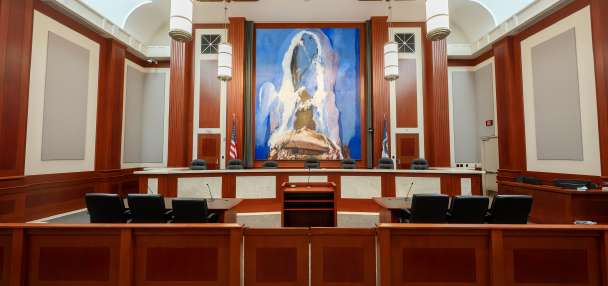
HB392, the District Court amendments law, establishes a three-judge court that will focus solely on lawsuits challenging state laws as unconstitutional. If a lawsuit is filed in district court against the state attorney general, governor, or Legislature, or if they are a party in a case, they can submit a notice requesting the case be heard by the constitutional court panel instead of a single judge. That notice, under the bill, cannot be challenged and is not subject to review.
SJR5 implements the laws in HB392 by rewriting Utah's court rules so the Legislature, governor or attorney general can force certain cases into a three-judge district panel and freeze the original judge out of the case.
Pointing the finger at each other
The petitioners' recent actions in the redistricting and the Great Salt Lake case stem from a motion filed last Sunday by Utah Attorney General Derek Brown and the Utah Legislature, as defendants, formally invoking the new laws and forcing the civil actions to be transferred from a single district judge to a three-judge district panel.
Senate President Stuart Adams said Monday that the attorney general's office has taken such actions in four lawsuits against the state:
- Planned Parenthood Association of Utah v. State of Utah, et al.
- The League of Women Voters of Utah, Mormon Women for Ethical Government, et al. v. Utah State Legislature, et al.
- Utah Physicians For a Healthy Environment, et al. v. Utah Dept. of Natural Resources, et al.
- Natalie R. v. State of Utah.
In their motion for a temporary restraining order, plaintiffs in the Great Salt Lake case accused the newly enacted laws of being "unilateral and arbitrary power" granted only to the state, further delaying litigation and creating further "irreparable harm to millions of birds and other imperiled species, and the health of millions of Utahns."
Furthermore, the proposed restraining order filed by the plaintiffs in the redistricting case said "forcing plaintiffs to proceed before a three-judge panel that may later be deemed unconstitutional delays the ultimate resolution of this matter. As a matter of judicial efficiency, transferring the case and burdening three judges, when HB392 may be declared unconstitutional, does not promote the orderly administration of justice."
But the Legislature's stance is that the cases are constitutional issues with potential statewide effects, and that their transfer to the new court is appropriate and necessary. Sen. Mike McKell, R-Spanish Fork, stated that the plaintiffs in these cases are guilty of the same practice they are criticizing the Legislature for: forum shopping.
"Make no mistake, they are forum shopping, and the three-judge panel does the opposite of that," McKell said Monday. It "creates a scenario where forum shopping can't happen. And it's interesting to me that these same groups that are attacking the Legislature, that want the public to get involved — and the public voice to be heard — are doing everything to quash the public voice."
Despite confidence in the state's judicial laws, Adams said he would "consider" reevaluating them and, potentially, changing them before the end of the legislative session, which concludes on March 6.