'%3e%3cpath%20d='M34.1406%205.85938C30.3906%202.10547%2025.3047%200%2020%200C14.6953%200%209.60938%202.10547%205.85938%205.85938C2.10938%209.61328%200%2014.6953%200%2020C0%2025.3047%202.10547%2030.3906%205.85938%2034.1406C9.61328%2037.8906%2014.6953%2040%2020%2040C25.3047%2040%2030.3906%2037.8945%2034.1406%2034.1406C37.8906%2030.3906%2040%2025.3047%2040%2020C40%2014.6953%2037.8945%209.60938%2034.1406%205.85938ZM37.0117%2023.543H31.1602V13.5391H27.6328V19.9414C28.1211%2020.6914%2028.3711%2021.582%2028.3711%2022.5625V22.625C28.3711%2023.668%2028.1172%2024.6055%2027.6328%2025.4297V26.6094H36.082C33.4883%2032.9375%2027.2891%2037.3789%2020.0039%2037.3789C10.3711%2037.3789%202.62109%2029.6289%202.62109%2020C2.62109%2010.3711%2010.3711%202.62109%2020%202.62109C29.6289%202.62109%2037.3789%2010.3711%2037.3789%2020C37.3789%2021.1484%2037.2617%2022.2656%2037.0508%2023.3477C37.0391%2023.4141%2037.0234%2023.4766%2037.0117%2023.543Z'%20fill='white'/%3e%3cpath%20d='M22.3086%2018.5352C20.4336%2018.125%2019.9531%2017.8398%2019.9766%2017.1836V17.1406C19.9766%2016.6992%2020.3477%2016.2148%2021.4023%2016.2148C22.582%2016.2148%2023.8867%2016.6797%2025.0781%2017.4766L26.8516%2015.0195C25.4453%2013.8906%2023.707%2013.3398%2021.5547%2013.3398C18.5195%2013.3398%2016.4375%2015%2016.4063%2017.4766V17.5352C16.3633%2020.2617%2018.5859%2020.9805%2021.293%2021.6016C23.0391%2021.9766%2023.5703%2022.3164%2023.5703%2022.9609L23.5469%2022.9766C23.5469%2023.3906%2023.2578%2023.7031%2022.7852%2023.8359C22.5742%2023.9062%2022.1289%2023.9727%2021.5156%2023.9727C20.7617%2023.9727%2019.7539%2023.8633%2018.6328%2023.4844C18.0898%2023.2891%2017.4727%2023.0039%2016.8047%2022.6133L20.1406%2026.625C20.2813%2026.6602%2021.0977%2026.8516%2021.7734%2026.8516C25.0039%2026.8516%2027.0859%2025.2461%2027.1094%2022.6328V22.5703C27.1602%2020.1133%2025.2148%2019.1719%2022.3086%2018.5352Z'%20fill='white'/%3e%3cpath%20d='M5.24219%2013.5664V26.6133H8.75391V23.7578L10.2969%2021.9531L14.2031%2026.6133H18.3867L12.3555%2019.5195L17.4023%2013.5664H13.4531L8.75391%2019.0586V13.5664H5.24219Z'%20fill='white'/%3e%3c/g%3e%3cdefs%3e%3cclipPath%20id='clip0_97_2430'%3e%3crect%20width='40'%20height='40'%20fill='white'/%3e%3c/clipPath%3e%3c/defs%3e%3c/svg%3e)


- HB337, sponsored by Rep. Tyler Clancy, R-Provo, proposed increasing nicotine taxes significantly.
- The bill passed the House committee 9-2 amid heated debate on health impacts on Friday.
- Opponents argue higher taxes will drive consumers elsewhere; supporters cite health benefits and reduced youth smoking.
SALT LAKE CITY – The Utah Legislature has taken the first step toward raising the state's tax on nicotine and tobacco products.
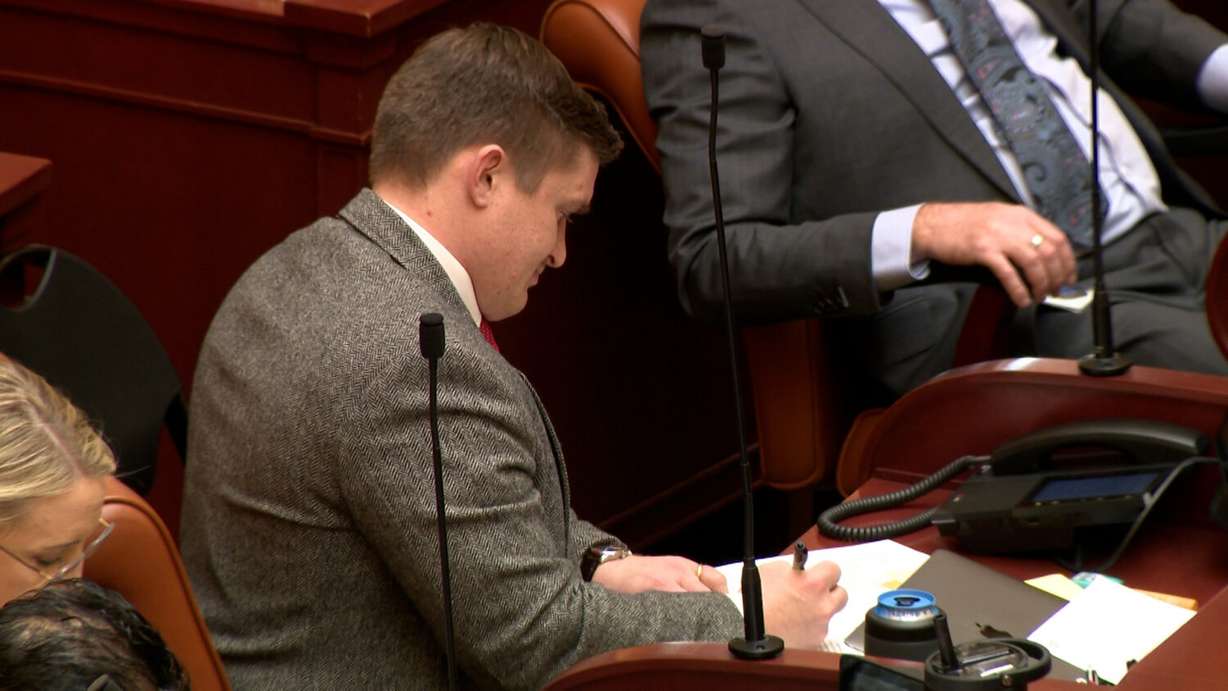
HB337, sponsored by Rep. Tyler Clancy, R-Provo, advanced out of the House Revenue and Taxation Committee on Friday in a 9-2 vote, following a hearing lasting more than 90 minutes.
But Clancy promised there's more work to come as the bill moves forward.
His current proposal would raise taxes on cigarettes to the tune of about $2 a pack. It would also change how smokeless and alternative nicotine products are taxed. Instead of determining it by weight, it would be based on a percentage of the manufacturer's sale price. Clancy estimated it would add an additional $1.50 up to $3 to the price of a can of nicotine pouches, such as Zyn.
Clancy said the harmful health effects of nicotine and tobacco products mean they should be treated differently.
"The status quo is not acceptable right now," he said.
Strong opinions
Paul Ray, a former state lawmaker, spoke in support of the bill, telling of being born with a congenital heart defect because his mother smoked while she was pregnant. He criticized tobacco companies, saying their product "really sucks."
"We know that cigarettes and tobacco products are price point related," Ray said. "The higher the price point, the less people smoke."
But the House committee heard strong opposition to the proposed tax increase. Dave Davis, president of the Utah Retail Merchants Association, said the hike would put Utah above surrounding states, causing smokers and nicotine users to spend their money elsewhere.
"If we're just driving people to a different channel, whether that be a cross-border channel or an online channel, really all we're doing is we're hurting Utah-based retailers," Davis said.
Billy Hesterman, with the Utah Taxpayers Association, also criticized Clancy's bill, estimating a tax hike will cost the average smoker $793 more a year if the Legislature approves the plan.
"We've heard a lot of talk about, 'We want to make things more affordable to Utah families here in the state,' and certainly this is a minority of Utah families probably," Hesterman said, "but this is an additional cost to them."
But Rep. Jen Dailey-Provost, D-Salt Lake City, pushed back, suggesting this "sin tax" should be considered differently than other taxes in the state because of its harmful health effects. Hesterman responded that his organization is "agnostic" about tax policy and wants a "uniform system across all taxation."
"I would argue that I think that your organization should not be so agnostic when … nothing should be agnostic for all products," Dailey-Provost countered, "and that you need to think a little more critically about some of these things."
Much of the discussion at Friday's hearing centered on youth tobacco usage and vaping, with some expressing concern that smokeless or nicotine pouches are a "gateway" to worse products.
"Nicotine is a lifelong burden for them," said Gayle Ruzicka, with the Utah Eagle Forum.
According to the Utah Department of Health and Human Services, youth cigarette smoking has dropped by 77% since 2013. However, youth vaping more than doubled between 2013 and 2019, according to department data. In 2019, about 12.4% of students in Utah said they had vaped in the last 30 days, although that number declined to 7.5% in 2023.
Brook Carlisle, with the American Cancer Society Cancer Action Network, said more than 15% of cancer deaths in Utah are attributed to smoking, per the organization's internal data.
"We know significantly increasing tobacco taxes and investing in tobacco prevention and cessation programs that save lives reduces health care costs and generates revenue," Carlisle said. "In fact, it is one of the most effective ways to prevent youth from starting to use tobacco and to encourage those who already are addicted to quit."
Speaking in opposition to the bill, James Curry, a representative from tobacco company Philip Morris International, said the multinational corporation is working to help people transition from cigarettes to "less harmful alternatives."
"HB337 would both significantly raise the tax on alternative nicotine products and eliminate tax incentives for modified-risk tobacco products," Curry said. "Put simply, this bill would make smoke-free alternatives significantly more expensive and therefore less affordable for Utahns who smoke, disincentivizing smokers from switching to reduced-risk products."
Bill moves forward
As the debate wrapped up, several lawmakers said they felt the bill wasn't ready for prime time and should not move forward right now.
"The tax that you're proposing is simply too high. I don't think it's in line with other states or our neighboring states," said Rep. Jill Koford, R-Ogden, also arguing that "nicotine patches help adults who are trying not to smoke."
Rep. Mark Strong, R-Bluffdale, called it a "significant tax" that would primarily impact people with lower incomes.
Clancy pushed back against holding the bill, arguing that moving the legislation forward would force more groups to come to the table and work together on a solution.
"I will work my tail off to get this into a good place that makes sense for everyone," he said.
Ultimately, the committee agreed, sending HB337 to the House of Representatives for consideration. Only Koford and Strong voted in opposition.