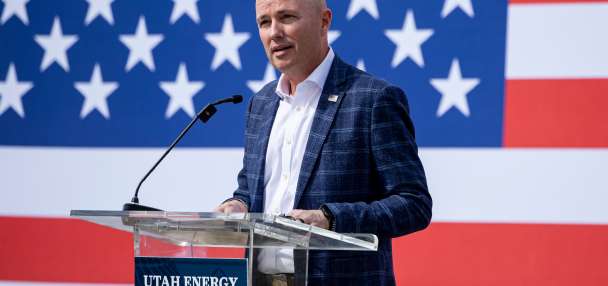
- Utah Senate President Stuart Adams claimed on Tuesday his homebuyer program reduced rental prices.
- The Kem C. Gardner Policy Institute, however, attributed rent drops to new apartment supply.
- Adams seeks $10 million more for the program despite budget constraints.
SALT LAKE CITY — A top lawmaker is asking for another $10 million for the state's first-time homebuyer assistance program.
But one of Senate President Stuart Adams' primary arguments for requesting that money doesn't quite stand up to scrutiny.
The program, which was created in 2023, gives first-time homebuyers up to $20,000 to spend on a down payment, closing costs, or buying down the interest rate on a newly constructed home.
Adams, R-Layton, has touted the fact that nearly 3,000 households have taken advantage of the program that he championed. But he has also repeatedly claimed that the first-time homebuyer incentive has made a positive impact on the state's housing market overall.
"Because you've taken those 3,000 people out of the rental market, what's happened is you've seen over the last three years rental prices stabilized," Adams told reporters on Tuesday, "and now they're coming down."
The Senate president made the same claim last week when he asked lawmakers for the additional $10 million.
"What happens when you increase the supply of anything? The price goes down," Adams said on Feb. 4 before the Economic and Community Development Appropriations Subcommittee. "For the last three years, since we've been able to put kids out of apartments into homes, the rental rates have stabilized and come down. It's amazing what you do when you actually increase the supply."

What's the truth?
It is true that rental rates in Utah have dropped.
According to the Kem C. Gardner Policy Institute at the University of Utah, which closely studies the housing market, rents are down about 1.5%-2% year over year, and they are 8% below their peak in 2023.
But, the Gardner Institute added, that decrease in rents is due almost entirely to an increase of new apartments in the state, not an increase in new housing for sale.
A recent study commissioned by the Rental Housing Association of Utah, a landlord advocacy group, found that the influx in new apartments is primarily concentrated in Salt Lake City where landlords have been offering unprecedented "lavish" concessions, including eight to 12 weeks of free rent and gift cards, to new tenants.
The study, authored by longtime Gardner Institute housing analyst Jim Wood, found that Salt Lake City will add around 7,500 renter households over the next three years, while only around 7,300 new rental units are expected to enter the market.
"By year-end 2028, the local market will be moving toward stabilization with a lower vacancy rate, likely around 6%, fewer and less generous concessions, and some small increases in rental rates," the study found.
Dejan Eskic, who also studies the housing market at the Gardner Institute, told KSL rents statewide could start rising late this year or in early 2027 due to an expected tightening of supply, although he acknowledged it's still a "moving target."
First-time homebuyers
Lawmakers are dealing with a tighter budget this year, which will be hashed out over the next few weeks as the 45-day legislative session winds down.
Adams wants more money to go to the first-time homebuyer program, which he said gives developers an incentive to build more starter single-family homes rather than "big mansions that they could make money on."
"Government does have a role as trying to make things or try to help people," Adams said, "and I think we're seeing some change — at least some positive change — in housing affordability, and I hope it stays."

The remaining balance in the first-time homebuyer program is just under $9.4 million, according to the Utah Housing Corporation, which administers it. That's enough to help roughly 470 additional homebuyers, officials said.
Meanwhile, homes for sale in Utah remain expensive. The median sales price for all housing types — including single-family homes, townhomes, and condos — was $505,000 in January.
That's up from $497,995 in January 2025 and $485,000 in January 2024. Home prices in Utah hit their peak in May 2022, coming out of the COVID-19 pandemic.