'%3e%3cpath%20d='M34.1406%205.85938C30.3906%202.10547%2025.3047%200%2020%200C14.6953%200%209.60938%202.10547%205.85938%205.85938C2.10938%209.61328%200%2014.6953%200%2020C0%2025.3047%202.10547%2030.3906%205.85938%2034.1406C9.61328%2037.8906%2014.6953%2040%2020%2040C25.3047%2040%2030.3906%2037.8945%2034.1406%2034.1406C37.8906%2030.3906%2040%2025.3047%2040%2020C40%2014.6953%2037.8945%209.60938%2034.1406%205.85938ZM37.0117%2023.543H31.1602V13.5391H27.6328V19.9414C28.1211%2020.6914%2028.3711%2021.582%2028.3711%2022.5625V22.625C28.3711%2023.668%2028.1172%2024.6055%2027.6328%2025.4297V26.6094H36.082C33.4883%2032.9375%2027.2891%2037.3789%2020.0039%2037.3789C10.3711%2037.3789%202.62109%2029.6289%202.62109%2020C2.62109%2010.3711%2010.3711%202.62109%2020%202.62109C29.6289%202.62109%2037.3789%2010.3711%2037.3789%2020C37.3789%2021.1484%2037.2617%2022.2656%2037.0508%2023.3477C37.0391%2023.4141%2037.0234%2023.4766%2037.0117%2023.543Z'%20fill='white'/%3e%3cpath%20d='M22.3086%2018.5352C20.4336%2018.125%2019.9531%2017.8398%2019.9766%2017.1836V17.1406C19.9766%2016.6992%2020.3477%2016.2148%2021.4023%2016.2148C22.582%2016.2148%2023.8867%2016.6797%2025.0781%2017.4766L26.8516%2015.0195C25.4453%2013.8906%2023.707%2013.3398%2021.5547%2013.3398C18.5195%2013.3398%2016.4375%2015%2016.4063%2017.4766V17.5352C16.3633%2020.2617%2018.5859%2020.9805%2021.293%2021.6016C23.0391%2021.9766%2023.5703%2022.3164%2023.5703%2022.9609L23.5469%2022.9766C23.5469%2023.3906%2023.2578%2023.7031%2022.7852%2023.8359C22.5742%2023.9062%2022.1289%2023.9727%2021.5156%2023.9727C20.7617%2023.9727%2019.7539%2023.8633%2018.6328%2023.4844C18.0898%2023.2891%2017.4727%2023.0039%2016.8047%2022.6133L20.1406%2026.625C20.2813%2026.6602%2021.0977%2026.8516%2021.7734%2026.8516C25.0039%2026.8516%2027.0859%2025.2461%2027.1094%2022.6328V22.5703C27.1602%2020.1133%2025.2148%2019.1719%2022.3086%2018.5352Z'%20fill='white'/%3e%3cpath%20d='M5.24219%2013.5664V26.6133H8.75391V23.7578L10.2969%2021.9531L14.2031%2026.6133H18.3867L12.3555%2019.5195L17.4023%2013.5664H13.4531L8.75391%2019.0586V13.5664H5.24219Z'%20fill='white'/%3e%3c/g%3e%3cdefs%3e%3cclipPath%20id='clip0_97_2430'%3e%3crect%20width='40'%20height='40'%20fill='white'/%3e%3c/clipPath%3e%3c/defs%3e%3c/svg%3e)


- Utah's air quality has improved despite population growth, with emissions dropping 53% since 2001.
- Bryce Bird highlighted effective measures like reducing gasoline vapor loss to improve air quality.
- Utah's Legislature seeks buyers for Delta's coal plant, inactive since November due to emissions laws.
SALT LAKE CITY — Bryce Bird, the director of Utah's air quality department, delivered good news about the state's pollution levels to Utah's Legislature on Tuesday.
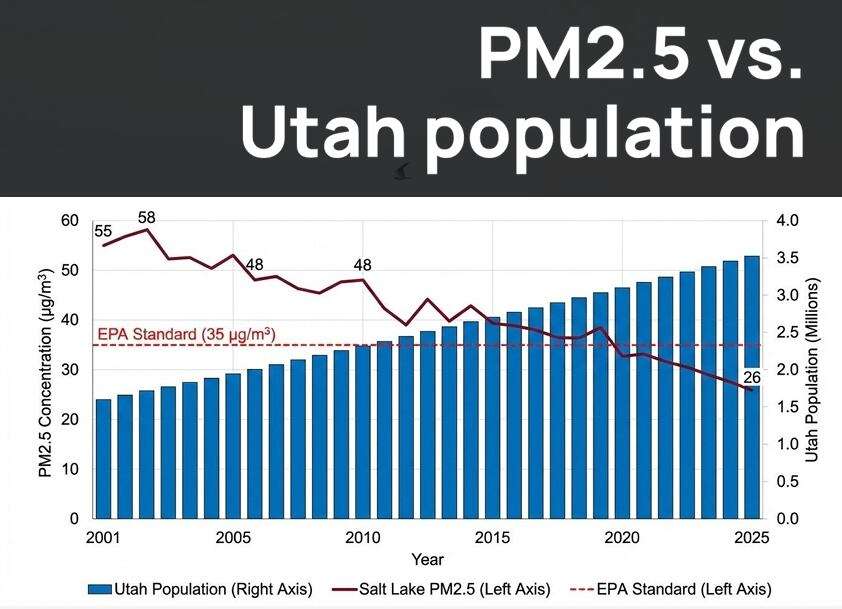
Over the past two decades, the Salt Lake Valley's emissions rate has declined, even as populations have increased, he told the Natural Resources, Agriculture and Environmental Quality Appropriations Subcommittee.
In 2001, its PM2.5 emissions sat at 55 micrograms per cubic meter, and in 2025, it had fallen to 26 micrograms per cubic meter — a 53% decrease. Meanwhile, the state's population has grown from about 2.3 million in 2001 to more than 3.5 million in 2025 (a 52% increase.)
PM2.5 refers to any airborne particle that is 2.5 micrometers or smaller, and it mostly comes from combustion or chemical reactions in the air.
This decrease is a good sign for Utah, since the Salt Lake Valley has the worst air quality of any region in the state. And on the whole, 99% of Utah's air quality data is acceptable to the federal Environmental Protection Agency, Bird told lawmakers.
The federal Clean Air Act requires states to monitor the air of any metropolitan area with a population larger than 50,000 people.
Bird suggests ways to continue bettering Utah's air quality
If an area is found to have high levels of ground-level ozone, it is designated as "nonattainment," and the federal Clean Air Act requires the state to reach a 15% improvement within a certain amount of time.
In 2018, the EPA designated the northern Wasatch Front and the Uinta Basin as nonattainment areas. Bird referenced this federal requirement on Tuesday morning and said that paints, solvents, gasoline emissions and organic chemicals from petroleum are the materials holding the state back from improvement.
He recommended several commercial and private fixes Utahns can make to reduce the state's ground-level ozone. These included putting domed covers over floating roof gasoline storage tanks, reducing spills and drips at gas stations, and storing gasoline in better containers with less vapor loss.
Utah's air quality department green-lights dormant coal plant
Bird said that in the past year, his department's staff issued a permit to allow the continued use of coal-fired units in Delta in central Utah.
Intermountain Power Project, the owner of the Delta coal plants, turned off the two coal-fired units last November. The plants were constructed in the mid-1980s to export coal power to Southern California, but restrictive emissions laws now prohibit the coastal state from using the Utah plant's energy.
The Utah Legislature has led efforts to save the coal plant, and at the beginning of December, there were 14 parties interested in the plant.
But as of Jan. 8, Utah's Office of Energy Development told the Deseret News there are still no buyers.