'%3e%3cpath%20d='M34.1406%205.85938C30.3906%202.10547%2025.3047%200%2020%200C14.6953%200%209.60938%202.10547%205.85938%205.85938C2.10938%209.61328%200%2014.6953%200%2020C0%2025.3047%202.10547%2030.3906%205.85938%2034.1406C9.61328%2037.8906%2014.6953%2040%2020%2040C25.3047%2040%2030.3906%2037.8945%2034.1406%2034.1406C37.8906%2030.3906%2040%2025.3047%2040%2020C40%2014.6953%2037.8945%209.60938%2034.1406%205.85938ZM37.0117%2023.543H31.1602V13.5391H27.6328V19.9414C28.1211%2020.6914%2028.3711%2021.582%2028.3711%2022.5625V22.625C28.3711%2023.668%2028.1172%2024.6055%2027.6328%2025.4297V26.6094H36.082C33.4883%2032.9375%2027.2891%2037.3789%2020.0039%2037.3789C10.3711%2037.3789%202.62109%2029.6289%202.62109%2020C2.62109%2010.3711%2010.3711%202.62109%2020%202.62109C29.6289%202.62109%2037.3789%2010.3711%2037.3789%2020C37.3789%2021.1484%2037.2617%2022.2656%2037.0508%2023.3477C37.0391%2023.4141%2037.0234%2023.4766%2037.0117%2023.543Z'%20fill='white'/%3e%3cpath%20d='M22.3086%2018.5352C20.4336%2018.125%2019.9531%2017.8398%2019.9766%2017.1836V17.1406C19.9766%2016.6992%2020.3477%2016.2148%2021.4023%2016.2148C22.582%2016.2148%2023.8867%2016.6797%2025.0781%2017.4766L26.8516%2015.0195C25.4453%2013.8906%2023.707%2013.3398%2021.5547%2013.3398C18.5195%2013.3398%2016.4375%2015%2016.4063%2017.4766V17.5352C16.3633%2020.2617%2018.5859%2020.9805%2021.293%2021.6016C23.0391%2021.9766%2023.5703%2022.3164%2023.5703%2022.9609L23.5469%2022.9766C23.5469%2023.3906%2023.2578%2023.7031%2022.7852%2023.8359C22.5742%2023.9062%2022.1289%2023.9727%2021.5156%2023.9727C20.7617%2023.9727%2019.7539%2023.8633%2018.6328%2023.4844C18.0898%2023.2891%2017.4727%2023.0039%2016.8047%2022.6133L20.1406%2026.625C20.2813%2026.6602%2021.0977%2026.8516%2021.7734%2026.8516C25.0039%2026.8516%2027.0859%2025.2461%2027.1094%2022.6328V22.5703C27.1602%2020.1133%2025.2148%2019.1719%2022.3086%2018.5352Z'%20fill='white'/%3e%3cpath%20d='M5.24219%2013.5664V26.6133H8.75391V23.7578L10.2969%2021.9531L14.2031%2026.6133H18.3867L12.3555%2019.5195L17.4023%2013.5664H13.4531L8.75391%2019.0586V13.5664H5.24219Z'%20fill='white'/%3e%3c/g%3e%3cdefs%3e%3cclipPath%20id='clip0_97_2430'%3e%3crect%20width='40'%20height='40'%20fill='white'/%3e%3c/clipPath%3e%3c/defs%3e%3c/svg%3e)



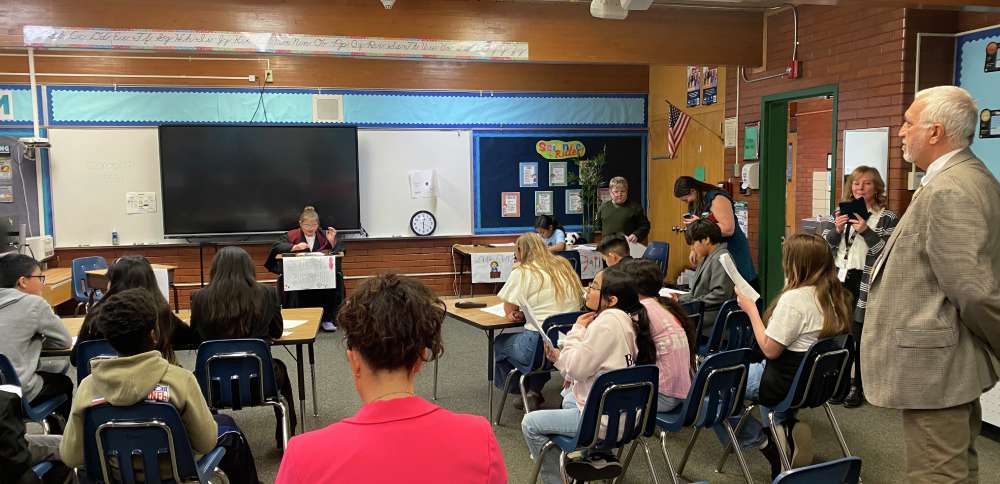
- Utah fifth-graders participated in a pretend trial with Salt Lake County's real district attorney.
- The trial was part of Project LEAD, an 18-week course on the criminal justice system.
- The program aims to teach students about choices and consequences through role-playing.
KEARNS — As the verdict of "guilty" was read, one side of the room collectively gasped, "No," while the other could be heard celebrating.
Salt Lake County deputy district attorney Kelsey Huddleston then asked the class, "What happens next?"
"They go to jail," one student opined.
"They get taken away," said another.
Huddleston then explained that a prosecutor's goal is to keep the public safe. But in this case, a judge would likely find a way to help the defendant recognize her thinking errors. Deputy district attorney Heather Lindsay added that both the defendant and victim in this scenario would likely each be referred to the services they need to help with behavioral issues on both sides.
The verdict came down Wednesday during a mock trial with fifth-grade students at David Gourley Elementary School, 4905 S. 4300 West, in Kearns. It marked the end of an 18-week course during which students were introduced to the criminal justice system.
"Every week is different," said Salt Lake County District Attorney Sim Gill, who attended Wednesday's classroom trial. He said the topics each week range from juvenile justice and bullying to conflict resolution and the rule of law.
"Does your school have any rules? And what happens if you break those rules? Do you have rules at home? So we're really giving them a connection with what their lived experience is about so they can retain it for the long term," he said. "At fifth grade, they are starting to be curious. They are starting to have a sense of their own identity, and they're starting to form their own ideas. So it's a really critical time. And that's a really great time for us to honor their curiosity and also to share something that they're thinking about."
This is the third year Gill and his team have hosted the Project LEAD program, a law-related education program that has engaged over 200 fifth-graders. He says he got the idea from his friend, former Los Angeles County District Attorney Jackie Lacey, whose office has been conducting its own Project LEAD since 1993.
"The goal of Project LEAD is simple: To teach children that the choices they make today can affect their lives forever," the LA District Attorney's website states.
Gill says the program is different from having a law enforcement officer or attorney speak at an assembly for 20 minutes. Project LEAD is an immersive, interactive program.
"It's more than just saying, 'Don't do something.' It's about answering their curiosity. It's about giving them the opportunity to role-play. What data shows you is that when you do an immersive way of interaction with children who are naturally curious, it retains for a longer period of time," Gill said.
The program also helps foster a relationship between prosecutors, police officers and the children. Gill says some of the students' only prior exposure to the criminal justice system comes from watching their parents or siblings go through it. In this scenario, he says the program not only gives students a better understanding of how decisions are made but also encourages them to consider the consequences of their own actions.
"They're incredibly curious; they want to know everything," the district attorney said.
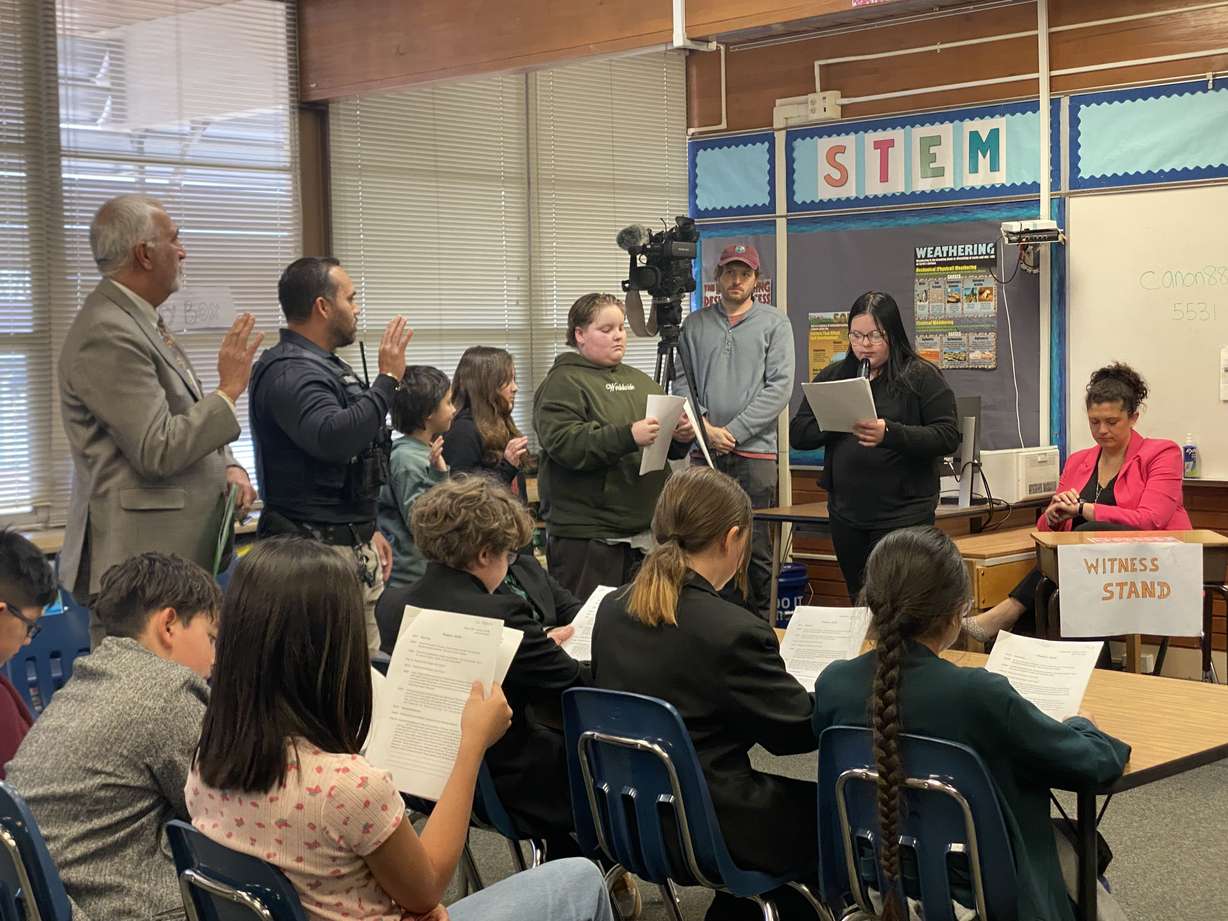
On Wednesday, the school's two fifth-grade classes held mock trials. The scenario for each class was the same: A girl was charged with possession of a loaded gun with intent to harm. In this case, a girl — a victim of ongoing bullying by another student — is found to have a loaded gun in her backpack when she goes to the Utah Fun Dome (formerly the 49th Street Galleria), where the student she is having issues with is also at.
The students read from a script as the trial unfolds.
"Only luck saved him from being shot," a student prosecutor stated during opening arguments. "A loaded gun is not a toy."
But a student defense attorney countered that the girl didn't know the gun was in her backpack and was as surprised as everyone else.
Both sides then called their witnesses to the stand, and after being sworn in, they were questioned and cross-examined. The girl on trial says she loaned her backpack to her cousin, who left his gun in it, unbeknownst to her. She also claimed that her prior comments to a friend about harming the student who bullied her were a "joke."
They're incredibly curious; they want to know everything.
–Salt Lake County District Attorney Sim Gill
Prosecutors, however, argued during closing arguments that just because she doesn't like someone or is being bullied, it doesn't give her the right to shoot that person.
As the jurors left the room to deliberate, Huddleston talked to the students about courtroom procedures and answered questions, such as "Who becomes a judge?"
After deliberating for about 15 minutes, the five-member jury returned a guilty verdict.
The class before, however, which was larger, ended in a hung jury and a mistrial. One of the class advisers informed the students that the jury deliberations had some "heated debate" and that there was at least one holdout on each side whose opinion could not be swayed.
Gill says it shows that the students are thinking independently about the issues and credits them with asking good questions.
"They're far more smarter than we think. They're picking up on how it feels to be treated wrong. They're picking up on wanting to help somebody because that's a natural instinct. They're far more smarter than I think we give them credit. And they're actually starting to think about these issues: What is right? What is fair? How did it make me feel? Yes, we have rules, and it's good to follow the rules. And what does it mean to not follow the rules? So that was really what was enlightening about it.
"(The jurors had) strong opinions. Some people believed that she was bullied and she didn't know that (the gun) was in her backpack. So giving them that opportunity to disagree and to say, OK, you have agency, that you can have a different opinion. And just because everyone says (one thing), you don't have to go along with it," Gill said.
The district attorney says that, given the program's success and requests from other schools, his office is considering expanding the project.