'%3e%3cpath%20d='M34.1406%205.85938C30.3906%202.10547%2025.3047%200%2020%200C14.6953%200%209.60938%202.10547%205.85938%205.85938C2.10938%209.61328%200%2014.6953%200%2020C0%2025.3047%202.10547%2030.3906%205.85938%2034.1406C9.61328%2037.8906%2014.6953%2040%2020%2040C25.3047%2040%2030.3906%2037.8945%2034.1406%2034.1406C37.8906%2030.3906%2040%2025.3047%2040%2020C40%2014.6953%2037.8945%209.60938%2034.1406%205.85938ZM37.0117%2023.543H31.1602V13.5391H27.6328V19.9414C28.1211%2020.6914%2028.3711%2021.582%2028.3711%2022.5625V22.625C28.3711%2023.668%2028.1172%2024.6055%2027.6328%2025.4297V26.6094H36.082C33.4883%2032.9375%2027.2891%2037.3789%2020.0039%2037.3789C10.3711%2037.3789%202.62109%2029.6289%202.62109%2020C2.62109%2010.3711%2010.3711%202.62109%2020%202.62109C29.6289%202.62109%2037.3789%2010.3711%2037.3789%2020C37.3789%2021.1484%2037.2617%2022.2656%2037.0508%2023.3477C37.0391%2023.4141%2037.0234%2023.4766%2037.0117%2023.543Z'%20fill='white'/%3e%3cpath%20d='M22.3086%2018.5352C20.4336%2018.125%2019.9531%2017.8398%2019.9766%2017.1836V17.1406C19.9766%2016.6992%2020.3477%2016.2148%2021.4023%2016.2148C22.582%2016.2148%2023.8867%2016.6797%2025.0781%2017.4766L26.8516%2015.0195C25.4453%2013.8906%2023.707%2013.3398%2021.5547%2013.3398C18.5195%2013.3398%2016.4375%2015%2016.4063%2017.4766V17.5352C16.3633%2020.2617%2018.5859%2020.9805%2021.293%2021.6016C23.0391%2021.9766%2023.5703%2022.3164%2023.5703%2022.9609L23.5469%2022.9766C23.5469%2023.3906%2023.2578%2023.7031%2022.7852%2023.8359C22.5742%2023.9062%2022.1289%2023.9727%2021.5156%2023.9727C20.7617%2023.9727%2019.7539%2023.8633%2018.6328%2023.4844C18.0898%2023.2891%2017.4727%2023.0039%2016.8047%2022.6133L20.1406%2026.625C20.2813%2026.6602%2021.0977%2026.8516%2021.7734%2026.8516C25.0039%2026.8516%2027.0859%2025.2461%2027.1094%2022.6328V22.5703C27.1602%2020.1133%2025.2148%2019.1719%2022.3086%2018.5352Z'%20fill='white'/%3e%3cpath%20d='M5.24219%2013.5664V26.6133H8.75391V23.7578L10.2969%2021.9531L14.2031%2026.6133H18.3867L12.3555%2019.5195L17.4023%2013.5664H13.4531L8.75391%2019.0586V13.5664H5.24219Z'%20fill='white'/%3e%3c/g%3e%3cdefs%3e%3cclipPath%20id='clip0_97_2430'%3e%3crect%20width='40'%20height='40'%20fill='white'/%3e%3c/clipPath%3e%3c/defs%3e%3c/svg%3e)




- Gov. Spencer Cox proposes retention for third graders failing reading tests in Utah.
- Deseret News poll shows 67% of Utahns support the third grade retention policy.
- Upcoming legislation will address classroom technology use and cellphone bans in schools.
SALT LAKE CITY — Utah Gov. Spencer Cox believes it's time to take action as almost half of the state's third graders are reportedly reading below minimum proficiency levels.
First, said Cox, more resources are needed in Utah's K-12 schools.
He's proposing to allocate tens of millions more in the state budget to hire paraprofessionals to supplement reading support for early elementary students.
But the governor wants to go beyond simply putting more cash into child literacy efforts. Cox also believes Utah should implement a retention policy requiring students to repeat third grade if they don't pass a reading comprehension test.
Any state policy that mandates holding kids back in school would surely be divisive. Cox acknowledges that — but he's certain the long-term benefits for a struggling child are worth the disruption.
"I think there's a way we can do it that treats kids and families with dignity and respect and makes it easy for them — but we need that pressure," said Cox at a recent literacy symposium.
"It's not that we want to hold kids back, it's that we want them reading at third grade level so we don't have to hold them back."
Legislative leaders indicated to the Deseret News at recent editorial board meetings that they back the idea as well.
Holding kids back for a year — a good idea?
Are Utahns on board with Cox's third grade retention policy?
Currently, holding a child back a grade is a rarity in Utah. It happens only in extreme cases, and usually at a parent or guardian's request. So a state-imposed retention policy would mark a significant departure from the status quo.
This month's Deseret News/Hinckley Institute of Politics poll gathered the opinions of 799 registered Utahns regarding the state's current retention standards.
More than a third — 38% believe they need to be "more strict." Another approximate third — 34% — say the standards "are about right."
Meanwhile, 8% believe they need to be less strict, while 19% said they don't know.
Obviously, Utah children and their parents would be most impacted by any grade retention policy.
Of poll respondents who identified as "parents," 37% believe the state's retention standards should be more strict. An identical number said the current standards are "about right," while 10% said the standards need to be less strict.
There's only a slight opinion gap between Republicans and Democrats on the current retention standards.
Forty-one percent of Republican respondents said the current standards need to be more strict, while 36% believe they are "about right." Among Democrats, 37% are in the "need to be more strict" camp, with 30% saying the standards are "about right" and 11% responding that standards need to be less strict.
Most Utahns support a 'repeat third grade' policy
The recent poll also suggests Utahns would generally support a proposed policy requiring third graders who don't pass a state reading test to repeat the grade.
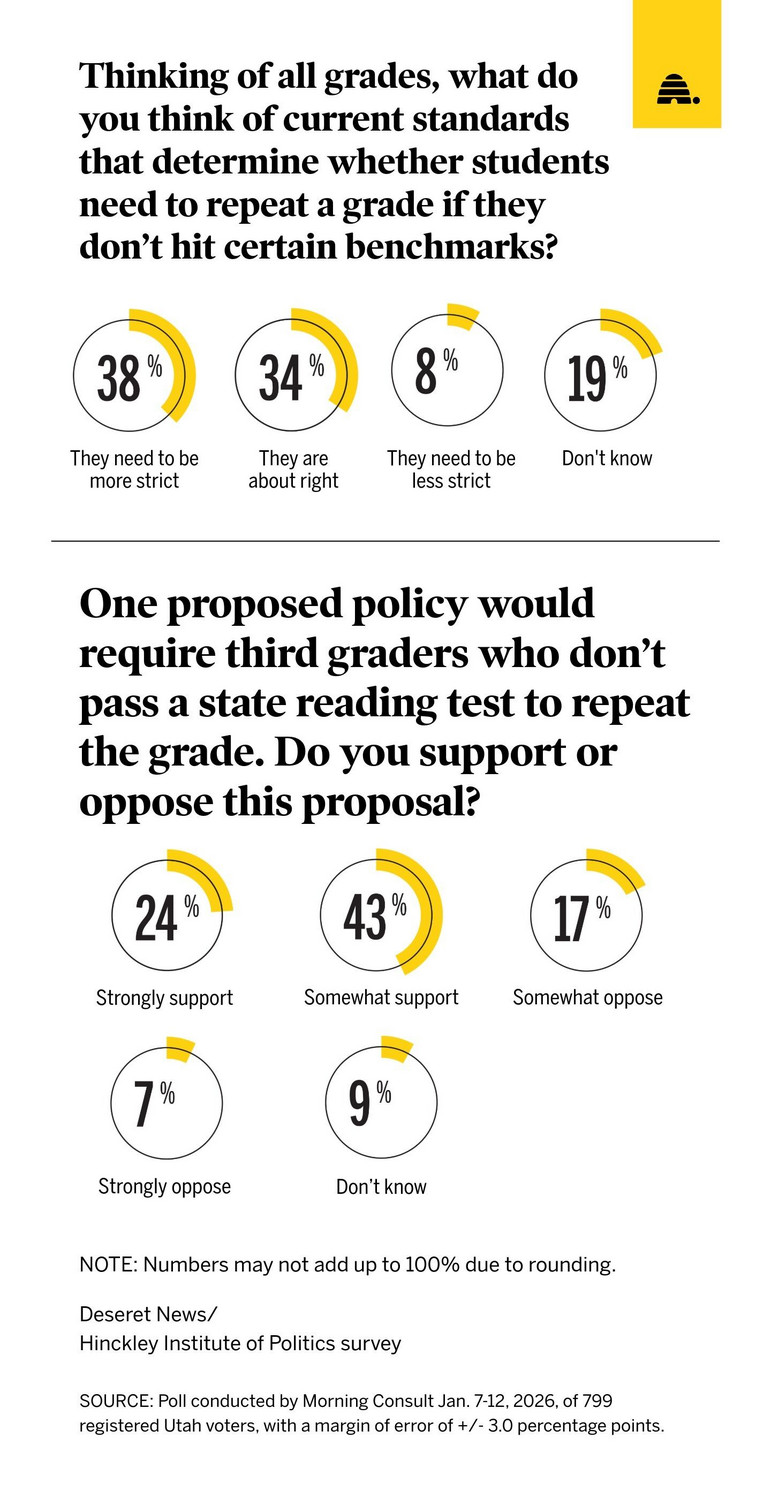
Slightly more than two-thirds of respondents — 67% — support the proposal, with 24% saying they "strongly support" it and 43% answering "somewhat support."
Meanwhile, 17% "somewhat oppose" and 7% "strongly oppose" a third grade retention policy.
The gap between those who support and those who oppose a third grade retention policy is a bit tighter for Utah parents included in the poll.
Fifty-nine percent of parents support it — with 19% responding "strongly support." Just under a third of parents voiced opposition to the proposed policy, with 8% saying they "strongly oppose."
Among Republican and Democratic respondents, 73% of Republicans expressed some level of support for a third grade retention policy. Democrats are slightly less on board, with 66% expressing support.
Technology in the classroom: Helpful — or harmful
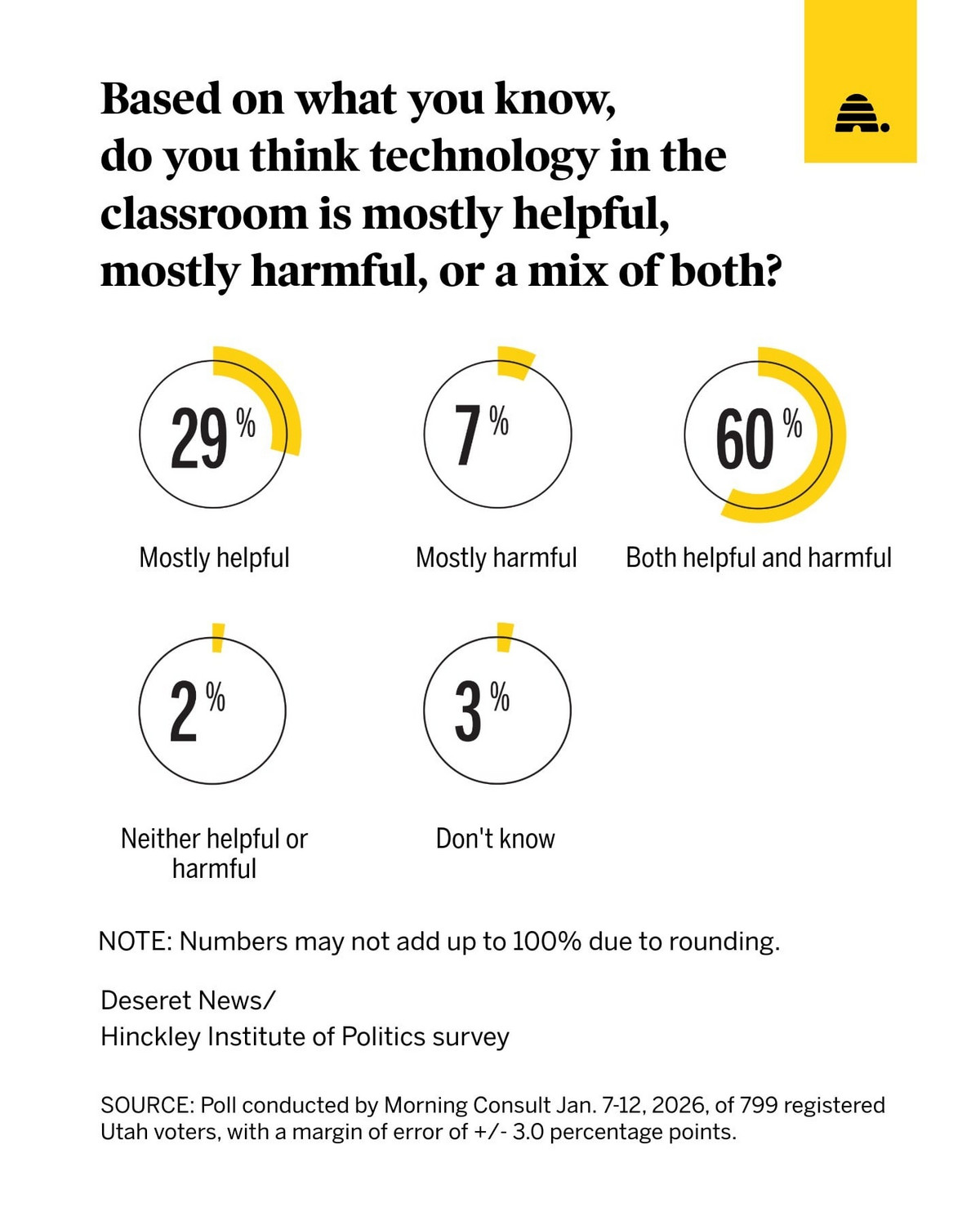
The poll also asked Utah voters if they think technology in the classroom is mostly helpful or mostly harmful — or a mix of both.
Sixty percent responded that tech in the classroom is "both helpful and harmful," while 29% believe it's "mostly helpful." Only 7% answered "mostly harmful."
Utah parents' feelings about classroom technology is about the same. While 26% of parents consider it to be "mostly helpful" and 9% say it's "mostly harmful," the vast majority of moms and dads — 61% — say technology in the classroom is both helpful and harmful.
Expect classroom technology to be a focus in the upcoming 2026 Utah Legislature.
A group of Republican lawmakers recently announced plans to introduce a pair of bills that would restrict classroom educational technology.
The proposed Software Accountability for Education, or SAFE, Act would establish a standard for approving instructional software before use. The anticipated bill would require software vendors to meet child safety requirements.
Meanwhile, the Balance Act would provide a statewide standard for tech in schools by reducing the screen time allowed in early grades, gradually increasing exposure as students age.
The Balance Act would instruct schools to eliminate nonessential screen time — and draft rules for the use of AI.
Lawmakers will also soon be tackling an education bill for a "bell-to-bell" cellphone ban in Utah's public K-12 schools.
The current default law requires students to pocket their cellphones during class time.