'%3e%3cpath%20d='M34.1406%205.85938C30.3906%202.10547%2025.3047%200%2020%200C14.6953%200%209.60938%202.10547%205.85938%205.85938C2.10938%209.61328%200%2014.6953%200%2020C0%2025.3047%202.10547%2030.3906%205.85938%2034.1406C9.61328%2037.8906%2014.6953%2040%2020%2040C25.3047%2040%2030.3906%2037.8945%2034.1406%2034.1406C37.8906%2030.3906%2040%2025.3047%2040%2020C40%2014.6953%2037.8945%209.60938%2034.1406%205.85938ZM37.0117%2023.543H31.1602V13.5391H27.6328V19.9414C28.1211%2020.6914%2028.3711%2021.582%2028.3711%2022.5625V22.625C28.3711%2023.668%2028.1172%2024.6055%2027.6328%2025.4297V26.6094H36.082C33.4883%2032.9375%2027.2891%2037.3789%2020.0039%2037.3789C10.3711%2037.3789%202.62109%2029.6289%202.62109%2020C2.62109%2010.3711%2010.3711%202.62109%2020%202.62109C29.6289%202.62109%2037.3789%2010.3711%2037.3789%2020C37.3789%2021.1484%2037.2617%2022.2656%2037.0508%2023.3477C37.0391%2023.4141%2037.0234%2023.4766%2037.0117%2023.543Z'%20fill='white'/%3e%3cpath%20d='M22.3086%2018.5352C20.4336%2018.125%2019.9531%2017.8398%2019.9766%2017.1836V17.1406C19.9766%2016.6992%2020.3477%2016.2148%2021.4023%2016.2148C22.582%2016.2148%2023.8867%2016.6797%2025.0781%2017.4766L26.8516%2015.0195C25.4453%2013.8906%2023.707%2013.3398%2021.5547%2013.3398C18.5195%2013.3398%2016.4375%2015%2016.4063%2017.4766V17.5352C16.3633%2020.2617%2018.5859%2020.9805%2021.293%2021.6016C23.0391%2021.9766%2023.5703%2022.3164%2023.5703%2022.9609L23.5469%2022.9766C23.5469%2023.3906%2023.2578%2023.7031%2022.7852%2023.8359C22.5742%2023.9062%2022.1289%2023.9727%2021.5156%2023.9727C20.7617%2023.9727%2019.7539%2023.8633%2018.6328%2023.4844C18.0898%2023.2891%2017.4727%2023.0039%2016.8047%2022.6133L20.1406%2026.625C20.2813%2026.6602%2021.0977%2026.8516%2021.7734%2026.8516C25.0039%2026.8516%2027.0859%2025.2461%2027.1094%2022.6328V22.5703C27.1602%2020.1133%2025.2148%2019.1719%2022.3086%2018.5352Z'%20fill='white'/%3e%3cpath%20d='M5.24219%2013.5664V26.6133H8.75391V23.7578L10.2969%2021.9531L14.2031%2026.6133H18.3867L12.3555%2019.5195L17.4023%2013.5664H13.4531L8.75391%2019.0586V13.5664H5.24219Z'%20fill='white'/%3e%3c/g%3e%3cdefs%3e%3cclipPath%20id='clip0_97_2430'%3e%3crect%20width='40'%20height='40'%20fill='white'/%3e%3c/clipPath%3e%3c/defs%3e%3c/svg%3e)



- Immigrants and immigration return as focuses for some lawmakers in Utah's 2026 legislative session, starting next week.
- Rep. Trevor Lee's HB88 aims to restrict the ability of immigrants in the country illegally to tap into public benefits.
- Other bills target international remittances and the threat of voting by immigrants.
SALT LAKE CITY — Immigration is a big focus of attention across the nation, and several proposals have emerged or are in the works for consideration when Utah's 2026 legislative session starts next week.
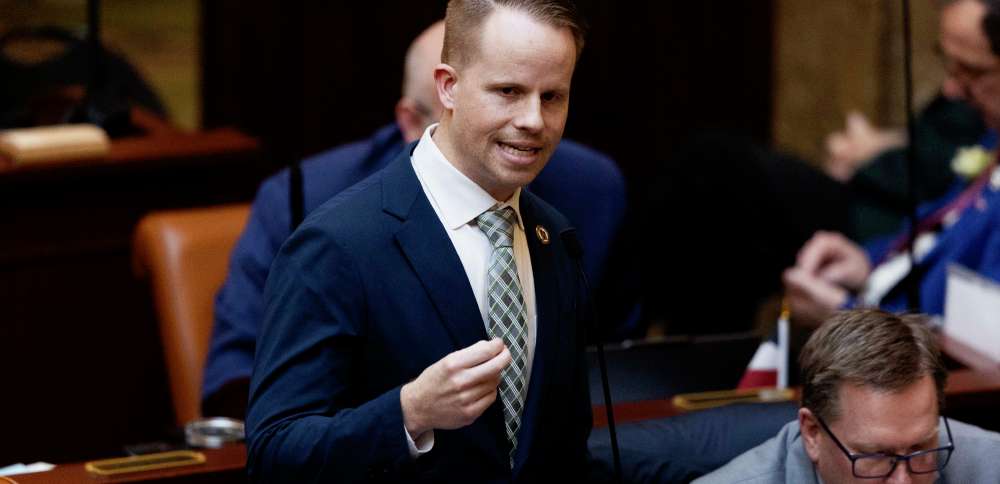
Most notably, Rep. Trevor Lee, R-Layton, has put forward a proposal that would prevent immigrants in the country illegally from being able to tap into public benefits. The measure, HB88, would potentially make immunizations by public health officials, food at food banks and housing at homeless shelters off limits to the population. "Benefits and welfare should go to citizens only," said Lee, an ardent critic of illegal immigration who also worries about the impact on U.S. culture of other classes of immigrants.
He's also considering legislation to eliminate the state program that lets Utah immigrants who are in the country illegally get driver privilege cards, which allow them to lawfully drive in the state. Another possibility, also in the works, would prohibit landlords and home sellers from renting or selling homes to those in the country illegally.
Other proposals from other lawmakers are in the works as well, including a measure put forward by Rep. Stephanie Gricius, R-Eagle Mountain, that would add a 2% tax to international remittances by immigrants in the country illegally. Rep. Cory Maloy, R-Lehi, is proposing a measure to beef up the rules meant to prevent immigrants from voting in elections. Rep. Matt MacPerson, R-West Valley City, proposes new rules targeting those who drive without a license, which includes immigrants, among others.
Last year was a big year for legislation focused on immigration and immigrants in the country illegally, and it appears the issue is returning for 2026. With the new session starting next Tuesday, Jan. 20, here's a look at some of the measures in the works:
HB88: The measure is modeled after a bill passed by Idaho lawmakers last year, HB135, which, as Lee puts it, "takes all benefits from illegal immigrants."
It would require proof of legal residency in the country to access testing at public health facilities for communicable diseases and immunizations. It would also require similar proof for those seeking help at food banks, crisis counseling and lodging at homeless shelters, presumably if the services are provided by state entities.
A critic of the measure, Ciriac Alvarez, senior policy analyst at Voices for Utah Children, said it's not crystal clear exactly how far-reaching HB88 would be. Her group advocates for Utah children, including immigrant children.
Alvarez worries that food banks and homeless shelters that receive state funds could fall under its umbrella and fears its impact on the estimated 100,000 immigrants in the country illegally in Utah and their 59,000 U.S.-born kids. She also wonders whether it would apply to other classes of immigrants, including asylum-seekers and immigrants in the country under the federal Deferred Action for Childhood Arrivals program.
HB135, the Idaho measure used as a model for HB88, faces a legal challenge and, in the meantime, hasn't gone into effect, according to the National Immigration Law Center.
Lee hasn't yet put forward a specific proposal to end access to driving privilege cards. But he's a critic and says he's working on it.
Access to such identification helps immigrants in the country illegally stay and work here, undermining federal laws, Lee said. "It straight-up rewards breaking the law and costs taxpayers. Utah's one of the only red states doing this — totally clashes with our values. Repeal time!" he said in an email.
Alvarez said the program also benefits other classes of immigrants, including those with legal parole in the United States. If it's eliminated, she warns that some will still drive.
Lee's idea of a bill to prohibit renting or selling of homes to immigrants in the country illegally is modeled after a measure passed by lawmakers in Tennessee last year, SB392, he said. That measure also faces a legal challenge.
HB141: The measure would require proof of U.S. citizenship or legal residency to send money abroad. Lacking such identification, entities wiring the funds would be required to impose a 2% tax on the amount to be sent, money that would go into Utah's general fund.
The tax would potentially apply to the money that immigrants in the United States illegally send to family back in their home countries, known as international remittances. A provision in the bill allows those who have to pay the tax to get a credit for the amount when filing their income taxes.
Gricius, who didn't respond to a query seeking comment, pursued similar legislation last year, HB284, but it stalled as the session came to an end. Remittances by immigrants from Mexico and El Salvador, among other countries, are a significant source of income for family and other recipients in their home countries.
HB209: The bill calls for increased steps when people are registering to vote to make sure they are U.S. citizens, not immigrants, who aren't allowed to vote in U.S. elections, whether here legally or illegally.
"As for noncitizens voting, Utah law already makes it illegal. This bill is about tightening safeguards and public confidence, not responding to widespread fraud," said Maloy, sponsor of the measure. "Even rare or inadvertent registrations undermine trust in elections."
The measure requires presentation of proof of U.S. citizenship when applying to register to vote. Utah's REAL ID state-issued driver's licenses specify whether holders are U.S. citizens or immigrants and could be used to demonstrate citizenship. Voters without Utah REAL ID identity cards, which feature a gold star, "will have to provide proof of citizenship to the county clerks," Maloy said.
The measure also contains a provision allowing for "targeted review" of registered voters suspected of not being U.S. citizens.
Read more:

Voces de Utah
Looking for more news from Utah's Latino community? Visit our Voces de Utah section for more stories, events and features.Utah Rep. Karianne Lisonbee, R-Syracuse, said earlier this year she was mulling such legislation. She cited at least two reports of noncitizens successfully registering to vote or actually voting in Utah. Maloy ended up as sponsor of the proposal.
HB136: The measure doesn't specifically single out immigrants but allows for seizure of cars operated by people without driver's licenses or driver privilege cards, which includes immigrants, among others.
MacPherson, the bill sponsor, noted 11 fatalities last year on Utah highways involving unlicensed drivers. Moreover, upward of 40% of "vehicle interactions" in West Valley City, where he lives, involve unlicensed drivers, he said. The pool of people without licenses includes kids, "sovereign-citizen types" and some immigrants, even though they are able to get driver privilege cards if not driver's licenses.
On encountering unlicensed drivers, police are "stuck without tools to deal with it," MacPherson said. "The best tool is to impound the vehicle. We already impound for DUI, reckless driving, expired registration and a host of other reasons. This gives this tool to law enforcement for this offense as well."
MacPherson proposed a similar measure in 2025, HB392, but it failed in the Senate as the session came to an end.