- A Utah State Board of Education member sued the Utah Education Association.
- The lawsuit claims UEA misled teachers about dues funding political activities.
- Freedom Foundation supports the lawsuit citing violations of Utah's Truth in Advertising Act.
SALT LAKE CITY — A member of the Utah State Board of Education filed a lawsuit against the Utah Education Association on Monday, alleging that the labor organization misled teachers about how their dues are being used for political activities.
The filing identified six instances from the past year where the UEA stated membership fees were "never used for political activities." These statements were later deleted or narrowed to "parties or candidates," but remain false, the filing alleges.
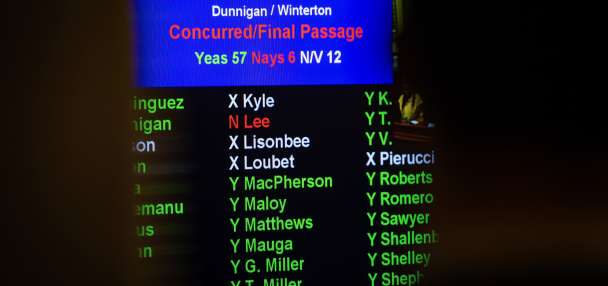
As part of its mission to lobby for policies it believes support teachers, the UEA helped to fund a referendum initiative in 2025 to repeal a new law that prohibited public unions from engaging in collective bargaining with local governments.
A portion of UEA members' dues, about $213 annually, are diverted to the National Education Association, according to the lawsuit. These are used to fund mostly Democratic candidates, campaigns and advocacy groups, including abortion rights causes.
The lawsuit asks Utah's 3rd District Court to order the UEA to retract its claim that member dues are not used for political activities, parties, candidates or campaigns. This is false advertising that needs to end, according to plaintiff Cole Kelley.
"I've watched people pay dues to the union based on a lot of misinformation and a lot of half-truths," Kelley told the Deseret News. "I think it's important for teachers to know the truth of what they are, and who they represent."
What did the UEA's statements say?
Kelley is a financial literacy teacher at American Fork High School who was elected to the State Board of Education in 2024. He has been an outspoken critic of the UEA for decades because, he said, it does not represent his "conservative values."
Following Kelley's work to help pass the public collective bargaining ban, known as HB267, he was approached by the Freedom Foundation, a conservative "union watchdog" organization, who wanted him to participate in the lawsuit, Kelley said.
The Freedom Foundation is a think tank, founded in 1991, to win legal battles against what it considers the largest obstacle to "free markets and limited, accountable government" — public-sector unions. The organization has now turned its sights to Utah.
In May 2025, Freedom Foundation provided a notice to the UEA alleging the claim that "UEA member dues are never used for political activities," which was found in multiple locations on the UEA website and social media accounts, was false advertising.
One of these statements was deleted. The remaining were amended to say, "UEA member dues are never used for political parties or candidates." Freedom Foundation reached out again in June and August, alleging this still violated Utah's Truth in Advertising Act.
When educators join UEA, they sign a membership form requiring them to join the NEA and pay a single, unified dues rate, according to Freedom Foundation research director Max Nelsen. Some teachers may not realize they are also supporting the NEA's "full spectrum of political advocacy," Nelson said.
"The new revised statements are also still false," Nelsen told the Deseret News. "By definition, if you're a UEA member, a portion of the dues you pay is going to the NEA and being used to finance political candidates and campaigns."
What are the NEA's political contributions?
The lawsuit refers to public funding disclosures showing that since 2017 the NEA has spent hundreds of thousands of dollars in contributions to Emily's List, a political committee that supports "pro-choice Democratic women," Democratic campaigns and the Democratic Party.
The NEA contributed millions more by transferring members' dues to its Advocacy Fund, according to the lawsuit, which made sizable donations to the presidential campaign of Kamala Harris, Democratic candidates for Congress and the Democratic Governors Association.
The UEA also has a separate advocacy fund, called the UEA-PAC, which supports "education-friendly candidates." While this political committee uses separate member contributions, the UEA still supports political causes indirectly by passing on membership dues to the NEA, Nelsen said.
Kelley and the Freedom Foundation allege that since the statements they consider to be false advertising appear alongside solicitations to become a UEA member, they violate Utah's Truth in Advertising Act, which prohibits "deceptive trade practices."
State code defines these as actions in any "business, vocation, or occupation" that represent services as having characteristics they do not have, advertises services with the intent not to sell them as advertised or creates a similar likelihood of misunderstanding.
However, in two decades practicing business law, Utah attorney Jeremy Eveland said he has never seen the state's Truth in Advertising statute applied to a public union. Typically, the law applies to commerce that is being advertised to the public, Eveland said.
"What we have here is a real novel concept," Eveland told the Deseret News. "I don't know if it falls into the Utah code because the Utah code does not govern labor organizations. I think overall, it's a stretch."
In a statement to the Deseret News, UEA communications director Hailey Higgins said the organization had yet to be served with the legal filing and does not comment on pending litigation.
"The UEA remains committed to serving Utah public educators and the students they serve with integrity, respect and transparency," Higgins said.