- Gov. Spencer Cox proposes a $30.7 billion budget prioritizing literacy, a homeless campus and child tax credits.
- The budget includes $20 million for reading support and $25 million for a homeless campus in Salt Lake City.
- Cox's proposal also allocates funds for school safety, technical colleges and outdoor recreation.
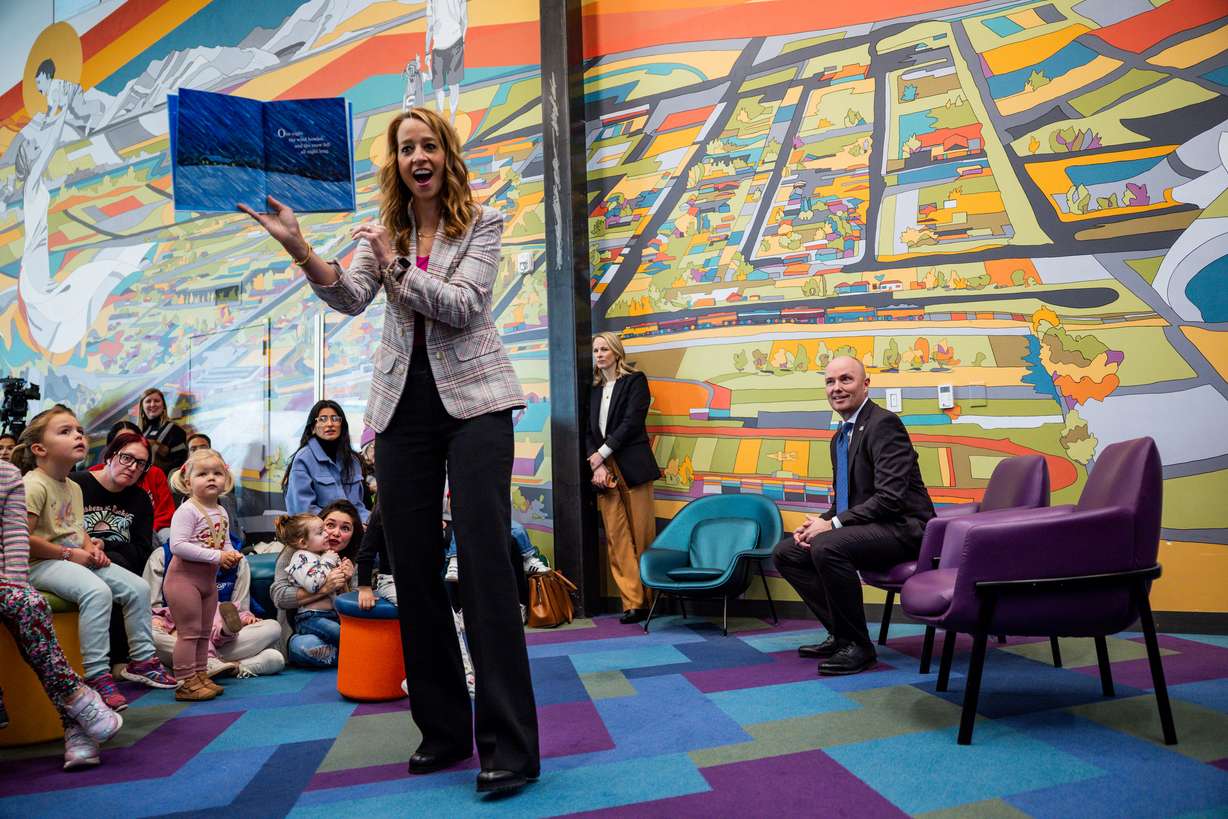
KEARNS — Standing in front of rows and rows of books, with dozens of young children enjoying story time at the other end of the Kearns Library, Utah's first lady Abby Cox shared what she described as a "sad statistic."
This year, only 46% of Utah's third-grade students have achieved reading proficiency. It's a figure that has "remained unchanged for the last several years," she said, and one the state is eager to improve.
"We have led on holding social media companies accountable and having that awareness of how dangerous social media is for our children," Cox said. "But what have we replaced it with? There's a big hole, and the hole is right here. This is what we fill it with. We fill it with books, because that's what we're having a problem with. ... The issues that we're having with literacy are a direct result of us not reading and children not having access to books and not being read to."
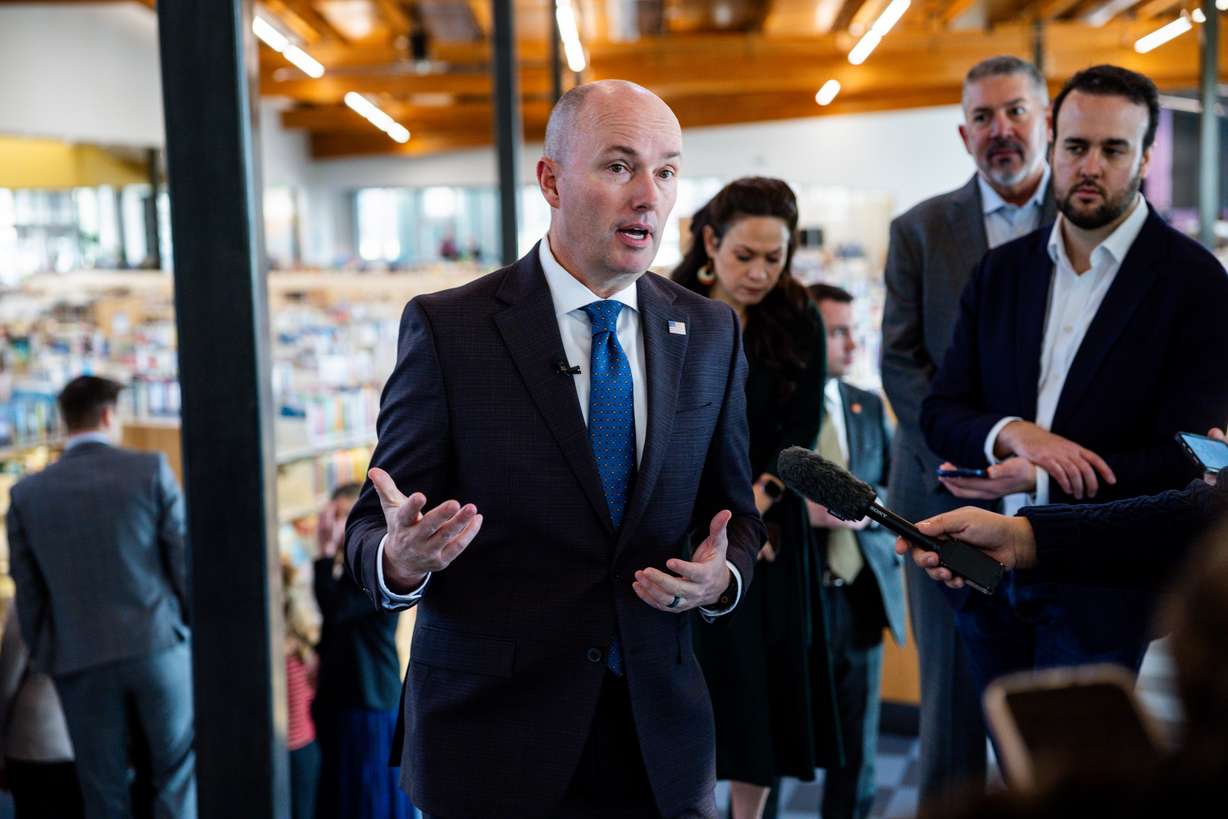
Adding to the list of "troubling" literacy statistics, Gov. Spencer Cox noted that 60% of low income households have no books in the home. As the growth in artificial intelligence threatens to outsource more thinking to machines, the governor said it's "incredibly dangerous" to continue to struggle with literacy.
"Reading is one of the things that allows us to think and one of the things that makes us human," he said.
To that end, Spencer Cox presented his annual proposal for a $30.7 billion state budget for the coming fiscal year on Wednesday. In addition to requests for funding for a new state homeless campus and an expanded child tax credit for families with young children, he is asking lawmakers to fund a literacy public awareness campaign and invest tens of millions in "paraprofessionals" to help teachers give an extra hand to young students who are falling behind.
That would include $20 million for reading support in elementary schools that fall below the statewide proficiency benchmark of 70% of third graders reading at grade level.
"And by the way, 70% is too low of a goal. It should be 100%. We know we can get there," he said. "We can't be prosperous as a country if we're not doing the work of bringing people together, to bring our kids together to have the very best education possible so that they can lead the economy in the future."
A 'tight' budget season
Due in part to significant cuts to federal spending enacted in the so-called One Big Beautiful Bill Act over the summer, the governor's budget proposal is lean this year and would represent a slight year-over-year decrease in state spending. It doesn't ask for any additional income tax cuts after five straight years of reductions.
"This year is going to be a very tight budget for one big reason," Cox told the KSL and Deseret News editorial boards ahead of the announcement. "And our economy is still doing very well. We're seeing growth and we're excited about what's happening in the economy, but the changes in the federal level, with the (One Big Beautiful Bill Act) … as we come into compliance with that bill, it's about a $300 million decrease to our anticipated funding sources."
Because of that, the governor said he is proposing a "flat" budget compared to the $30.8 billion approved by state lawmakers earlier this year.
While the governor proposes a budget each year, it's the Utah Legislature that ultimately decides how to spend taxpayer money. The general session begins Jan. 20.
"While the budget is the Legislature's constitutional responsibility, we value the important role of the governor and state agencies," said House Speaker Mike Schultz, R-Hooper, in a statement. "We look forward to continued collaboration with Gov. Cox to deliver a budget that reflects the needs and values of Utahns."
"As we balance the state's budget, the focus remains on strengthening the pillars that sustain opportunity in Utah: keeping taxes low to enhance affordability, ensuring high-quality education, holding social media and tech companies accountable, enhancing public safety, safeguarding water resources and advancing energy and innovation," added Senate President Stuart Adams, R-Layton.
Daniel Woodruff, KSL-TVThe Republican-controlled Legislature has made cutting income taxes a major priority over the last several years. Asked if he would support another year of that, Cox said "those are conversations that we will have," while noting the funding limits imposed by the One Big Beautiful Bill.
"We haven't had any direct conversations about anything above and beyond that. Again, it's a tight year," Cox said. "I've supported those tax reductions in the past, and so we'll look at that."
However, Cox added, state leaders need to determine what Utah's long-term tax policy will look like.
"We've got to figure out what that looks like moving forward before we cut too deeply," he said.
Funding for new homeless campus
One area where Cox is asking lawmakers for a "fairly significant" investment is in addressing homelessness. The state plans to build a 1,300-bed homeless campus on the west side of Salt Lake City, and the governor is requesting $25 million in new one-time funding for construction and capital improvements as well as $20 million in ongoing funds to provide services.
Cox hopes the investments in the campus will yield more public safety funds from the federal government, as it brings the state more in line with an executive order from President Donald Trump directing that funds be prioritized to states that focus on a treatment-first approach to individuals experiencing homelessness.
"The local governments will play a role in that as well, and then we'll be working with the federal government on additional funding," Cox said. "The current administration has made it clear that they're interested in models like Utah's, and so we're hoping that we can get some additional funding there."
The $25 million Cox has requested won't cover the entire cost of construction — the full cost is still to be determined — and the governor said the state is counting on local governments and the private sector to step in as well. Additional funds from the federal government would help, he said, but progress on those talks with federal partners was delayed during the recent government shutdown.
Cox said the results of the new approach will be measured across several metrics, including "how many people do we have camping on the streets."
"We need to greatly reduce that number," he said. "We want to see how many people are actually getting into housing. That's an important metric. We want to see those that are experiencing homelessness because of mental illness or addiction — how many of them are in recovery and how many of them are getting the services that they need to recover."
The governor also wants $2.5 million to expand the child tax credit for families with very young children, which he said would give families an additional $220 on average. Lawmakers earlier this year adjusted that tax credit to cover children age 5 or younger, while this latest proposal aims to add an extra enhancement for kids under 3.
Boosting public and higher ed
For public education, Cox is requesting $191 million for a 4.2% increase to the weighted pupil unit to account for inflation, $50 million to pay for school safety upgrades, $7.6 million to help pay for students' school lunches, and $500,000 for the literacy campaign.
An additional $80 million would fund the hiring of "paraprofessionals" in schools to support teachers in educating students who need extra help. Some $60 million would fund behavioral interventions for K-3 students, with the rest going to reading support in elementary schools that fall below statewide benchmarks for literacy.
"What the paraprofessionals will do, especially the literacy coaches, will help the teachers be able to break the students up into groups," to focus on students who need additional support, Lt. Gov. Deidre Henderson said. "If you've just got one teacher and you've got 27 kids, it makes it tough. … It makes an enormous difference. It's a game-changer."
After the shooting death of conservative activist Charlie Kirk at Utah Valley University in September, Cox is asking for $3.4 million to enhance campus safety and security measures. He also proposes spending $10 million in one-time money to expand the capacity of Utah's technical colleges to ensure the state has a "skilled and adaptable workforce."
Other budget requests
The budget plan also sets aside $3 million for ongoing services to victims of domestic violence and sexual violence, including "crisis intervention, shelter, therapy, and case management."
State and higher education employees would receive a 2.6% cost-of-living increase under the governor's plan.
Outdoor recreation is also included in the proposal. Due to increasing demand, the governor said he wants to create a new state park at Mantua Reservoir in Box Elder County. Improved amenities at the reservoir are expected to cost $2 million in one-time funding.
The governor is also asking lawmakers for $5 million for the Great Salt Lake long-term water program, to go along with another $5 million for similar projects along the Colorado River. Those funds would bolster existing investments in infrastructure and data collection on the two important waterways.
There is no requested funding in the budget proposal for new full-time positions in the executive branch, nor is there a request for any new bonding to pay for big-ticket projects.
Contributing: Brigham Tomco