Estimated read time: 6-7 minutes
- A Deseret News/Hinckley Institute poll shows 51% of Utah Democrats have a favorable view of socialism.
- Utah Democrats support socialist ideas more than the national average of 48%.
- Young Utahns face affordability issues, increasing interest in socialist policies and candidates.
SALT LAKE CITY — Seattle voters elected a self-described socialist mayor last week just days after New York City voters did the same — and Utah's Democratic strongholds could be next, according to a new Deseret News/Hinckley Institute of Politics poll.
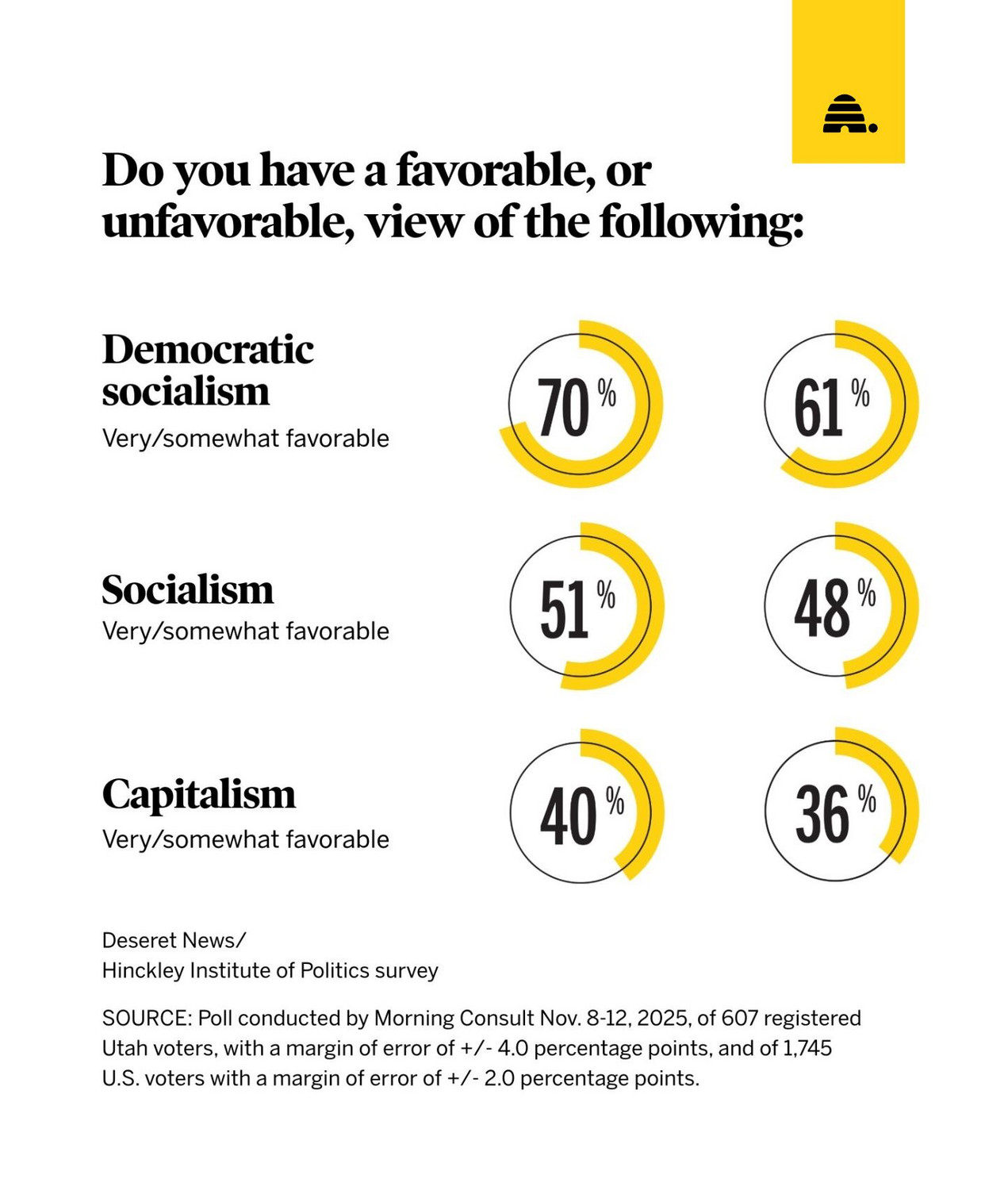
A slight majority, 51%, of Utah voters who identify as Democrats said they have a favorable view of socialism, compared to 48% of Democrats nationally. Utah Democrats appeared uniquely open to experimenting with socialism across multiple questions.
Whereas 54% of Democrats nationally said they approve of New York City Mayor-elect Zohran Mamdani's plans for office, 65% of Utah Democrats said they approve of the 34-year-old member of the Democratic Socialists of America.
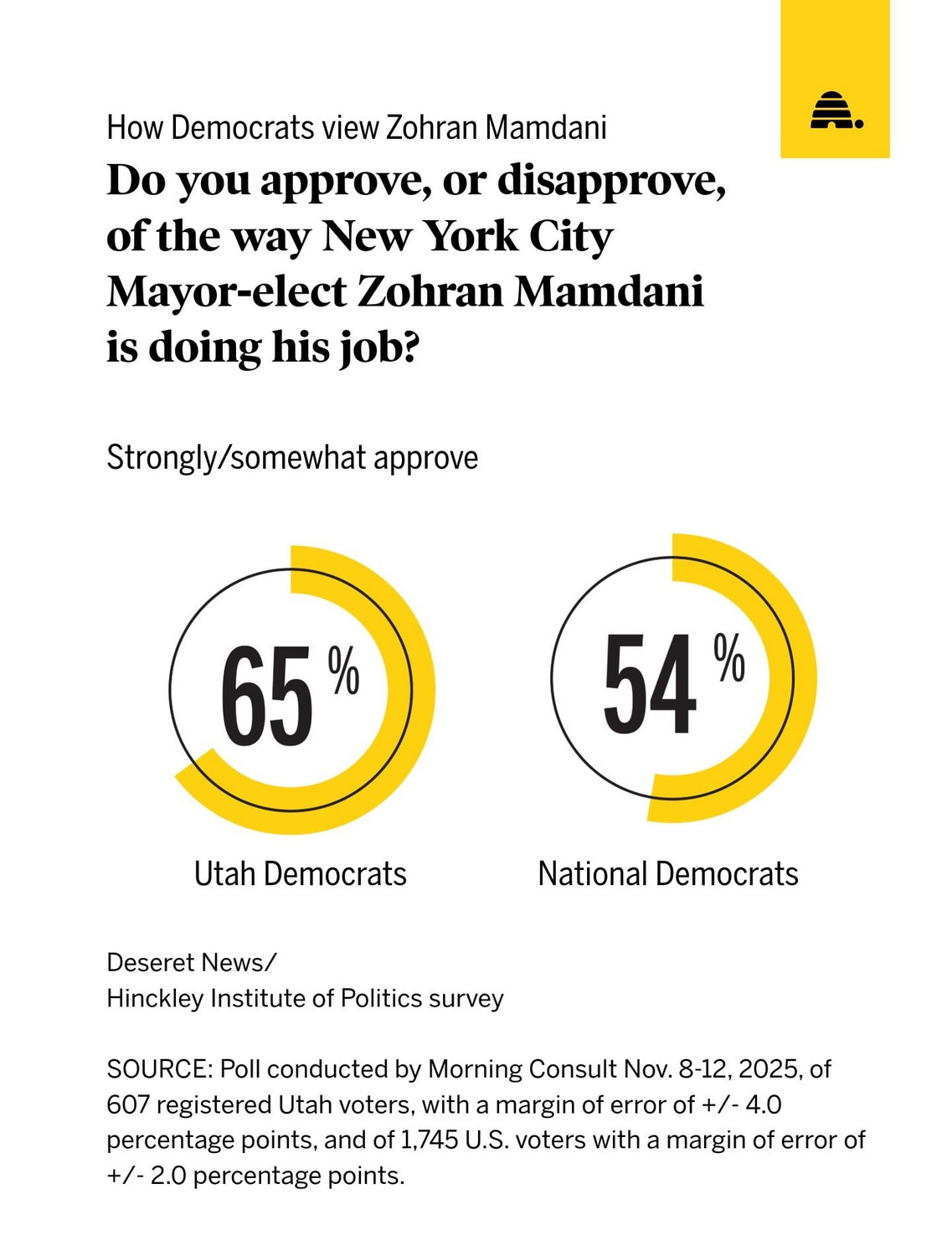
Democratic socialism — the political ideology espoused by New York Rep. Alexandria Ocasio-Cortez and Vermont Sen. Bernie Sanders — was viewed favorably by 61% of Democrats nationally. But it was viewed favorably by 70% of Democrats in Utah.
Socialism refers to an economic system where the state owns major resources and industries instead of private firms, and redistributes wealth equally. Democratic socialism is seen as a way to achieve this incrementally through elected officials.
While small Nordic countries like Sweden and Finland have implemented some democratic socialist principles, places that have tried to make socialism a reality have historically devolved into greater authoritarianism and poverty, like the Soviet Union, Cuba, Venezuela and China.
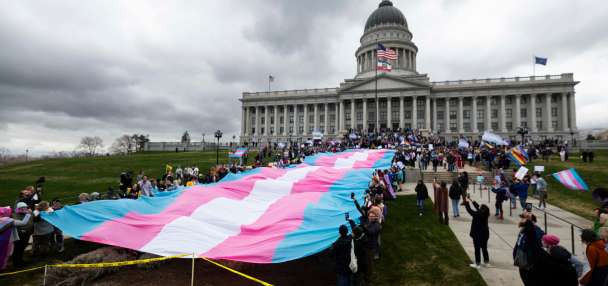
In April, Ocasio-Cortez and Sanders held a Salt Lake City rally attended by up to 20,000 people. This interest in the left wing of the Democratic Party reflects Utah's young demographics, according to Jason Perry, director of the University of Utah's Hinckley Institute.
"They are dealing with the same affordability pressures everyone else is feeling, so when people like Mamdani, Bernie Sanders or Alexandria Ocasio-Cortez come to Utah to talk about the cost of living and fairness, it resonates," Perry said.
"You see big crowds because many young people feel squeezed out of the traditional path to stability. So it makes sense that Utah Democrats are a little more open to these ideas than Democrats nationally."
Could Utah elect a socialist?
The appetite among the vast majority of Utah Democrats for increased public ownership and expanded social welfare may find an electoral outlet now that the state's congressional boundaries have been redrawn to include an almost-guaranteed Democratic seat in the U.S. House.
On Nov. 10, a district judge rejected the Utah Legislature's map, which created two more competitive districts, in favor of a map making a "Democratic-leaning district anchored in the northern portion of Salt Lake" that leans blue by up to 20 percentage points.
Some Beehive State politicos, like lobbyist Taylor Morgan, believe the seat leans so progressive that former Rep. Ben McAdams, who previously served as the Democratic mayor of Salt Lake County, is "too conservative" to win there in a Democratic Party primary.
These dynamics have convinced left-leaning organizers in Utah that they have a better shot of electing a socialist candidate in the new 1st Congressional District than they do in the Salt Lake City mayoral race or other municipal elections in Democrat-heavy districts.
"That's something that we are very interested in seeing, and I think it's a possibility in Utah," said Adrienne Gailey, the co-chair of the Salt Lake chapter of Democratic Socialists of America. "Right now, the focus is on the congressional district."
State Democratic Party chair Brian King said he thinks it would "be a challenge in Utah" to elect a democratic socialist, but he said it is "a positive thing" that Utah Democrats are more likely to favor Mamdani and his socialist ideology.
Young people struggling to make ends meet care less about "the democratic socialist label," King said, and care more about policies that address their "basic needs," like affording housing, college tuition, gas and groceries.
Considering socialistic solutions is actually "a very logical thing," King said, because young people are dissatisfied with the state's pro-free market Republican leadership, and because the state has a long history of embracing communitarian principles.
"I think that the system is showing some strain," King said. "If we don't have leaders in our country and in our state who are able to address our basic needs, you can't blame people when they say, 'Well, then we're going to look for alternatives.'"
How popular is capitalism in Utah?
Aside from self-identified Democrats, Utahns are less interested in socialism than the rest of the country. The state's youngest voters are also less likely to have favorable views toward Mamdani or unfavorable views toward capitalism, the poll found.
Nationally, 31% of all voters approve of Mamdani compared to 24% in Utah. Among Gen Z voters, 39% approve of the millennial candidate nationwide, compared to 29% in Utah. This pattern was repeated across multiple questions related to different economic systems.
Whereas 44% of Gen Z nationally have a favorable view of democratic socialism, 34% do in Utah. The same goes for socialism, which is viewed favorably by 42% of Gen Z nationwide and 37% of Gen Z in the state.
The least popular economic system among Gen Z Americans is capitalism, viewed favorably by just 29% of Gen Z nationwide. But the system of private property, profits and prices set by supply and demand was viewed favorably by 42% of young Utahns.
Despite the fact that the U.S. is the richest country in the world by total net household wealth, Perry said it is understandable why young people would feel discouraged about the American dream, particularly as home ownership and college costs grow out of reach.
While Utah has been named the best state in the U.S. three years in a row, with one of the strongest economies in the country, it has been hit especially hard by the affordability crisis, with the state's median home price ranking ninth most expensive in the country.
"Affordability is really what pulls young people toward Zohran Mamdani and toward some of these socialist ideas," Perry said. "He talks about rent, transit, groceries and the basics in a very down-to-earth way. Young people in Utah feel the same squeeze."
"Housing costs keep rising faster than wages, most renters do not see a path to owning a home, and everyday expenses feel heavier. Even with lower student debt here, a lot of young adults still feel like they are falling behind. So when someone speaks directly to what their day-to-day life actually feels like, of course, it gets their attention."
Among American voters of all ages, democratic socialism was viewed favorably by 34% of respondents, socialism by 31% and capitalism by 49%, the poll found.
There were wide partisan disparities, with almost no Republicans in favor of socialism, and 59% of Republicans holding favorable views toward capitalism, compared to 47% of independents and 39% of Democrats.
Morning Consult administered the poll nationally among 1,745 registered voters from Nov. 7 to 12 with a margin of error of +/- 2 percentage points. The Utah survey was conducted among 607 voters from Nov. 8 to 12 with a margin of error of +/-4 points.