'%3e%3cpath%20d='M34.1406%205.85938C30.3906%202.10547%2025.3047%200%2020%200C14.6953%200%209.60938%202.10547%205.85938%205.85938C2.10938%209.61328%200%2014.6953%200%2020C0%2025.3047%202.10547%2030.3906%205.85938%2034.1406C9.61328%2037.8906%2014.6953%2040%2020%2040C25.3047%2040%2030.3906%2037.8945%2034.1406%2034.1406C37.8906%2030.3906%2040%2025.3047%2040%2020C40%2014.6953%2037.8945%209.60938%2034.1406%205.85938ZM37.0117%2023.543H31.1602V13.5391H27.6328V19.9414C28.1211%2020.6914%2028.3711%2021.582%2028.3711%2022.5625V22.625C28.3711%2023.668%2028.1172%2024.6055%2027.6328%2025.4297V26.6094H36.082C33.4883%2032.9375%2027.2891%2037.3789%2020.0039%2037.3789C10.3711%2037.3789%202.62109%2029.6289%202.62109%2020C2.62109%2010.3711%2010.3711%202.62109%2020%202.62109C29.6289%202.62109%2037.3789%2010.3711%2037.3789%2020C37.3789%2021.1484%2037.2617%2022.2656%2037.0508%2023.3477C37.0391%2023.4141%2037.0234%2023.4766%2037.0117%2023.543Z'%20fill='white'/%3e%3cpath%20d='M22.3086%2018.5352C20.4336%2018.125%2019.9531%2017.8398%2019.9766%2017.1836V17.1406C19.9766%2016.6992%2020.3477%2016.2148%2021.4023%2016.2148C22.582%2016.2148%2023.8867%2016.6797%2025.0781%2017.4766L26.8516%2015.0195C25.4453%2013.8906%2023.707%2013.3398%2021.5547%2013.3398C18.5195%2013.3398%2016.4375%2015%2016.4063%2017.4766V17.5352C16.3633%2020.2617%2018.5859%2020.9805%2021.293%2021.6016C23.0391%2021.9766%2023.5703%2022.3164%2023.5703%2022.9609L23.5469%2022.9766C23.5469%2023.3906%2023.2578%2023.7031%2022.7852%2023.8359C22.5742%2023.9062%2022.1289%2023.9727%2021.5156%2023.9727C20.7617%2023.9727%2019.7539%2023.8633%2018.6328%2023.4844C18.0898%2023.2891%2017.4727%2023.0039%2016.8047%2022.6133L20.1406%2026.625C20.2813%2026.6602%2021.0977%2026.8516%2021.7734%2026.8516C25.0039%2026.8516%2027.0859%2025.2461%2027.1094%2022.6328V22.5703C27.1602%2020.1133%2025.2148%2019.1719%2022.3086%2018.5352Z'%20fill='white'/%3e%3cpath%20d='M5.24219%2013.5664V26.6133H8.75391V23.7578L10.2969%2021.9531L14.2031%2026.6133H18.3867L12.3555%2019.5195L17.4023%2013.5664H13.4531L8.75391%2019.0586V13.5664H5.24219Z'%20fill='white'/%3e%3c/g%3e%3cdefs%3e%3cclipPath%20id='clip0_97_2430'%3e%3crect%20width='40'%20height='40'%20fill='white'/%3e%3c/clipPath%3e%3c/defs%3e%3c/svg%3e)




This archived news story is available only for your personal, non-commercial use. Information in the story may be outdated or superseded by additional information. Reading or replaying the story in its archived form does not constitute a republication of the story.
- BYU students and professors led an archaeological camp at Hinckley Mounds, uncovering Fremont Indian artifacts.
- Students gain hands-on experience in history and archaeology, enhancing research skills.
- The site, preserved by the Hinckley family, faced threats from local development projects.
PROVO — Nestled just north of the Provo Airport is a slice of land that has been under one family's name since 1898.
Below that land is a glimpse into Utah's past, long before that.
"This is a 1,000-year-old Fremont Indian site," Brigham Young University archaeology professor Mike Searcy said amid sounds of shovels clanking and earth turning.
Under the hot summer sun, Utah middle and high school students — accompanied by BYU history and archaeology students — participated in an excavation at the Hinckley Mounds archaeological site in west Provo.
The excavation was part of the weeklong inaugural BYU Young Historian Camp, designed to help students learn and practice evidence-based research methods in hopes of preparing them to navigate 21st-century challenges of researching issues using online sources and social media.
"The idea is just to give our students experience in digging (and) the high school and middle school students experience in history, in general," Searcy said.
The excavation site is situated on what was once the Provo River Delta, the traditional home of the Fremont Indians, making it an archaeologically rich destination.
"It was really just mud and soil, and that's why so many people lived here. It was great for farming. So, if you find a rock, there's a good chance that it was brought here by somebody at some point," said Jeff Nokes, a BYU history professor and former middle and high school history teacher.
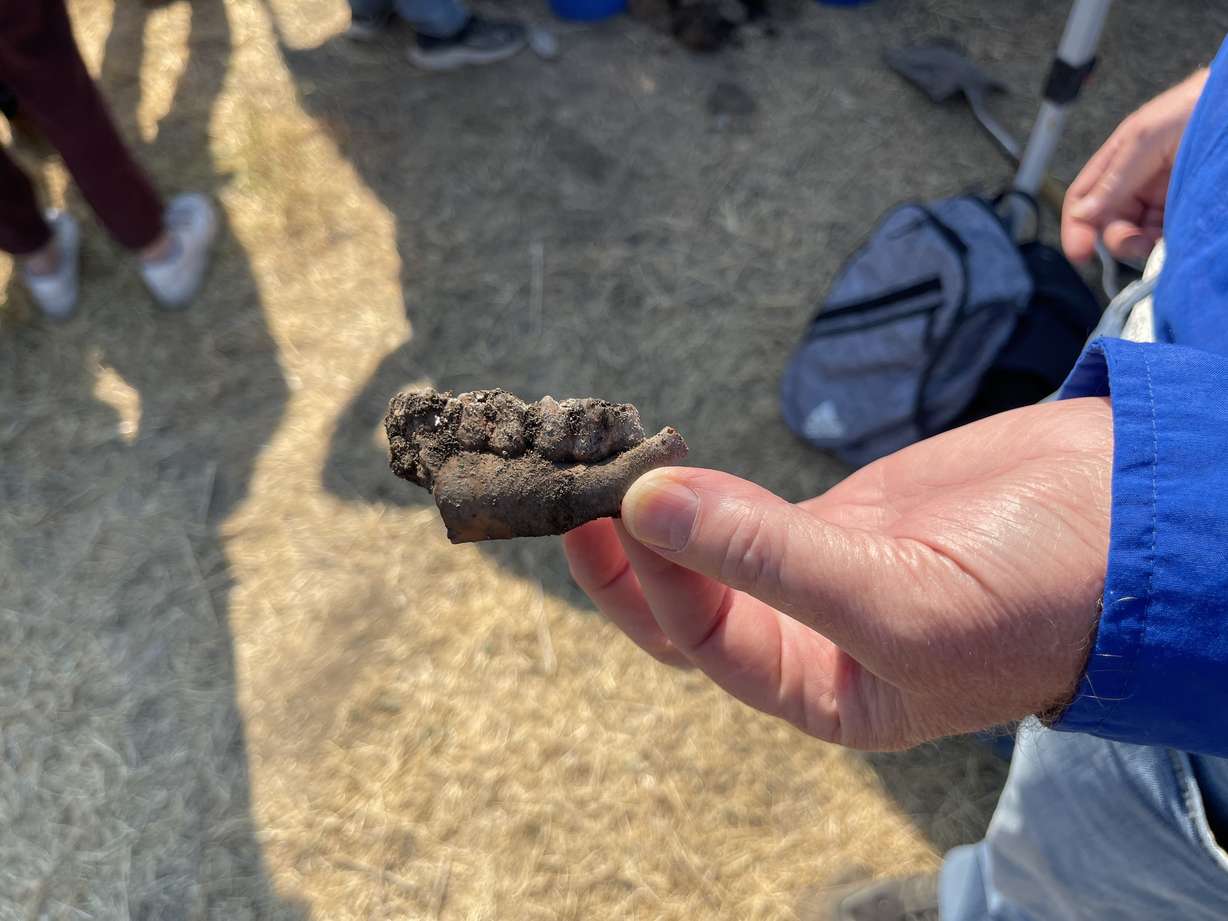
On Wednesday morning alone, the group had already unearthed a piece of ceramic and a piece of a jawbone with teeth intact.
But the site was almost completely lost in history forever when the city of Provo proposed running Lakeview Parkway directly over it.
"The city and politicians are so worried about build, build, build, build, build, and not conserving anything," said Angela Hinckley-Robichaux, the latest in a long line of Hinckleys who have worked to protect the site while also welcoming academic groups and researchers like the ones in the camp.
Still, the construction of Lakeview Parkway did impact some of the site, and Hinckley-Robichaux said Searcy found the ancient bones of an infant below where the road currently runs, about a week before ground broke on the road.
"Which makes it even more important for me to fight to keep this little piece," Hinckley-Robichaux said. "I just love to see people coming out (and) learning. It makes me super proud that my great-grandfather and grandfather preserved it."
Searcy gave credit to the Hinckley family for working so hard to preserve the area since the late 1800s, describing the site as a "very, very small window into what was a much larger village."
"When it comes to science, we are so lucky to have this right here, 15 minutes from campus, where we literally have an open classroom," Searcy said.
While the site's historical and familial significance to Hinckley-Robichaux and academic significance to BYU students and people like Searcy and Nokes is clear, it will also provide a valuable, hands-on lesson to the Utah middle and high school students interested in history that can't be replicated in a classroom.
"We have some young women here that are going into seventh grade next year. They're going to be learning about the Fremont culture. And I just can't wait till the teacher asks a question, 'What did the Fremont eat?' And she'll say, 'They ate deer.' And the teacher will say, 'How do you know they ate deer?' She'll say, 'Because I was at an archeological site where we found a deer neck,'" Nokes said.