'%3e%3cpath%20d='M34.1406%205.85938C30.3906%202.10547%2025.3047%200%2020%200C14.6953%200%209.60938%202.10547%205.85938%205.85938C2.10938%209.61328%200%2014.6953%200%2020C0%2025.3047%202.10547%2030.3906%205.85938%2034.1406C9.61328%2037.8906%2014.6953%2040%2020%2040C25.3047%2040%2030.3906%2037.8945%2034.1406%2034.1406C37.8906%2030.3906%2040%2025.3047%2040%2020C40%2014.6953%2037.8945%209.60938%2034.1406%205.85938ZM37.0117%2023.543H31.1602V13.5391H27.6328V19.9414C28.1211%2020.6914%2028.3711%2021.582%2028.3711%2022.5625V22.625C28.3711%2023.668%2028.1172%2024.6055%2027.6328%2025.4297V26.6094H36.082C33.4883%2032.9375%2027.2891%2037.3789%2020.0039%2037.3789C10.3711%2037.3789%202.62109%2029.6289%202.62109%2020C2.62109%2010.3711%2010.3711%202.62109%2020%202.62109C29.6289%202.62109%2037.3789%2010.3711%2037.3789%2020C37.3789%2021.1484%2037.2617%2022.2656%2037.0508%2023.3477C37.0391%2023.4141%2037.0234%2023.4766%2037.0117%2023.543Z'%20fill='white'/%3e%3cpath%20d='M22.3086%2018.5352C20.4336%2018.125%2019.9531%2017.8398%2019.9766%2017.1836V17.1406C19.9766%2016.6992%2020.3477%2016.2148%2021.4023%2016.2148C22.582%2016.2148%2023.8867%2016.6797%2025.0781%2017.4766L26.8516%2015.0195C25.4453%2013.8906%2023.707%2013.3398%2021.5547%2013.3398C18.5195%2013.3398%2016.4375%2015%2016.4063%2017.4766V17.5352C16.3633%2020.2617%2018.5859%2020.9805%2021.293%2021.6016C23.0391%2021.9766%2023.5703%2022.3164%2023.5703%2022.9609L23.5469%2022.9766C23.5469%2023.3906%2023.2578%2023.7031%2022.7852%2023.8359C22.5742%2023.9062%2022.1289%2023.9727%2021.5156%2023.9727C20.7617%2023.9727%2019.7539%2023.8633%2018.6328%2023.4844C18.0898%2023.2891%2017.4727%2023.0039%2016.8047%2022.6133L20.1406%2026.625C20.2813%2026.6602%2021.0977%2026.8516%2021.7734%2026.8516C25.0039%2026.8516%2027.0859%2025.2461%2027.1094%2022.6328V22.5703C27.1602%2020.1133%2025.2148%2019.1719%2022.3086%2018.5352Z'%20fill='white'/%3e%3cpath%20d='M5.24219%2013.5664V26.6133H8.75391V23.7578L10.2969%2021.9531L14.2031%2026.6133H18.3867L12.3555%2019.5195L17.4023%2013.5664H13.4531L8.75391%2019.0586V13.5664H5.24219Z'%20fill='white'/%3e%3c/g%3e%3cdefs%3e%3cclipPath%20id='clip0_97_2430'%3e%3crect%20width='40'%20height='40'%20fill='white'/%3e%3c/clipPath%3e%3c/defs%3e%3c/svg%3e)



This archived news story is available only for your personal, non-commercial use. Information in the story may be outdated or superseded by additional information. Reading or replaying the story in its archived form does not constitute a republication of the story.
- Gov. Spencer Cox said he supports decisions to pursue the death penalty for Ralph Menzies.
- Cox acknowledges the death penalty should be used rarely and cautiously.
- Utah is one of a handful of states where the governor doesn't have power to issue pardons or commute sentences.
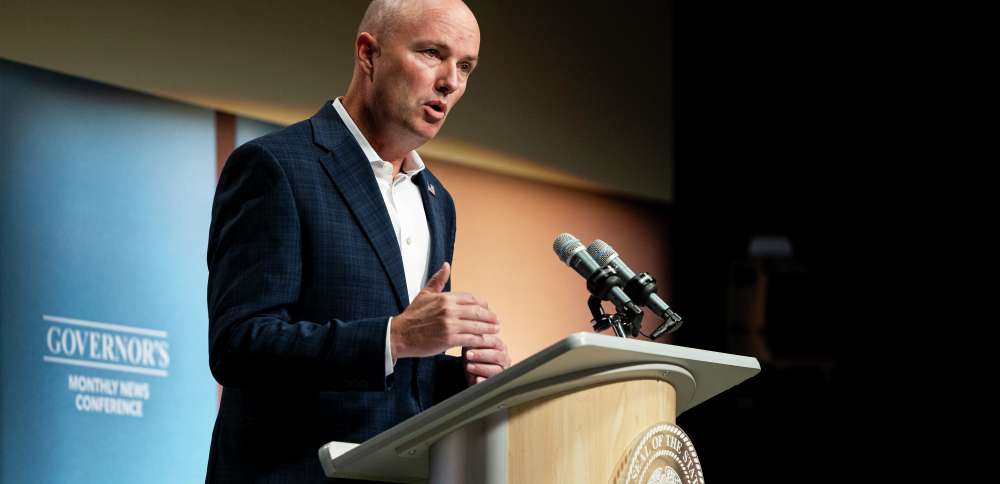
SALT LAKE CITY — Utah Gov. Spencer Cox said he is "supportive" of decisions that have led to the scheduled execution of Ralph Leroy Menzies, adding that the death penalty is appropriate in certain cases but should be used only rarely.
Menzies, 67, is scheduled to be executed by firing squad on Sept. 5 in what will be the second execution during the Cox administration, after Taberon Dave Honie was killed by lethal injection in August 2024. It was the first execution in Utah in 14 years.
"These are very, very hard situations," Cox told reporters during his monthly news conference Thursday, when asked if the state should still be in business of executing prisoners. State lawmakers have tried to repeal Utah's death penalty statute — a legislative committee came within one vote of advancing a measure in 2022 — but it remains one of 27 states with the death sentence.
"I'll just be perfectly honest, this is one I struggle with," Cox continued. "I'm very cautious about the power of the state — especially the power of the state to put people to death, the ultimate penalty — and I don't believe that governments are infallible. I think governments make mistakes, and I think the worst mistake we could ever make is to put someone to death who was perhaps innocent."
He went on to say he thinks it's "very clear" that Menzies is not innocent and said after talking to family members impacted by violent crimes, "there probably are circumstances where it's still warranted."
"It's a close call for me, but I'm supportive of the decisions that were made ... in these two cases," he said, referring to Menzies and Honie. "I think it should be very, very, very, very rare."
Menzies was convicted of murdering 26-year-old Maurine Hunsaker in 1986 after abducting her. Her body was found in Big Cottonwood Canyon two days later. He was sentenced to death in 1988, and 3rd District Judge Matthew Bates signed his death warrant on July 9 after denying his latest request to stay the case.
Menzies' attorneys asked the Utah Board of Pardons and Parole to grant him clemency on Wednesday, saying he has worsening dementia and that the judge made a mistake when issuing the death sentence. They said Menzies no longer understands why the state is trying to kill him.
The clemency petition said the board has not granted clemency since the death penalty was reinstated and that Utah has never executed someone with dementia, saying, "If ever there were a case that warrants (clemency), this is the case."
Utah is one of only a handful of states that gives sole clemency power to a board or advisory group, rather than the governor, according to the American Civil Liberties Union. Some states give governors full discretion over pardons, while others allow the executive to issue pardons following a recommendation from an advisory panel. Utah's governor has the power of reprieve over most convictions, which suspends an individual's sentence for a period of time.
Cox said he agrees with Utah's process, both personally and because of the potential for an executive to abuse the power.
"Selfishly, it's a relief to not have that power. It's nice not to have people, you know, coming and begging for me to be able to make those decisions," he said. "There's a reason the president of the United States (has that power) — although I believe it's been abused by every president in recent memory. So, I think it's a mistake to allow unfettered discretion, and it can lead to abuse and favors being done.
"And I don't like that either, but there probably are some circumstances where it would have been nice to have the ability to do something."